
Opening your dashboard
Class 12 Physics Chapter 16 Refraction of Light at Spherical Surfaces - Lenses: Practice Questions
107 questions on Chapter 16, each worked through on its own page with the AI tutor. Class 12 Physics, ICSE 2026-27.
107 questions
1–3 marks · Mixed difficulty
- 11 mark
Question 1
A convex spherical surface separates air (on the left) from a transparent medium (on the right). Its first principal focus is to the left of the pole and its second principal focus is to the right of the pole. The refractive index of the medium is
- 23 marks
Question 2
One end of a long glass block () is ground into a convex spherical surface of radius of curvature . A point object is placed in air on the axis, in front of this surface. Assume the block is long enough for any image to form inside it.
(i) Show that the image formed inside the glass is real only if the object is farther than from the pole.
(ii) Find the position of the image when the object is from the pole.
(iii) Find the position of the image when the object is from the pole, and comment on the result.
- 32 marks
Question 3
A narrow parallel beam of light in air falls along the axis on the convex spherical end (radius of curvature ) of a long transparent rod of refractive index . Consider only the refraction at this end.
(i) Show that, whatever the value of , the beam can never converge at or before the centre of curvature of the surface.
(ii) Find the refractive index for which the beam converges at a distance from the pole.
- 42 marks
Question 4
A point object in air is in front of the convex spherical end (radius of curvature ) of a long transparent plastic rod. A real image is formed inside the plastic, from the pole. Find the refractive index of the plastic. (Hypothetical data.)
- 51 mark
Question 5
A narrow parallel beam travelling in air falls on a convex glass surface () and comes to a focus inside the glass at a distance from the pole. The same surface now has water () in front of it instead of air, and a parallel beam travels through the water to the surface. The beam now focuses inside the glass at a distance
- 63 marks
Question 6
A long glass tank is filled with water (). One end is closed by a thin glass window that bulges outwards, so the water surface there is convex towards the air with radius of curvature . Neglect the thin glass. A small lamp in air is moved along the axis towards the window.
(i) Find where the image of the lamp is formed in the water when the lamp is , and from the window.
(ii) Describe how the image moves as the lamp approaches.
(iii) At what distance of the lamp does the image go to infinity? (Hypothetical data.)
- 71 mark
Question 7
Which one of the following statements about the principal foci of a thin lens in air is correct?
- 81 mark
Question 8
A ray of light falls on a thin concave lens in air. Before refraction, the ray is directed towards the principal focus that lies on the far side of the lens. After refraction, the ray
- 92 marks
Question 9
A student finds two thin lenses of the same diameter in a drawer, one convex and one concave. She has only a sheet of white paper and a sunny window.
(i) Describe one test with the paper that tells her which lens is convex, and use it to estimate the focal length of the convex lens.
(ii) Why does the same test give no result with the concave lens?
- 103 marks
Question 10
In a lab, a narrow laser ray is sent parallel to the principal axis of a thin lens, and its height above or below the axis is measured on a screen behind the lens. (Hypothetical data.)
(i) With lens P, the ray enters above the axis. On a screen behind the lens, it is below the axis. Find the focal length of P and state its type.
(ii) With lens Q, the ray enters above the axis. On a screen behind the lens, it is above the axis. Find the focal length of Q, with its sign.
(iii) For lens Q, how high above the axis would a ray entering above the axis be on the same screen?
- 111 mark
Question 11
A small bulb is placed on the axis to the left of a thin convex lens in air, and the light comes out of the lens as a parallel beam. The bulb is removed, and a parallel beam along the axis is sent into the lens from the right. The beam converges at a point
- 121 mark
Question 12
An object is moved along the axis of a thin convex lens of focal length , from to in front of it. During this movement, the image formed by the lens
- 133 marks
Question 13
An object tall stands upright on the axis, in front of a thin convex lens of focal length .
(i) Draw a ray diagram to a suitable scale (for example on paper along the axis) using two standard rays, and read off the position and height of the image.
(ii) Check your readings with the lens formula.
(iii) State the nature of the image.
- 141 mark
Question 14
An object is moved along the axis of a thin concave lens of focal length , from to in front of the lens. During this movement, the image
- 152 marks
Question 15
Can a single thin convex lens form a virtual, diminished image of a real object? Justify your answer using the lens formula.
- 163 marks
Question 16
The figure shows an object , tall, placed to the left of a thin lens . An erect image , tall, is seen to the left of the lens, on the same side as the object.
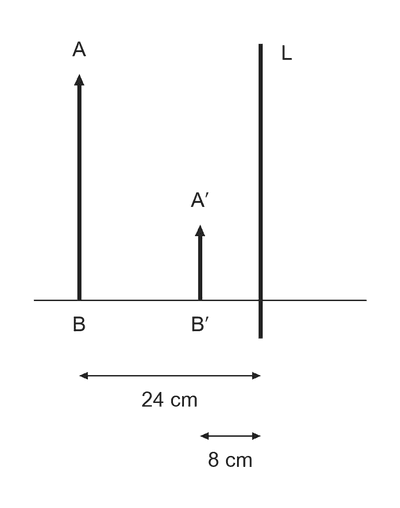
(i) Is the image real or virtual? Give a reason.
(ii) Identify the type of lens, with a reason.
(iii) Find the focal length of the lens using the lens formula, and check the image height.
- 171 mark
Question 17
A thin concave lens is used with a real object placed anywhere in front of it. Which one of the following can the lens never produce?
- 183 marks
Question 18
An object tall stands on the axis, in front of a thin concave lens of focal length .
(i) Draw a ray diagram, using two standard rays, to locate the image.
(ii) Find the position and height of the image using the lens formula.
(iii) State the nature of the image.
- 193 marks
Question 19
A camera has a thin convex lens of focal length . To focus, the lens is moved closer to or farther from the film (sensor). (Hypothetical data.)
(i) How far from the film is the lens when a very distant scene is in focus?
(ii) How far, and in which direction, must the lens be moved from this position to focus on a person away?
(iii) The lens can be moved out at most from its position in (i). What is the nearest object distance that can be focused?
- 201 mark
Question 20
In an experiment with a thin convex lens of focal length , a student uses the new Cartesian sign convention and plots (on the -axis) against (on the -axis) for real images. The graph is a straight line with
- 212 marks
Question 21
A student is asked to find the image of an object placed in front of a concave lens of focal length . The working is:
and the student concludes that a real image is formed behind the lens.
(i) Explain why the conclusion cannot be right, and identify the error.
(ii) Give the correct position and nature of the image.
- 221 mark
Question 22
A thin concave lens forms an image of a real object placed in front of it. In the new Cartesian sign convention, the signs of the object distance , the image distance and the focal length are, in that order,
- 233 marks
Question 23
A student holds a thin convex lens from a white wall and gets a sharp image of a window that is from the lens on the other side. (Hypothetical data.)
(i) Find the focal length of the lens.
(ii) She now wants a sharp image of a tree away. How far from the wall must she hold the lens?
(iii) State the nature of the image on the wall.
- 241 mark
Question 24
For a thin lens, an object is at and the lens formula gives the image at . Which one of the following is correct?
- 252 marks
Question 25
A thin convex lens of focal length forms a real image of a lamp at behind it when the lamp is in front of it.
(i) The lamp is now placed in front of the lens. Use the lens formula to find the new image position.
(ii) What general property of light does this result show? What name is given to such a pair of points?
- 261 mark
Question 26
A stamp collector holds a convex lens of focal length close to a stamp so that she sees an erect, virtual image of the stamp from the lens, on the same side as the stamp. The magnification produced is
- 273 marks
Question 27
A slide projector has a convex lens of focal length . A picture wide on the slide has to give a sharp image wide on a screen.
(a) How far from the lens must the slide and the screen be?
(b) The screen is now moved farther from the lens. By how much, and in which direction, must the slide be moved to refocus? How wide is the new picture?
(Hypothetical data.)
- 281 mark
Question 28
A small square card of side is held in front of a convex lens of focal length , with its face perpendicular to the principal axis. The area of the image of the card on a screen is
- 293 marks
Question 29
A thin straight rod long lies along the principal axis of a convex lens of focal length , with its near end and its far end in front of the lens.
(a) Find where the images of the two ends are formed, and the length of the image of the rod.
(b) Find the lateral magnification at each end. A small pin standing upright at the near end and an identical pin at the far end are also imaged; compare the heights of their images.
(c) Show that the length of the image equals times the length of the rod, where and are the lateral magnifications at the two ends.
- 303 marks
Question 30
An object stands upright on the principal axis in front of a thin concave lens. Draw a ray diagram showing the image , and use it, with the new Cartesian sign convention, to show that the lateral magnification is .
- 313 marks
Question 31
A convex lens forms a real image of an object with magnification . When the object is moved farther from the lens, the magnification of the real image becomes .
(a) Find the focal length of the lens.
(b) Find the image distance in each case and how far the image moves.
- 321 mark
Question 32
A spectacle prescription reads: right eye , left eye . Which statement about the two lenses is correct?
- 333 marks
Question 33
A beam of light is converging towards a point beyond the position where a thin lens is to be placed. Find the power of the lens (with sign) that will make the beam
(a) emerge parallel to the axis;
(b) come to a focus behind the lens;
(c) emerge diverging as if from a point in front of the lens.
Use the lens formula in the form , with distances in metre.
- 342 marks
Question 34
An elderly person cannot see print clearly when it is nearer than to the eye. Reading glasses are to let the person read a book held from the eye. Treating the glasses as a thin lens close to the eye,
(a) find the power of the lens needed;
(b) state the nature of the image the lens forms and its magnification.
(Hypothetical data.)
- 351 mark
Question 35
A camera lens forms a sharp image of a distant hill on the sensor behind the lens. The power of the lens is
- 362 marks
Question 36
(a) Show that the lens formula can be written as , where and are in metre and is the power in dioptre.
(b) Use this form to find the image distance when an object is placed (i) and (ii) in front of a lens of power . State whether each image is real or virtual.
- 371 mark
Question 37
A spectacle lens of power is made from crown glass (). The same prescription is now made in a plastic of , keeping the same shape (the same ratio of the two radii). Compared with the glass lens, each surface's curvature of the plastic lens must be
- 381 mark
Question 38
Lens is equiconvex with each face of radius . Lens is plano-convex with its curved face of radius . Both are made of the same glass. The ratio of their powers is
- 393 marks
Question 39
A meniscus lens has both faces curved the same way: the first face (met first by the light) has radius and the second face has radius , and both centres of curvature lie on the far side of the lens (to the right, light travelling left to right). The glass has .
(a) Find the focal length and power of the lens. Is it converging or diverging?
(b) Is the lens thicker at the middle or at the edge?
(c) Another meniscus lens of the same glass has a first face of radius and a second face of radius , both centres again on the far side. Find its focal length.
- 403 marks
Question 40
A thin-walled hollow glass shell has the shape of an equiconvex lens, each face of radius . The glass walls are so thin and uniform that they have no lens effect of their own. Take .
(a) The shell, filled with air and sealed, is held under water. Find its focal length and say whether it converges or diverges light.
(b) The shell is filled with water and held in air. Find its focal length.
- 411 mark
Question 41
A thin biconvex lens of glass () has faces of radii and . Its focal length is measured first with light falling on the face and then, after turning the lens round, with light falling on the face. The two values are
- 421 mark
Question 42
In deriving the lens maker's formula, which of the following is not an assumption or condition used?
- 433 marks
Question 43
A cemented doublet is made of two thin lenses in contact. The first is an equiconvex lens of crown glass () with faces of radius . The second is a plano-concave lens of flint glass () whose concave face (radius ) is cemented exactly onto the second face of the crown lens; its other face is plane.
(a) Find the power of each lens.
(b) Find the focal length of the doublet. Is it converging or diverging?
- 441 mark
Question 44
A converging lens of power and a diverging lens of power are placed on a common axis apart. The power of the combination is
- 453 marks
Question 45
An object is placed in front of a convex lens of focal length . A concave mirror of focal length is placed beyond the lens on the same axis, facing the lens, as shown.
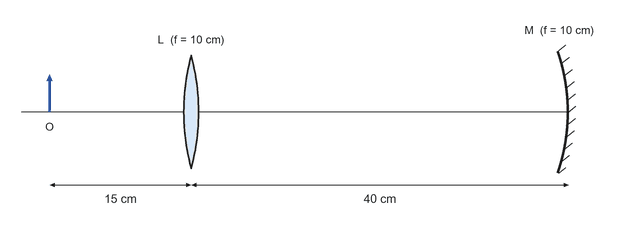
(a) Where does the lens alone form the image of ?
(b) What happens to the light after it is reflected by the mirror?
(c) The reflected light passes back through the lens. Where is the final image, and is it real or virtual?
(Hypothetical data.)
- 461 mark
Question 46
Two identical thin plano-convex lenses, each of focal length , are placed coaxially in contact, first with their curved faces touching and then with their plane faces touching. The focal lengths of the two arrangements are
- 473 marks
Question 47
Two convex lenses and , each of focal length , are placed apart on a common axis. An object tall stands in front of .
(a) Find the position and size of the image formed by .
(b) Find the position, size and nature of the final image formed by .
(c) Why could such a pair be used to give an erect real image?
(Hypothetical data.)
- 481 mark
Question 48
Two converging lenses of powers and are placed on a common axis. At what separation is the power of the combination equal to the power of the stronger lens alone?
- 492 marks
Question 49
“Sunglasses have curved surfaces. But their power is zero.” Why?
- 502 marks
Question 50
A convex lens of refractive index is immersed in a medium of refractive index . Will it behave as convergent or divergent if (i) and (ii) ?
- 512 marks
Question 51
How will you combine a convex lens and a concave lens such that the combination acts as (i) converging, (ii) diverging and (iii) plane glass plate?
- 522 marks
Question 52
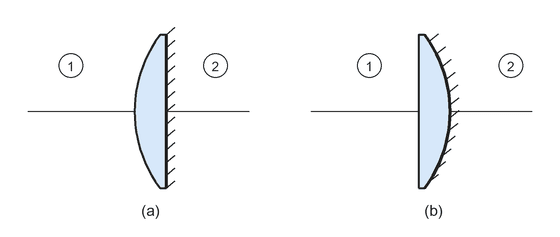
Fig. (a) shows a plano-convex lens, with its plane surface silvered in Fig. (a) and the concave surface silvered in Fig. (b). Calculate the focal length in each case.
- 533 marks
Question 53
An empty spherical glass flask of diameter 50 cm is kept in water of refractive index 4/3. A parallel beam of light is allowed to strike the flask, horizontally. The beam is observed from within the flask. Where does the beam get focussed? Neglect the effect of glass.
- 543 marks
Question 54
A convex lens of focal length 0.12 cm produces an image, which is three times as long as the object. Find the distance between the object and the lens for a real image.
- 553 marks
Question 55
An object is placed at a distance of 4 cm from a concave lens of focal length 12 cm. Find the position and nature of the image.
- 563 marks
Question 56
When an object is kept at a distance of 60 cm from the optic centre of a concave lens, an image is formed at a distance of 20 cm from the lens. Find the focal length of the lens.
- 573 marks
Question 57
Where should an object be kept in front of a diverging lens of focal length 15 cm so that it forms an image at a distance of 10 cm from the optic centre of the lens.
- 583 marks
Question 58
An object of height 5 cm is placed at a distance of 15 cm in front of a concave lens of focal length 10 cm. Find the size of the image.
- 593 marks
Question 59
A concave lens of focal length 21 cm produces an image whose magnification is 0.6. Find the distance between the object and the optic centre of the lens.
- 603 marks
Question 60
The radius of curvature of each face of a biconcave lens made of glass of refractive index 1.5 is 30 cm. Calculate the focal length of the lens in air.
- 613 marks
Question 61
The radii of curvature of the two faces of a convex lens are 0.1 m and 0.15 m, respectively. If the focal length of the lens is 0.12 m, find the refractive index of the material of the lens.
- 622 marks
Question 62
The refractive index of the material of a concave lens is . The lens is immersed in a medium of refractive index (). A parallel beam of light is incident on the lens. Draw a diagram to show the path of emergent rays.
- 631 mark
Question 63
State one assumption made in deriving the formula for refraction at spherical interface.
- 642 marks
Question 64
A biconvex spherical lens has focal length 20 cm. If it is split into two halves to form two plano-convex, what is the focal length of each plano-convex lens.
- 652 marks
Question 65
Sunglasses have curved surfaces, but their power is zero. Why?
- 662 marks
Question 66
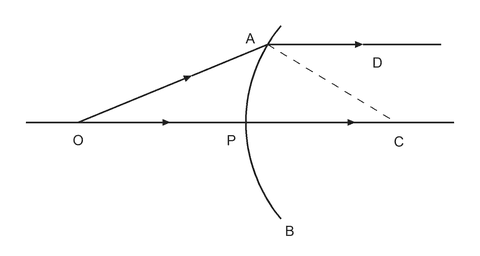
In the given figure, is a point object placed in air on the axis of a spherical surface of glass block, is an incident ray. The direction of refracted ray in the glass block is parallel to the principal axis ; radius of spherical surface . Use the formula to show that the distance , where and .
- 672 marks
Question 67
A convex lens of focal length cm is combined with a diverging lens of power 6.5 D. What are the power and focal length of the combination?
- 681 mark
Question 68
A double convex lens of glass () has radius of curvature of each of its surface as 0.2 m. The power of the lens is
- 691 mark
Question 69
If the focal length of a double convex lens for red light is , its focal length for the violet light is
- 701 mark
Question 70
A candle placed 25 cm from a lens, forms an image on a screen placed 75 cm on the other end of the lens. The focal length and the type of the lens should be
- 711 mark
Question 71
We combined a convex lens of focal length and concave lens of focal length and their combined focal length was . The combination of these lenses will behave like a concave lens, if
- 721 mark
Question 72
In a plano-convex lens, the radius of curvature of the convex lens is 10 cm. If the plane side is polished, then the focal length will be (refractive index 1.5)
- 731 mark
Question 73
The focal length of convex lens is 10 cm and its refractive index is 1.5. If the radius of curvature of one surface is 7.5 cm, the radius of curvature of the second surface will be
- 741 mark
Question 74
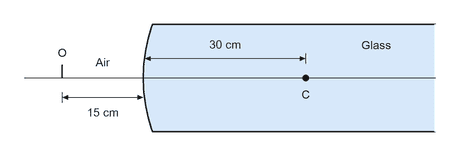
A point object placed in front of a glass rod having spherical end of radius of curvature 30 cm. The image would be formed at
- 751 mark
Question 75
An object has image thrice of its original size when kept at 8 cm and 16 cm from a convex lens. Focal length of the lens is
- 761 mark
Question 76
The combination of a convex lens ( cm) and a thin concave lens ( cm) is
- 771 mark
Question 77
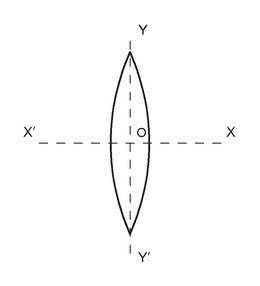
An equiconvex lens is cut into two halves along (i) and (ii) as shown in the given figure. Let be the focal lengths of the complete lens, of each half in case (i), and of each half in case (ii), respectively. Choose the correct statement from the following.
- 781 mark
Question 78
A thin glass (refractive index 1.5) lens has optical power of −5 D in air. Its optical power in a liquid medium with refractive index 1.6 will be
- 791 mark
Question 79
The unit of focal power of a lens is
- 801 mark
Question 80
A convex lens is in contact with a concave lens. The magnitude of the ratio of their focal lengths is . Their equivalent focal length is 30 cm. What are their individual focal lengths?
- 811 mark
Question 81
If two +5 D lenses are mounted at some distance apart, the equivalent power will always be negative if the distance is
- 821 mark
Question 82
When light rays from the Sun fall on a convex lens along a direction parallel to its axis,
- 831 mark
Question 83
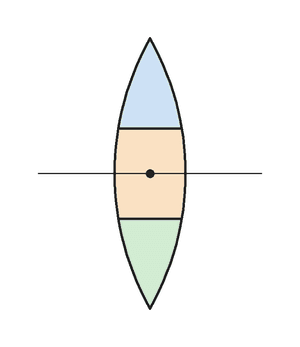
A convex lens is made up of three different materials as shown in the figure. For a point object placed on its axis, the number of images formed are
- 841 mark
Question 84
A diverging lens with magnitude of focal length 25 cm is placed at a distance of 15 cm from a converging lens of magnitude of focal length 20 cm. A beam of parallel light falls on the diverging lens. The final image formed is
- 851 mark
Question 85
A point object is placed at a distance of 20 cm from a thin plano-convex lens of focal length 15 cm. If the plane surface is silvered, the image will form at

- 861 mark
Question 86
An air bubble in sphere having 4 cm diameter appears 1 cm from surface nearest to eye when looked along the diameter. If , the distance of the bubble from the refracting surface is
- 871 mark
Question 87
A biconvex lens of focal length forms a circular image of the Sun of radius in focal plane. Then,
- 881 mark
Question 88
When a biconvex lens of glass having refractive index 1.47 is dipped in a liquid, it acts as a plane sheet of glass. This implies that the liquid must have refractive index
- 891 mark
Question 89
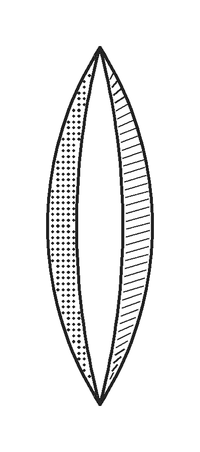
A convex lens is made of 3 layers of glass of 3 different materials as shown in the figure. A point object is placed on its axis. The number of images of the object is
- 901 mark
Question 90
A thin plano-convex lens acts like a concave mirror of focal length 0.2 m when silvered from its plane surface. The refractive index of the material of the lens is 1.5. The radius of curvature of the convex surface of the lens will be
- 911 mark
Question 91
A convex lens is dipped in a liquid whose refractive index is equal to the refractive index of the lens. Then its focal length will
- 921 mark
Question 92
Focal length of a convex lens of refractive index 1.5 is 2 cm. Focal length of lens when immersed in a liquid of refractive index 1.25 will be
- 931 mark
Question 93
A biconvex lens has a radius of curvature of magnitude 20 cm. Which one of the following options describes best the image formed of an object of height 2 cm placed 30 cm from the lens?
- 941 mark
Question 94
When will the convergent nature of a convex lens be less as compared with air?
- 951 mark
Question 95
A convex lens of focal length produces an image times than that of the size of the object. The distance of the object from the lens is
- 961 mark
Question 96
Two thin lenses of focal lengths and are in contact. The focal length of this combination is
- 971 mark
Question 97
If aperture of lens is halved, the image will be
- 981 mark
Question 98
The graph shows how the magnification produced by a thin lens varies with image distance . What is the focal length of the lens used?
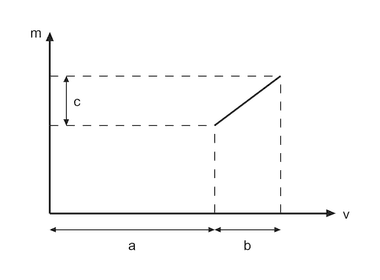
- 991 mark
Question 99
Two similar thin equiconvex lenses, of focal length each, are kept coaxially in contact with each other such that the focal length of the combination is . When the space between the two lenses is filled with glycerine, which has the same refractive index () as that of the glass, then the equivalent focal length is . The ratio will be
- 1001 mark
Question 100
A thin lens made of glass (refractive index = 1.5) of focal length cm is immersed in a liquid of refractive index 1.42. If its focal length in liquid is , then the ratio is close to the integer
- 1011 mark
Question 101
A point-like object is placed at a distance of 1 m in front of a convex lens of focal length 0.5 m. A plane mirror is placed at a distance of 2 m behind the lens. The position and nature of the final image formed by the system is
- 1021 mark
Question 102
A double convex lens has power and same radii of curvature of both surfaces. The radius of curvature of a surface of a plano-convex lens made of the same material with power is
- 1031 mark
Question 103
The refractive index of a converging lens is 1.4. What will be the focal length of this lens if it is placed in a medium of same refractive index? (Assume the radii of curvature of the face of lens are and , respectively.)
- 1041 mark
Question 104
Find the distance of the image from object , formed by the combination of lenses shown in the figure.
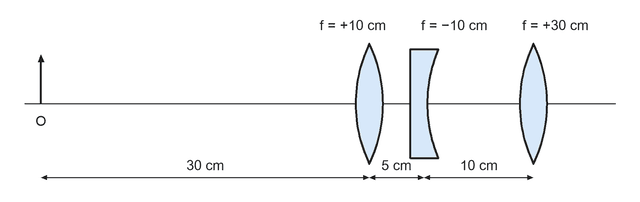
- 1051 mark
Question 105
An object is placed at the focus of a concave lens having focal length . What is the magnification and distance of the image from the optic centre of the lens?
- 1061 mark
Question 106
A convex lens of focal length 20 cm and a concave lens of focal length 5 cm are kept along the same axis with a distance between them. If a parallel beam of light falling on leaves as a parallel beam, then the distance (in cm) will be
- 1071 mark
Question 107
Regions I and II are separated by a spherical surface of radius 25 cm as shown in the figure. An object is kept in region I and a distance of 40 cm from the surface. The distance of the image from the surface is
