Opening your dashboard
Class 12 Physics Chapter 16 Refraction of Light at Spherical Surfaces - Lenses: Previous Year Questions
19 questions on Chapter 16, each solved step by step. Class 12 Physics, ICSE 2026-27.
19 questions with solutions
1–5 marks · Mixed difficulty
The first 16 solutions are on this page. This chapter is a long one, so the rest open on their own page to keep this one quick to load.
- 13 marks
Question 1
A point object O is placed at a distance of from a convex lens L of focal length as shown in Figure 5 below. On the other side of the lens, a convex mirror M is placed such that its distance from the lens is equal to the focal length of the lens. The final image formed by this combination is observed to coincide with the object O. Find the focal length of the convex mirror.
 Solve with AI
Written solution
Solution:
Key idea: The final image can coincide with the object only if the light retraces its own path. So, after passing through the lens, the rays must strike the convex mirror normally, that is, along lines through the mirror's centre of curvature.
Step 1 — State the sign convention and the data.
We use the New Cartesian sign convention: distances are measured from the lens (or from the pole of the mirror), positive in the direction of the incident light (left to right) and negative against it. So for the convex lens and .
Step 2 — Find where the lens alone would form the image.
The lens formula gives the image distance :
So the rays leaving the lens converge towards a point , 30 cm to the right of the lens.
Step 3 — Locate this point relative to the mirror.
The mirror is 10 cm from the lens, so lies behind the mirror at a distance
Step 4 — Use the condition for the light to retrace its path.
The rays converging towards meet the mirror along lines that pass through . A ray returns along its own path only if it meets the mirror normally, that is, along a radius. Every line through is a radius only if is the centre of curvature C of the mirror. The reflected rays then go back through the lens and meet again at O, as the figure shows.

Step 5 — Find the focal length of the mirror.
The radius of curvature is the distance from the pole to C, and the focal length of a spherical mirror is half of it:
Here is the focal length of the mirror. The centre of curvature of this convex mirror lies in the direction the light travels, so in the New Cartesian convention and .
Therefore, the focal length of the convex mirror is 10 cm ( in the New Cartesian sign convention).
- 21 mark
Question 2
Two thin lenses having optical powers of and are placed in contact with each other. The focal length of the combination is:
Solve with AIAnswer
(A)
(B)
(C)
- Correct
(D)
Answer: (D)
Key idea: For thin lenses in contact the powers add, . The focal length is the reciprocal of the power, , and it comes out in metres when is in dioptres.
Step 1 — Add the powers with their signs.
The concave lens has negative power and the convex lens positive power, so
Step 2 — Take the reciprocal to get the focal length.
A dioptre is an inverse metre, so the reciprocal of the power gives the focal length in metres:
The minus sign shows that the combination behaves as a diverging (concave) lens.
Why the others are wrong:
- (A) This has the wrong sign and the wrong unit: the combination is diverging, and with in dioptres gives metres, not centimetres.
- (B) The sign is right but the unit is wrong: a focal length of would need a power of .
- (C) The unit is right but the sign is wrong: comes from taking the net power as , forgetting that the stronger lens is the concave one.
Therefore, the focal length of the combination is (a diverging combination), option (D).
- 32 marks
Question 3
State how focal length of a glass lens (Refractive Index ) changes when it is completely immersed in:
(i) Water (Refractive Index )
(ii) A liquid (Refractive Index )
Solve with AIWritten solution
Solution:
Key idea: By the lens maker's formula, a lens of refractive index in a medium of refractive index has . Immersing the lens does not change its radii, so only the factor changes.
Step 1 — Write the ratio of the focal lengths.
Dividing the formula for the lens in air () by the formula for the lens in the medium, the bracket of radii cancels. With the focal length in air and the focal length in the medium:
For this glass, .
Step 2 — Work out the case (i): the lens in water.
We first find the new factor for :
Now the ratio of focal lengths, with the focal length in water:
The factor is still positive, so the lens keeps its nature (a convex lens still converges and a concave lens still diverges), but its focal length becomes about 3.9 times as large.
Step 3 — Work out the case (ii): the lens in the liquid.
For the factor is
With the focal length in the liquid:
The factor is now negative, so the focal length changes sign as well as becoming 5.5 times as large in size. A convex (converging) glass lens now behaves as a diverging lens, and a concave lens as a converging lens.
Therefore, (i) in water the focal length increases to about 3.9 times its value in air, with no change in the nature of the lens; (ii) in the liquid the focal length becomes 5.5 times as large and changes sign, so a converging lens becomes diverging (and a diverging lens converging).
- 41 mark
Question 4
A converging lens of focal length is kept in contact with a diverging lens of focal length . Find the focal length of the combination.
Solve with AIWritten solution
Solution:
Key idea: For thin lenses in contact, , where each focal length carries its sign: positive for a converging (convex) lens and negative for a diverging (concave) lens.
Step 1 — Write the focal lengths with their signs.
The converging lens has and the diverging lens has .
Step 2 — Combine them.
We substitute the values into the formula for lenses in contact:
Step 3 — Interpret the sign.
The focal length is negative, so the combination behaves as a diverging lens. This makes sense: the diverging lens is the stronger of the two (its focal length is shorter).
Therefore, the focal length of the combination is , that is, it acts as a diverging lens of focal length 120 cm.
- 51 mark
Question 5
How can the spherical aberration produced by a lens be minimised ?
Solve with AIWritten solution
Solution:
Key idea: Spherical aberration occurs because rays that strike a lens far from its axis (marginal rays) are brought to a focus nearer the lens than rays close to the axis (paraxial rays). A point object therefore gives a blurred image.
Step 1 — Cut off the marginal rays.
A stop (diaphragm) placed in front of the lens lets only the paraxial rays through. All of these focus at nearly the same point, so the aberration is reduced, although the image becomes dimmer.
Step 2 — Share the bending between the surfaces.
The aberration is also reduced by sharing the deviation of the rays between the two surfaces. For parallel incident light, a plano-convex lens is used with its curved face towards the incident light, or a suitable convex lens is combined with a concave lens so that their aberrations cancel. Lenses with specially shaped non-spherical (aspheric) surfaces reduce it further.
Therefore, spherical aberration is minimised by using a stop so that only paraxial rays form the image (or by using a plano-convex lens with its curved face towards the incident light, or a suitable combination of a convex and a concave lens).
- 63 marks
Question 6
Starting with an expression for refraction at a single spherical surface, obtain Lens Maker's Formula.
Solve with AIWritten solution
Solution:
Key idea: Refraction at a single spherical surface separating media of refractive indices (the side the light comes from) and gives . A thin lens is two such surfaces very close together: the image formed by the first surface acts as the object for the second.
Step 1 — Set up the lens and the sign convention.
Take a thin lens of refractive index placed in a medium of refractive index . Its first and second surfaces have radii of curvature and . We use the New Cartesian sign convention and, because the lens is thin, measure all distances from its optical centre. A point object O on the axis is at distance .

Step 2 — Write the result for the first surface.
If the second surface were absent, the first surface (light going from into ) would form an image at distance :
Step 3 — Write the result for the second surface.
The rays inside the glass head towards but meet the second surface first. For this surface, is the object, at distance (the thickness of the lens is neglected). The light now goes from back into and forms the final image I at distance :
Step 4 — Add the two equations.
Adding (1) and (2), the term cancels:
Dividing both sides by :
Step 5 — Bring in the focal length.
When the object is at infinity (, so ), the image forms at the second principal focus, so . Equation (3) becomes
Writing for , the refractive index of the lens material relative to the surrounding medium:
Note: Comparing this with equation (3) also gives the thin-lens formula .
Therefore, the lens maker's formula is , where is the refractive index of the lens material relative to the surrounding medium and , are the radii of curvature of the first and second surfaces.
- 72 marks
Question 7
A biconvex lens made of glass (refractive index 1.5) has two spherical surfaces having radii 20 cm and 30 cm. Calculate its focal length.
Solve with AIWritten solution
Solution:
Key idea: The lens maker's formula gives the focal length of a thin lens in air: , with the radii signed by the New Cartesian convention.
Step 1 — Give the radii their signs.
Let the light travel from left to right. For a biconvex lens the centre of curvature of the first surface lies to the right (positive) and that of the second surface to the left (negative):
Step 2 — Substitute into the lens maker's formula.
We substitute and the signed radii:
Step 3 — Check that the order of the faces does not matter.
If the lens is turned round, the radii become and . The bracket of radii is then
This is the same as before, so the focal length does not change.
Therefore, the focal length of the lens is 24 cm (a converging lens, ).
- 83 marks
Question 8
When two thin lenses are kept in contact, prove that their combined or effective focal length F is given by:
where the terms have their usual meaning.
Solve with AIWritten solution
Solution:
Key idea: For a thin lens, the lens formula in the New Cartesian sign convention is . In a combination of lenses, the image formed by the first lens acts as the object for the second lens.
Step 1 — Set up the two lenses.
Two thin lenses and , of focal lengths and , are placed in contact on a common principal axis. Because both are thin and touching, all distances can be measured from one common optical centre. A point object O sits on the axis at distance .
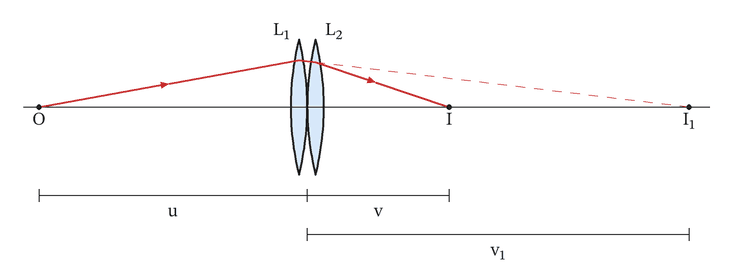
Step 2 — Find the image formed by the first lens alone.
If were absent, would form an image at distance . The lens formula for gives
Step 3 — Use that image as the object for the second lens.
The rays leaving converge towards , so acts as a (virtual) object for . Since the lenses are in contact, it is at the same distance from . forms the final image I at distance :
Step 4 — Add the two equations.
Adding (1) and (2), the term cancels:
Step 5 — Compare with a single equivalent lens.
Suppose a single lens of focal length forms the image of the same object O at the same place I. Its lens formula is
The left sides of (3) and (4) are the same, so their right sides must be equal:
Watch out: Each focal length carries its sign: positive for a convex (converging) lens and negative for a concave (diverging) lens.
Therefore, for two thin lenses in contact, , where is the focal length of the combination and , are those of the two lenses.
- 92 marks
Question 9
Where will you keep an object in front of a:
(i) Convex lens in order to get a virtual and magnified image?
(ii) Concave mirror to get a real and diminished image?
Solve with AIWritten solution
Solution:
Key idea: A convex lens gives a virtual, erect, magnified image only when the object is closer to it than its principal focus. A concave mirror gives a real, inverted, diminished image when the object is beyond its centre of curvature.
Step 1 — Work out part (i) for the convex lens.
Let the object be at a distance from the lens, so in the New Cartesian convention. The lens formula gives
When is less than , the right-hand side is negative, so is negative. The image is then on the same side as the object, so it is virtual. Its magnification simplifies to
This is greater than 1 when is less than , so the image is erect and magnified. For example, with a focal length of 10 cm and the object 6 cm from the lens, the image forms 15 cm from the lens on the object's side, magnified 2.5 times.
Step 2 — Work out part (ii) for the concave mirror.
For a concave mirror the image is real and diminished when the object is beyond the centre of curvature C (farther than ). The image then forms between the focus F and C, real and inverted. For example, by the mirror formula , a concave mirror of focal length 10 cm with the object 30 cm in front of it forms a real, inverted image 15 cm in front of it, half the size of the object.
Note: Part (ii) is about spherical mirrors, from the previous chapter.
Therefore, (i) the object must be placed between the optical centre and the principal focus of the convex lens (closer than its focal length); (ii) the object must be placed beyond the centre of curvature of the concave mirror (farther than twice its focal length).
- 103 marks
Question 10
For two thin lenses kept in contact with each other, show that:
Where the terms have their usual meaning.
Solve with AIWritten solution
Solution:
Key idea: For a thin lens, the lens formula in the New Cartesian sign convention is . In a combination of lenses, the image formed by the first lens acts as the object for the second lens.
Step 1 — Set up the two lenses.
Two thin lenses and , of focal lengths and , are placed in contact on a common principal axis. Because both are thin and touching, all distances can be measured from one common optical centre. A point object O sits on the axis at distance .
Step 2 — Find the image formed by the first lens alone.
If were absent, would form an image at distance . The lens formula for gives
Step 3 — Use that image as the object for the second lens.
The rays leaving converge towards , so acts as a (virtual) object for . Since the lenses are in contact, it is at the same distance from . forms the final image I at distance :
Step 4 — Add the two equations.
Adding (1) and (2), the term cancels:
Step 5 — Compare with a single equivalent lens.
Suppose a single lens of focal length forms the image of the same object O at the same place I. Its lens formula is
The left sides of (3) and (4) are the same, so their right sides must be equal:
Watch out: Each focal length carries its sign: positive for a convex (converging) lens and negative for a concave (diverging) lens.
Therefore, for two thin lenses in contact, , where is the focal length of the combination and , are those of the two lenses.
- 115 marks
Question 11
(i) Derive an expression for refraction at a single (convex) spherical surface, i.e. a relation between u, v, R, (rarer medium) and (denser medium),
(ii) Name the phenomenon due to which the sun appears reddish at sunset.
Solve with AIWritten solution
Solution:
Key idea: Snell's law at the point of incidence, , applied to a paraxial ray (one close to the axis, so every angle is small and in radians), together with the geometry of the triangles in the figure.
Step 1 — Draw the figure and state the sign convention.
A convex spherical surface with pole P and centre of curvature C separates a rarer medium of refractive index (left) from a denser medium of refractive index (right). A ray from a point object O on the axis meets the surface at A, bends towards the normal CA, and crosses the axis at the image I. AM is the perpendicular from A to the axis. The angles , and are the angles that OA, CA and IA make with the axis. We use the New Cartesian sign convention: distances are measured from P, positive in the direction of the incident light.
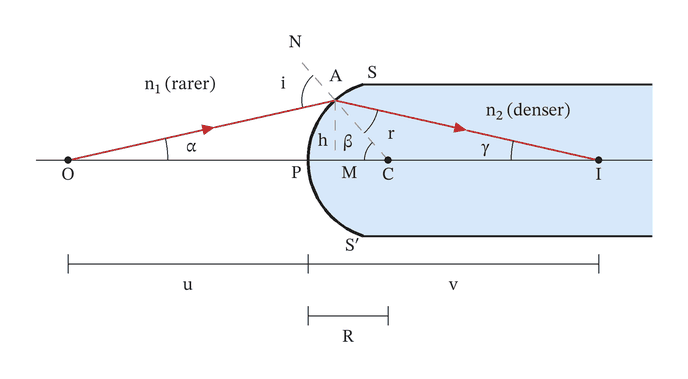
Step 2 — Relate the angles of incidence and refraction to α, β and γ.
The angle of incidence is the exterior angle of triangle AOC at A, so it equals the sum of the two interior opposite angles:
In triangle AIC, the exterior angle at C is , so , which gives
Step 3 — Apply Snell's law for small angles.
For a paraxial ray, and , so Snell's law becomes . Substituting the angles from Step 2:
Step 4 — Write each small angle in terms of h.
Because the ray is paraxial, A is very close to P, so M almost coincides with P, and each small angle equals its tangent:
Step 5 — Substitute and cancel h.
We put these into the equation of Step 3:
Cancelling and collecting the terms in PC on the right:
Step 6 — Apply the sign convention.
O is against the direction of the incident light, while I and C are along it. So the object distance is negative and the other two are positive:
Substituting these distances:
This relation holds for every paraxial ray, so all such rays from O meet at the same point I: a point image is formed.
Step 7 — Answer part (ii).
At sunset, sunlight travels a long path through the atmosphere. The air molecules scatter short wavelengths much more strongly than long ones (the scattered intensity varies as ), so most of the blue is scattered out of the direct beam. Mainly the red end of the spectrum reaches the eye, and the sun looks reddish. This phenomenon is the scattering of light (Rayleigh scattering).
Therefore, (i) for refraction at a convex spherical surface, ; (ii) the sun appears reddish at sunset because of the scattering of light by the air molecules.
- 123 marks
Question 12
Obtain an expression for refraction at a single convex spherical surface i.e., the relation between (rarer medium), (denser medium), object distance u, image distance v and the radius of curvature
Solve with AIWritten solution
Solution:
Key idea: Snell's law at the point of incidence, , applied to a paraxial ray (one close to the axis, so every angle is small and in radians), together with the geometry of the triangles in the figure.
Step 1 — Draw the figure and state the sign convention.
A convex spherical surface with pole P and centre of curvature C separates a rarer medium of refractive index (left) from a denser medium of refractive index (right). A ray from a point object O on the axis meets the surface at A, bends towards the normal CA, and crosses the axis at the image I. AM is the perpendicular from A to the axis. The angles , and are the angles that OA, CA and IA make with the axis. We use the New Cartesian sign convention: distances are measured from P, positive in the direction of the incident light.
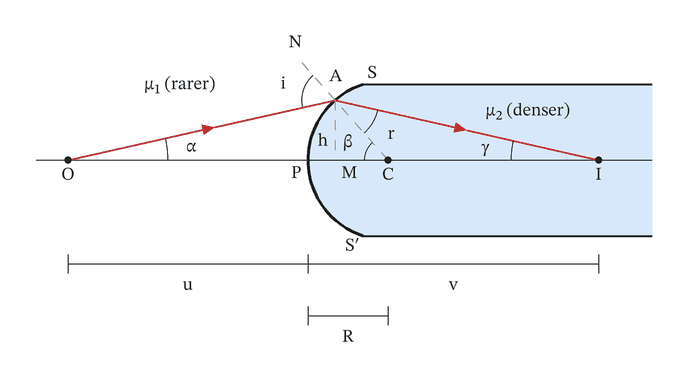
Step 2 — Relate the angles of incidence and refraction to α, β and γ.
The angle of incidence is the exterior angle of triangle AOC at A, so it equals the sum of the two interior opposite angles:
In triangle AIC, the exterior angle at C is , so , which gives
Step 3 — Apply Snell's law for small angles.
For a paraxial ray, and , so Snell's law becomes . Substituting the angles from Step 2:
Step 4 — Write each small angle in terms of h.
Because the ray is paraxial, A is very close to P, so M almost coincides with P, and each small angle equals its tangent:
Step 5 — Substitute and cancel h.
We put these into the equation of Step 3:
Cancelling and collecting the terms in PC on the right:
Step 6 — Apply the sign convention.
O is against the direction of the incident light, while I and C are along it. So the object distance is negative and the other two are positive:
Substituting these distances:
This relation holds for every paraxial ray, so all such rays from O meet at the same point I: a point image is formed.
Therefore, for refraction at a single convex spherical surface, , where is the radius of curvature of the surface.
- 135 marks
Question 13
Read the passage given below and answer the questions that follow.
There are two types of lenses: Converging lenses and Diverging lenses, depending on whether they converge or diverge an incident beam of light. They are also called convex or concave lenses. Lenses are usually made of glass. Convex lenses are more popular as they form a real image of an object. They are widely used in our daily life, for instance, in microscopes, telescopes, projectors, cameras, spectacles etc. Microscopes are used to view small and nearby objects whereas telescopes are used to see distant objects.
i. State any one factor on which focal length of a lens depends.
ii. Give an example where a convex lens behaves like a diverging lens.
iii. What type of lens is used in a camera?
iv. Write an expression for magnifying power of a compound microscope when its final image lies at the least distance of distinct vision (D).
v. State any one difference between a reflecting telescope and a refracting telescope.
Solve with AIWritten solution
Solution:
Key idea: The lens maker's formula, , shows what the focal length of a lens depends on. Here is the refractive index of the lens material and that of the surrounding medium.
Step 1 — Answer part i: a factor on which the focal length depends.
From the formula, the focal length depends on the refractive index of the lens material relative to the surrounding medium, and on the radii of curvature of its surfaces. Since the refractive index changes with colour, it also depends on the wavelength of the light. Any one of these is an answer, for example the refractive index of the material of the lens.
Step 2 — Answer part ii: a convex lens that diverges.
If a convex lens is placed in a medium whose refractive index is greater than that of its material, the factor becomes negative, so the focal length becomes negative and the lens diverges light. For example, a convex glass lens () immersed in carbon disulphide () has , so it behaves as a diverging lens.
Step 3 — Answer part iii: the lens in a camera.
A camera must form a real, inverted, diminished image of the scene on its film or sensor, and only a converging lens can do this. So a camera uses a convex (converging) lens. In practice it is a combination of several lenses that acts, as a whole, as one converging lens.
Step 4 — Answer part iv: magnifying power of a compound microscope.
When the final image is at the least distance of distinct vision , the magnifying power is the product of the magnification by the objective and the magnifying power of the eyepiece. In size,
Here and are the distances of the object and of its image from the objective (taken in size), and is the focal length of the eyepiece. Since (the tube length) and , this is often written as .
Step 5 — Answer part v: reflecting and refracting telescopes.
A refracting telescope uses a convex lens as its objective, while a reflecting telescope uses a concave mirror. Because a mirror reflects all colours alike, a reflecting telescope is free from chromatic aberration; a large mirror is also easier to make and to support than a large lens.
Note: Parts iv and v are about optical instruments, from a later chapter.
Therefore, i. the refractive index of the lens material (or the radii of curvature of its surfaces); ii. a convex lens immersed in a liquid of higher refractive index, such as a glass lens in carbon disulphide; iii. a convex (converging) lens; iv. ; v. a reflecting telescope has a concave mirror as its objective (no chromatic aberration), a refracting telescope a convex lens.
- 143 marks
Question 14
A student is performing an experiment to determine focal length of a convex lens by using lens formula i.e., by no parallax method. The examiner gives some instructions to the student. The student responds to each instruction as per her understanding of the experiment.
State whether the student's response is correct or incorrect. Give a reason for your answer.
i. EXAMINER: Image formed by the lens is magnified. Reduce the size of the image. STUDENT moves the lens towards the object pin.
ii. EXAMINER: Plot a graph of (1/v) against (1/u). STUDENT takes (1/v) on Y axis and (1/u) on X axis.
iii. EXAMINER: Write the relation between the optical power (P) and the focal length (f) of the convex lens. STUDENT writes P = 2f.
Solve with AIWritten solution
Solution:
Key idea: In the no-parallax (–) method, the real image of the object pin formed by the convex lens is located with an image pin. For a real image, the lens formula gives the size of the magnification as , so the image is larger the closer the object is to the focus.
Step 1 — Judge response i (moving the lens towards the object pin).
Moving the lens towards the object pin makes smaller, bringing the object nearer the focus. Then becomes smaller and the magnification larger. For example, take . An object distance of 30 cm gives a magnification of 2, while 25 cm gives 4. So the image grows instead of shrinking.
To reduce the image, the lens should be moved away from the object pin. Beyond the image becomes smaller than the object: an object distance of 60 cm gives a magnification of 0.5. The response is incorrect.
Step 2 — Judge response ii (the axes of the graph).
"Plot a graph of A against B" means A goes on the Y axis and B on the X axis. So for a graph of against , is plotted on the Y axis and on the X axis. The graph is a straight line whose intercepts on the axes give the value of (in size). The response is correct.
Step 3 — Judge response iii (power and focal length).
The optical power of a lens is the reciprocal of its focal length:
is in dioptres when is in metres. The relation is wrong both in form and in units ( is a length, the object distance at which the image is the same size as the object). The response is incorrect.
Therefore, i. incorrect: moving the lens towards the object pin enlarges the image, so it should be moved away from the object pin; ii. correct: in a graph of against , goes on the Y axis; iii. incorrect: the relation is .
- 151 mark
Question 15
Given below are two statements marked, Assertion and Reason. Read the two statements and choose the correct option.
Assertion: When a convex lens made of glass is completely immersed in water, its focal length increases.
Reason: Refractive index of glass with respect to water is greater than that of glass with respect to air.
Solve with AIAnswer
(A) Both Assertion and Reason are true and Reason is the correct explanation for Assertion.
(B) Both Assertion and Reason are true but Reason is not the correct explanation for Assertion.
- Correct
(C) Assertion is true and Reason is false.
(D) Both Assertion and Reason are false.
Answer: (C) Assertion is true and Reason is false.
Key idea: For a lens of refractive index in a medium of refractive index , . The ratio is the refractive index of glass with respect to the medium.
Step 1 — Judge the Assertion.
Water () is denser than air, so the ratio is smaller than and the factor is smaller than . A smaller factor means a larger focal length. For ordinary glass () the factor falls from 0.5 to about 0.128, so the focal length becomes about 3.9 times as large. The Assertion is true.
Step 2 — Judge the Reason.
The refractive index of glass with respect to water is , while with respect to air it is . Since is greater than 1, the first is always the smaller. The Reason states the opposite, so it is false.
Step 3 — Choose the option.
The Assertion is true and the Reason is false, which is option (C).
Why the others are wrong:
- (A) It treats the Reason as true, but the refractive index of glass with respect to water (about 1.13) is less than that with respect to air (1.5).
- (B) It also treats the Reason as true, which it is not, so the question of whether it explains the Assertion does not arise.
- (D) It calls the Assertion false, but the focal length of a glass lens in water is about 3.9 times its value in air, so it does increase.
Therefore, the Assertion is true and the Reason is false, option (C).
- 162 marks
Question 16
The objective of a telescope consists of two lenses kept in contact. One lens has an optical power of whereas the other lens has an optical power of . Calculate focal length of the objective.
Solve with AIWritten solution
Solution:
Key idea: For thin lenses in contact the powers add, , and the focal length is (in metres when is in dioptres).
Step 1 — Add the powers with their signs.
The objective is the combination of the two lenses in contact, so its power is
Step 2 — Find the focal length.
The focal length is the reciprocal of the power:
The power is positive, so the objective is converging, as a telescope objective must be.
Therefore, the focal length of the objective is (200 cm), and it is a converging combination.
- 171 mark
Question 17
When a biconvex lens of glass of refractive index was dipped in a certain transparent liquid, it was found to behave like a plane sheet of glass. So, the refractive index of the liquid is:
- 181 mark
Question 18
A thin convex lens of power is kept in contact with a thin concave lens of power . Calculate the focal length of the combination.
- 192 marks
Question 19
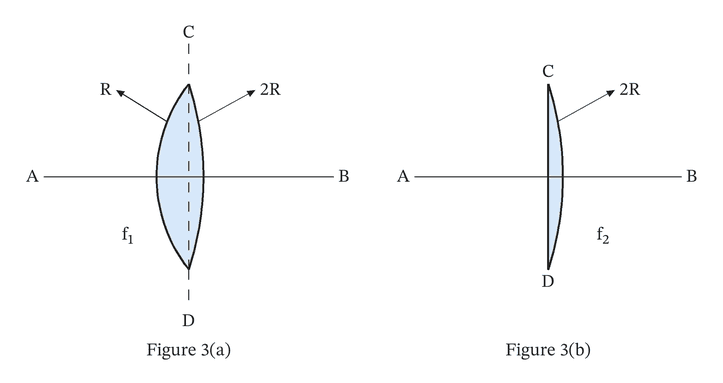
A bi-convex lens of focal length is placed in air as shown in Figure 3(a) below. The radii of curvature of its first and second surfaces are and respectively. The lens is cut along the plane CD. Compare the focal length of the resulting lens shown in Figure 3(b) with that of the original lens shown in Figure 3(a).