Solution:
Key idea: Snell's law at the point of incidence, n1sini=n2sinr, applied to a paraxial ray (one close to the axis, so every angle is small and sinθ≈tanθ≈θ in radians), together with the geometry of the triangles in the figure.
Step 1 — Draw the figure and state the sign convention.
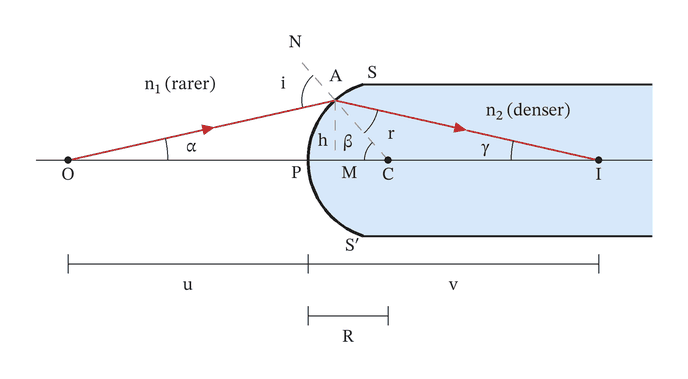
A convex spherical surface with pole P and centre of curvature C separates a rarer medium of refractive index n1 (left) from a denser medium of refractive index n2 (right). A ray from a point object O on the axis meets the surface at A, bends towards the normal CA, and crosses the axis at the image I. AM =h is the perpendicular from A to the axis. The angles α, β and γ are the angles that OA, CA and IA make with the axis. We use the New Cartesian sign convention: distances are measured from P, positive in the direction of the incident light.
Step 2 — Relate the angles of incidence and refraction to α, β and γ.
The angle of incidence i is the exterior angle of triangle AOC at A, so it equals the sum of the two interior opposite angles:
i=α+β
In triangle AIC, the exterior angle at C is β, so β=r+γ, which gives
r=β−γ
Step 3 — Apply Snell's law for small angles.
For a paraxial ray, sini≈i and sinr≈r, so Snell's law becomes n1i=n2r. Substituting the angles from Step 2:
n1(α+β)=n2(β−γ)
Step 4 — Write each small angle in terms of h.
Because the ray is paraxial, A is very close to P, so M almost coincides with P, and each small angle equals its tangent:
α≈OPh
β≈PCh
γ≈PIh
Step 5 — Substitute and cancel h.
We put these into the equation of Step 3:
n1(OPh+PCh)=n2(PCh−PIh)
Cancelling h and collecting the terms in PC on the right:
OPn1+PIn2=PCn2−n1
Step 6 — Apply the sign convention.
O is against the direction of the incident light, while I and C are along it. So the object distance is negative and the other two are positive:
OP=−u
PI=+v
PC=+R
Substituting these distances:
−un1+vn2=Rn2−n1
vn2−un1=Rn2−n1
This relation holds for every paraxial ray, so all such rays from O meet at the same point I: a point image is formed.
Step 7 — Answer part (ii).
At sunset, sunlight travels a long path through the atmosphere. The air molecules scatter short wavelengths much more strongly than long ones (the scattered intensity varies as λ41), so most of the blue is scattered out of the direct beam. Mainly the red end of the spectrum reaches the eye, and the sun looks reddish. This phenomenon is the scattering of light (Rayleigh scattering).
Therefore, (i) for refraction at a convex spherical surface, vn2−un1=Rn2−n1; (ii) the sun appears reddish at sunset because of the scattering of light by the air molecules.
