
Question 103 marksAsked 2020Medium
For two thin lenses kept in contact with each other, show that:
Where the terms have their usual meaning.
Confirming your payment
Sign up now and get 250 free tokens.
Previous Year Questions · Question 10 of 19
For two thin lenses kept in contact with each other, show that:
Where the terms have their usual meaning.
Solution:
Key idea: For a thin lens, the lens formula in the New Cartesian sign convention is . In a combination of lenses, the image formed by the first lens acts as the object for the second lens.
Step 1 — Set up the two lenses.
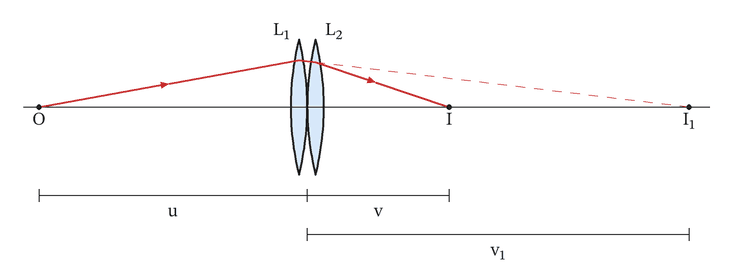
Two thin lenses and , of focal lengths and , are placed in contact on a common principal axis. Because both are thin and touching, all distances can be measured from one common optical centre. A point object O sits on the axis at distance .
Step 2 — Find the image formed by the first lens alone.
If were absent, would form an image at distance . The lens formula for gives
Step 3 — Use that image as the object for the second lens.
The rays leaving converge towards , so acts as a (virtual) object for . Since the lenses are in contact, it is at the same distance from . forms the final image I at distance :
Step 4 — Add the two equations.
Adding (1) and (2), the term cancels:
Step 5 — Compare with a single equivalent lens.
Suppose a single lens of focal length forms the image of the same object O at the same place I. Its lens formula is
The left sides of (3) and (4) are the same, so their right sides must be equal:
Watch out: Each focal length carries its sign: positive for a convex (converging) lens and negative for a concave (diverging) lens.
Therefore, for two thin lenses in contact, , where is the focal length of the combination and , are those of the two lenses.