
Question 123 marksAsked 2023Medium
Obtain an expression for refraction at a single convex spherical surface i.e., the relation between (rarer medium), (denser medium), object distance u, image distance v and the radius of curvature
Confirming your payment
Sign up now and get 250 free tokens.
Previous Year Questions · Question 12 of 19
Obtain an expression for refraction at a single convex spherical surface i.e., the relation between (rarer medium), (denser medium), object distance u, image distance v and the radius of curvature
Solution:
Key idea: Snell's law at the point of incidence, , applied to a paraxial ray (one close to the axis, so every angle is small and in radians), together with the geometry of the triangles in the figure.
Step 1 — Draw the figure and state the sign convention.
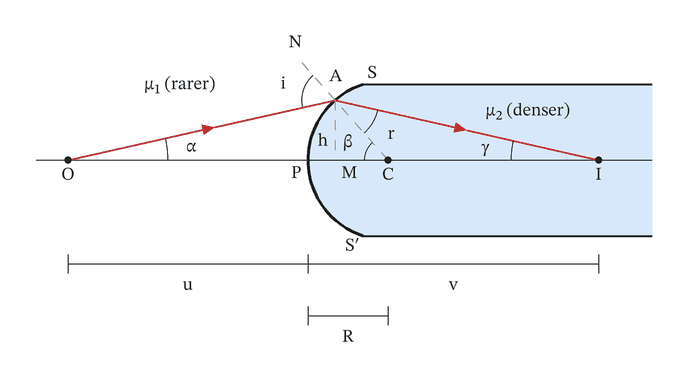
A convex spherical surface with pole P and centre of curvature C separates a rarer medium of refractive index (left) from a denser medium of refractive index (right). A ray from a point object O on the axis meets the surface at A, bends towards the normal CA, and crosses the axis at the image I. AM is the perpendicular from A to the axis. The angles , and are the angles that OA, CA and IA make with the axis. We use the New Cartesian sign convention: distances are measured from P, positive in the direction of the incident light.
Step 2 — Relate the angles of incidence and refraction to α, β and γ.
The angle of incidence is the exterior angle of triangle AOC at A, so it equals the sum of the two interior opposite angles:
In triangle AIC, the exterior angle at C is , so , which gives
Step 3 — Apply Snell's law for small angles.
For a paraxial ray, and , so Snell's law becomes . Substituting the angles from Step 2:
Step 4 — Write each small angle in terms of h.
Because the ray is paraxial, A is very close to P, so M almost coincides with P, and each small angle equals its tangent:
Step 5 — Substitute and cancel h.
We put these into the equation of Step 3:
Cancelling and collecting the terms in PC on the right:
Step 6 — Apply the sign convention.
O is against the direction of the incident light, while I and C are along it. So the object distance is negative and the other two are positive:
Substituting these distances:
This relation holds for every paraxial ray, so all such rays from O meet at the same point I: a point image is formed.
Therefore, for refraction at a single convex spherical surface, , where is the radius of curvature of the surface.