Solution:
Key idea: By the lens maker's formula, f1=(n−1)(R11−R21), where n is the refractive index of the glass and R1, R2 are the signed radii of the first and second surfaces (New Cartesian convention, light travelling from left to right). A plane surface has R=∞.
Step 1 — Find the focal length of the original lens.
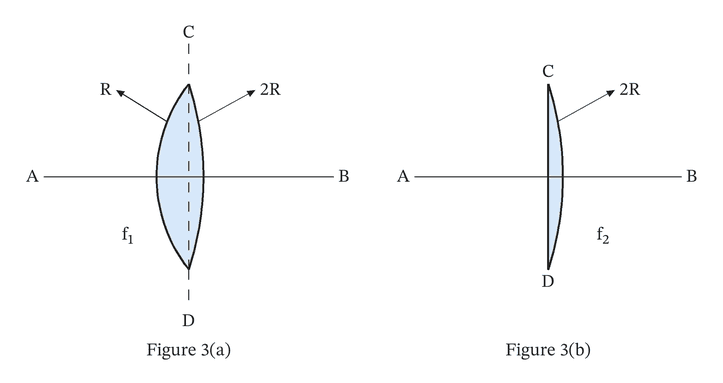
In Figure 3(a) the first surface has its centre of curvature on the right and the second on the left:
R1=+R
R2=−2R
Substituting into the lens maker's formula:
f11=(n−1)(R1−−2R1)
f11=(n−1)2R3
Step 2 — Find the focal length of the cut lens.
Cutting along the plane CD leaves, in Figure 3(b), a plano-convex lens of the same glass. Its first surface is the flat face CD and its second surface is the curved face of radius 2R:
R1=∞
R2=−2R
Substituting again:
f21=(n−1)(0−−2R1)
f21=(n−1)2R1
Step 3 — Compare the two focal lengths.
Dividing the result of Step 1 by that of Step 2, the factor (n−1) cancels:
f1f2=1/(2R)3/(2R)
f1f2=3
Turning either lens round would not change its focal length, so this comparison holds whichever way the lenses face.
Therefore, f2=3f1: the focal length of the cut (plano-convex) lens is three times that of the original lens.