
Question 563 marksMedium
What is linear magnification () produced by a lens? Obtain the relation connecting (i) , and and (ii) , and .
Confirming your payment
Sign up now and get 250 free tokens.
Refraction of Light at Spherical Surfaces - Lenses · Question 56 of 88
What is linear magnification () produced by a lens? Obtain the relation connecting (i) , and and (ii) , and .
Solution:
Key idea: Linear magnification compares the size of the image with the size of the object. Combining it with the lens formula lets us write using only and , or only and . We use the New Cartesian sign convention: distances are measured from the optical centre and are positive in the direction of the incident light, and heights are positive upwards.
Step 1 — Define linear magnification.
Linear magnification is the ratio of the height of the image to the height of the object .
Step 2 — Show from the ray diagram that m equals v/u.
In the figure, is the object and is its real, inverted image. The ray through the optical centre goes straight on, so triangles and are similar.
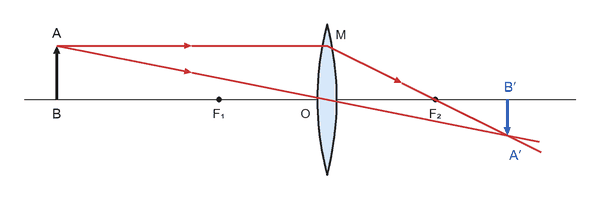
Now we put in the signs. The image lies below the axis, so , while . The image is on the far side of the lens, so , and the object is on the incident side, so .
Step 3 — Relate m, u and f (part i).
We multiply every term of the lens formula by , so that the ratio appears.
Adding 1 to both sides and writing the right-hand side over gives the next line.
Since , we take the reciprocal of both sides.
Step 4 — Relate m, v and f (part ii).
This time we multiply every term of the lens formula by , so that the ratio appears.
We replace by and rearrange for .
Step 5 — Check both results with numbers.
Take a convex lens of focal length +10 cm and an object 15 cm in front of it ( cm).
The lens formula then gives an image distance of +30 cm, so is . The relation from part (i) gives the same value.
The relation from part (ii) agrees as well.
Therefore, the magnification is the ratio of image height to object height and equals ; in terms of and it is (part i), and in terms of and it is (part ii).