
Question 573 marksMedium
Derive the formula for a lens.
Confirming your payment
Sign up now and get 250 free tokens.
Refraction of Light at Spherical Surfaces - Lenses · Question 57 of 88
Derive the formula for a lens.
Solution:
Key idea: We use two pairs of similar triangles in the ray diagram of a convex lens forming a real image, and then put in the New Cartesian signs. Distances are measured from the optical centre and are positive in the direction of the incident light.
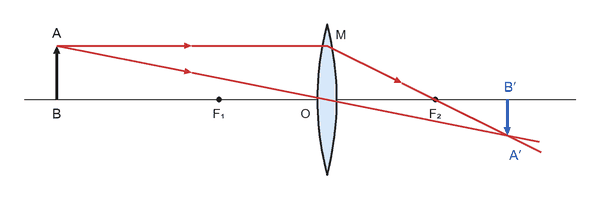
Step 1 — Describe the ray diagram.
In the figure, is the object and is its real, inverted image. The ray , parallel to the principal axis, passes through the second focus after refraction. The ray through the optical centre goes straight on. The lens is thin, so lies on the line through perpendicular to the axis, and .
Step 2 — Use triangles ABO and A′B′O.
These triangles are similar, because their angles at are vertically opposite and each has a right angle at the axis. So their sides are in proportion.
Step 3 — Use triangles MOF₂ and A′B′F₂.
These triangles are also similar: their angles at are vertically opposite and each has a right angle. Since , they give a second expression for the same ratio.
The distance is the image distance minus the focal distance.
Step 4 — Equate the two ratios.
Both right-hand sides are equal to , so they are equal to each other.
Step 5 — Put in the signs.
The object is on the incident side, so . The image and the focus are on the far side, so and .
Cross-multiplying removes the fractions.
Step 6 — Divide by uvf.
Dividing every term by the product turns each term into a reciprocal.
Note: The same formula holds for a concave lens and for virtual images, as long as the sign convention is used throughout.
Therefore, the lens formula is .