Solution:
Key idea: For a lens of refractive index n in a medium of refractive index n′, the lens maker's formula is
f1=(n′n−1)(R11−R21)
For a concave lens the second bracket is negative, so the sign of f is decided by the first bracket.
Step 1 — Medium denser than the lens, n′>n (case i).
The first bracket (n′n−1) is negative. A negative bracket times the negative second bracket gives a positive f. So the concave lens acts as a converging lens: the parallel beam is bent towards the axis and meets at a real focus F beyond the lens.

Step 2 — Medium of the same index, n′=n (case ii).
The first bracket is zero, so f1=0 and f is infinite. Light is not bent at the surfaces, so the parallel beam passes straight through undeviated.
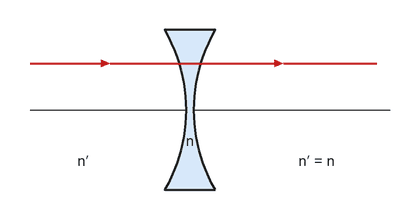
Step 3 — Medium less dense than the lens, n′<n (case iii).
The first bracket is positive. A positive bracket times the negative second bracket gives a negative f. So the lens acts as a diverging lens, its usual behaviour in air: the parallel beam spreads out and appears to come from the focus F on the incident side (dashed line).
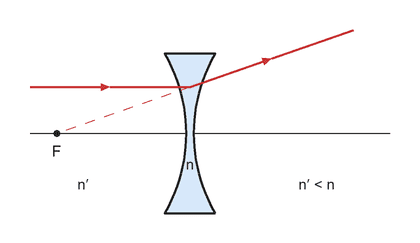
Therefore, the concave lens (i) converges the parallel beam to a real focus when n′>n, (ii) lets it pass undeviated when n′=n, and (iii) diverges it as if from a virtual focus when n′<n.
