Solution:
Key idea: The hemispherical end of the rod is a single refracting surface, so vn2−un1=Rn2−n1 (New Cartesian convention, light from left to right). For such a surface the lateral magnification is m=n2un1v, the ratio of the image height h2 to the object height h1.
Step 1 — Write down the data with their signs.
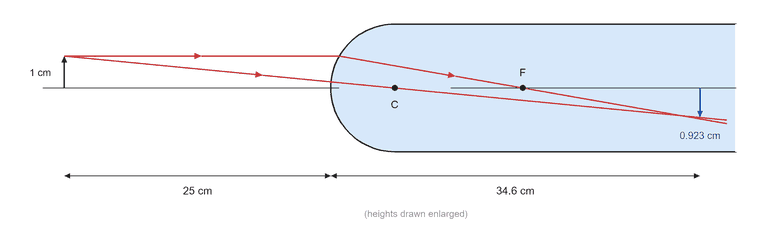
Light goes from the object in air, where n1=1, into the glass rod, where n2=1.5. The object is 25 cm in front of the rounded end, so u=−25 cm. The rounded end bulges towards the object, so its centre of curvature C lies inside the rod and R=+6 cm, while the object height is h1=1 cm.
Step 2 — Substitute into the refraction formula.
We put the values in, keeping v as the unknown.
v1.5−−251=61.5−1
v1.5+251=121
Step 3 — Solve for the image position.
We move 251 to the right-hand side and use the common denominator 300.
v1.5=30025−30012
v1.5=30013
v=131.5×300
v=13450 cm
v≈34.6 cm
The value is positive, so the image is real and lies inside the rod.
Step 4 — Find the magnification.
We use the magnification formula for a single refracting surface.
m=1.5×(−25)1×13450
m=−1312
m≈−0.923
Step 5 — Find the height of the image.
The image height is the magnification times the object height.
h2=m×h1
h2=−0.923×1
h2=−0.923 cm
The negative sign shows that the image is inverted.
Note: The book prints 34.61 cm. The exact value, 13450 cm, is 34.615… cm, and the printed figure is this value cut off after the second decimal place.
Therefore, the image is real and inverted, formed inside the rod about 34.6 cm from the rounded edge, and its height is about 0.923 cm.

