
Question 813 marksMedium
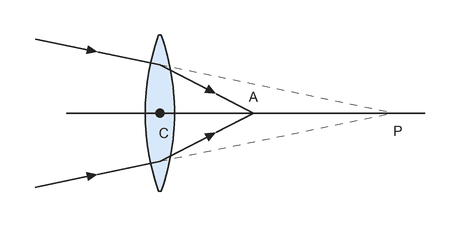
Light is converging to a point and a convex lens of focal length 20 cm is placed at in the path of the beam, where cm. The beam now converges to . Find the distance .
Confirming your payment
Sign up now and get 250 free tokens.
Refraction of Light at Spherical Surfaces - Lenses · Question 81 of 88
Light is converging to a point and a convex lens of focal length 20 cm is placed at in the path of the beam, where cm. The beam now converges to . Find the distance .
Solution:
Key idea: The beam is converging towards P, which lies beyond the lens. For the lens, P acts as a virtual object on the side where the light goes, so its distance is positive in the New Cartesian convention. The lens formula then gives the new meeting point A.
Step 1 — Write down the data with their signs.
The light travels from left to right and P is 30 cm to the right of the lens at C, so , and the convex lens has .
Step 2 — Find the image distance.
We rearrange the lens formula for and substitute.
Step 3 — Interpret the result.
The image distance is positive, so the rays now meet at a real point A, 12 cm to the right of the lens. This is closer than P, as expected, because a converging lens makes an already converging beam converge more strongly.
Therefore, the distance CA is 12 cm.