
Question 412 marksMedium
Draw ray diagrams to show how a convex lens forms (i) a real magnified image and (ii) a virtual magnified image.
Confirming your payment
Sign up now and get 250 free tokens.
Refraction of Light at Spherical Surfaces - Lenses · Question 41 of 88
Draw ray diagrams to show how a convex lens forms (i) a real magnified image and (ii) a virtual magnified image.
Solution:
Key idea: Two rays are enough to locate the image of the top of an object standing on the principal axis: a ray parallel to the principal axis passes through the second focus after refraction, and a ray through the optic centre goes straight on.
Step 1 — Place the object for a real magnified image (part i).
A convex lens gives a real, magnified image when the object is between and . We draw the object there and trace the two rays from .
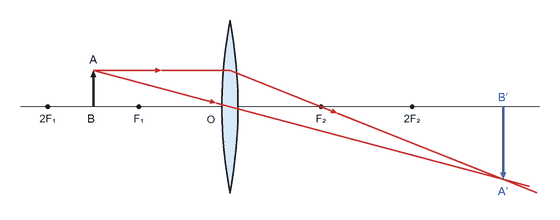
Step 2 — Read the image in part (i).
The two refracted rays actually meet at on the other side of the lens, so the image is real. The image lies beyond , is inverted, and is larger than the object.
Step 3 — Place the object for a virtual magnified image (part ii).
A convex lens gives a virtual, magnified image when the object is between and the optic centre . We draw the object there and trace the same two rays from .

Step 4 — Read the image in part (ii).
The two refracted rays spread apart and never meet. Produced backwards (dashed lines), they appear to come from on the same side as the object. So the image is virtual, erect and magnified.
Therefore, (i) with the object between and the convex lens forms a real, inverted, magnified image beyond , and (ii) with the object between and it forms a virtual, erect, magnified image on the same side as the object.