
Question 665 marksMedium
When two thin lenses are kept in contact, obtain the relation and discuss the nature of the combined lens when , and .
Confirming your payment
Sign up now and get 250 free tokens.
Refraction of Light at Spherical Surfaces - Lenses · Question 66 of 88
When two thin lenses are kept in contact, obtain the relation and discuss the nature of the combined lens when , and .
Solution:
Key idea: The image formed by the first lens acts as the object for the second lens. Adding the lens formulae for the two lenses gives the focal length of the pair. The nature of the pair then depends on which lens is more powerful (has the shorter focal length).
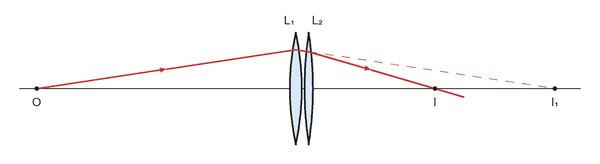
Step 1 — Set up the arrangement.
Two thin lenses and , of focal lengths and , are in contact with a common principal axis. A point object is at distance . The lenses are thin and touching, so all distances are measured from the same point.
Step 2 — Apply the lens formula to L₁.
The lens alone would form the image at distance .
Step 3 — Apply the lens formula to L₂.
The rays heading for fall on , so is a virtual object for at the same distance . The final image is at distance .
Step 4 — Add (1) and (2).
The terms in cancel when the equations are added.
Step 5 — Compare with an equivalent lens.
A single lens of focal length forming the same image obeys , so the right-hand sides must be equal.
Step 6 — Decide which combination the cases refer to.
If both lenses are convex, both terms are positive, so is always positive and shorter than either focal length. If both are concave, is always negative. So the three cases matter for a convex lens of focal length combined with a concave lens whose focal length has size (its signed focal length is ).
Step 7 — Case f₁ > f₂.
The denominator is negative, so is negative. The concave lens is the more powerful one, and the combination behaves as a diverging (concave) lens.
For example, a convex lens of focal length 20 cm with a concave lens of focal length 10 cm gives cm.
Step 8 — Case f₁ < f₂.
The denominator is positive, so is positive. The convex lens is the more powerful one, and the combination behaves as a converging (convex) lens.
For example, a convex lens of focal length 10 cm with a concave lens of focal length 20 cm gives cm.
Step 9 — Case f₁ = f₂.
The two powers cancel, so is zero and is infinite. The combination behaves like a plane glass plate with zero power.
Therefore, ; for a convex lens () with a concave lens (size ) the pair is diverging if , converging if , and a zero-power plane plate if .