Opening your dashboard
Class 12 Physics Chapter 16 Refraction of Light at Spherical Surfaces - Lenses: Competency-Based Questions (CBQ)
59 questions on Chapter 16, each worked through on its own page with the AI tutor. Class 12 Physics, ICSE 2026-27.
59 questions
1–4 marks · Mixed difficulty
- 11 mark
Question 1
Competency: Analysis & Evaluation
A glass paperweight is a solid hemisphere (). It rests with its flat face on a printed page, and a student looks straight down at the letters under the middle of the flat face, through the curved top.
Assertion (A): The letters under the centre of the flat face appear to lie on the paper itself, at their real depth below the curved top.
Reason (R): Rays from the centre of curvature of a spherical refracting surface meet the surface along the normal, so they pass through it without bending.
- 23 marks
Question 2
Competency: Application
An underwater camera looks out through a dome port: a thin, clear hemispherical dome of radius with air inside and sea water () outside. The camera lens sits at the centre of curvature of the dome. Neglect the thickness of the dome, so the only refracting surface is a water–air surface of radius , bulging out into the water. (Hypothetical data.)
(a) A fish is in front of the dome, on its axis. Where is the image of the fish formed by the dome?
(b) Where is the image of a very distant fish formed?
(c) Using (b), explain why a camera behind a dome port must be focused on a nearby point even to photograph distant fish.
- 33 marks
Question 3
Competency: Application
In a indicator LED, the tiny light-emitting chip is buried in clear epoxy () whose top is a convex dome of radius . The chip lies on the axis of the dome, below its pole. Treat the dome as a single spherical surface between epoxy and air. (Hypothetical data.)
(a) Looking down the axis from above, where does the chip appear to be?
(b) How far below the pole should the chip be placed for the light leaving the dome to form a parallel beam?
(c) With the chip at , is the beam leaving the dome converging, parallel or diverging? Which way should the chip be moved to make the beam narrower?
- 41 mark
Question 4
Competency: Analysis & Evaluation
While drawing ray diagrams for thin lenses, a student always draws the ray through the optic centre as a straight line.
Assertion (A): A ray passing through the optic centre of a thin lens goes on without bending.
Reason (R): Near the optic centre the two faces of a lens are parallel to each other, so that part of the lens acts like a thin parallel-sided glass slab.
- 51 mark
Question 5
Competency: Analysis & Evaluation
A student draws four rays from the top of an object placed in front of a thin convex lens of focal length (, are the principal foci).
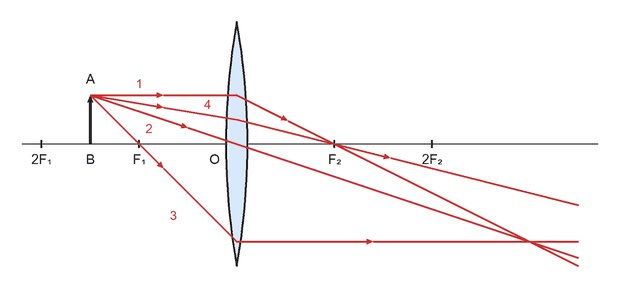
Which ray is drawn incorrectly, and why?
- 61 mark
Question 6
Competency: Application
In an adjustable-beam torch, a small bulb sits on the axis of a convex lens of focal length . With the bulb at the first principal focus, the torch gives a parallel beam. The user turns the head of the torch so that the bulb is now from the lens. What happens to the beam? (Hypothetical data.)
- 74 marks
Question 7
Competency: Application
A door viewer (peephole) lets a person inside see the whole corridor outside. Treat it as a single thin concave lens of focal length . (Hypothetical data.)
(a) Using the lens formula, show that for a real object at any distance, the image formed by a concave lens lies between the lens and its focus.
(b) A visitor tall stands from the lens. Find the position and height of the image.
(c) Another visitor stands away. By how much does the image position differ from that in (b)? Why can both visitors be seen clearly without any adjustment? Draw a ray diagram for (b).
- 81 mark
Question 8
Competency: Analysis & Evaluation
A convex lens forms a sharp image of a lit window on a sheet of tracing paper. A student stands behind the tracing paper, facing the window, and looks at the image through the paper. As seen by the student, the window has a red curtain on its left side and a green plant at the top.
Assertion (A): In the image on the tracing paper, the student sees the red curtain on the right side and the green plant at the bottom.
Reason (R): A convex lens turns a real image upside down but keeps its left and right sides as they are.
- 91 mark
Question 9
Competency: Analysis & Evaluation
A student looks at a postage stamp through a magnifying glass and sees an enlarged, erect, virtual image of it. She wants to photograph this enlarged image with her phone camera.
Assertion (A): The virtual image seen through the magnifying glass cannot be photographed with a camera.
Reason (R): The rays forming a virtual image do not actually meet; they only appear to diverge from the image.
- 101 mark
Question 10
Competency: Analysis & Evaluation
On an optical bench, a candle is placed in front of a thin convex lens of focal length , and a sharp image is found on a screen.
Assertion (A): The image on the screen is of the same size as the candle.
Reason (R): A convex lens forms a real image of any object placed beyond its first principal focus.
- 111 mark
Question 11
Competency: Analysis & Evaluation
A student finds the image of a needle formed by a thin convex lens for five object positions and records, in the new Cartesian sign convention:
Reading 1 2 3 4 5 (cm) (cm) One image distance has been wrongly read. Which reading is it? (Hypothetical data.)
- 124 marks
Question 12
Competency: Analysis & Evaluation
Instead of measuring distances from the lens, a student measures them from the principal foci of a thin convex lens: = distance of the object in front of , and = distance of the real image beyond (both positive numbers). She finds and . (Hypothetical data.)
(a) Starting from the lens formula, show that .
(b) Find the focal length of the lens.
(c) Show that the magnification is , and check its value in this experiment against .
- 133 marks
Question 13
Competency: Application
On an optical bench, the lens upright is at the mark, the object needle at the mark, and the image needle (no parallax) at the mark. To find the index correction, a knitting needle of length is placed so that it just touches the lens and the object needle; the uprights then read and . Take the same correction for the image side. (Hypothetical data.)
(a) Find the focal length from the scale readings without any correction.
(b) Find the index correction and the corrected focal length.
(c) Find the percentage error that would be made by ignoring the index correction.
- 144 marks
Question 14
Competency: Application
A sports photographer uses a camera lens of focal length (treat it as one thin lens). A runner away crosses the field at right angles to the line of sight at . Each pixel of the sensor is wide. (Hypothetical data.)
(a) Find the image distance and the lateral magnification for the runner.
(b) How fast does the runner's image move across the sensor?
(c) Find the blur of the image (in mm) for an exposure of . What is the longest exposure for which the blur is no more than one pixel?
- 151 mark
Question 15
Competency: Application
A classroom document camera has a lens of focal length (treat it as one thin lens) and a sensor tall. The real, inverted image of an A4 page ( tall) must just fill the height of the sensor. How far from the page must the lens be? (Hypothetical data.)
- 161 mark
Question 16
Competency: Application
To check an old spectacle lens, a student holds it above a page of print. She finds that the lens forms an erect image of the letters that is times their real size. The power of the lens is (Hypothetical data.)
- 173 marks
Question 17
Competency: Application
Adjustable spectacles use a "fluid lens": clear silicone oil () between a flat, rigid glass plate and a thin flexible membrane. Pumping oil in or out changes the membrane's curvature, so the lens acts as a thin plano-convex or plano-concave lens of oil. Neglect the plate and the membrane. (Hypothetical data.)
(a) What radius of curvature of the membrane gives a power of ?
(b) Oil is pumped out until the membrane is concave with a radius of curvature of . Find the power now.
(c) If water () were used instead of the oil, what radius would give ? Why do makers prefer the oil?
- 181 mark
Question 18
Competency: Analysis & Evaluation
The label on a reading lens says "focal length ". A student wants to write its power.
Assertion (A): A thin convex lens of focal length has a power of .
Reason (R): The power of a lens in dioptre is the reciprocal of its focal length measured in centimetre.
- 191 mark
Question 19
Competency: Analysis & Evaluation
During an eye test, an optometrist places a lens and a lens together in the trial frame and notes "" on the card.
Assertion (A): The total power of two thin lenses placed together can be found simply by adding the numbers written on them in dioptre.
Reason (R): For thin lenses in contact, .
- 201 mark
Question 20
Competency: Application
A factory grinds biconvex lenses designed for glass of refractive index , giving a focal length of in air. One batch of glass turns out to have a refractive index of , and the lenses are ground to the same radii. The focal length of these lenses is about (Hypothetical data.)
- 211 mark
Question 21
Competency: Analysis & Evaluation
A student says that a magnifying lens must have two curved faces, so a lens with one flat face cannot magnify.
Assertion (A): A lens must have both faces curved to have a non-zero power.
Reason (R): In the lens maker's formula, a plane face has an infinite radius of curvature, so its term is zero.
- 224 marks
Question 22
Competency: Analysis & Evaluation
To find the refractive index of a liquid, a student lays a thin equiconvex glass lens on a plane mirror. Each face of the lens has a radius of curvature of (measured with a spherometer). A pin held above the lens coincides with its own inverted image (no parallax) when it is above the lens. A few drops of the liquid are then put between the lens and the mirror, forming a thin plano-concave liquid lens; now the pin coincides with its image at . (Hypothetical data.)
(a) Find the focal length of the liquid lens.
(b) Find the refractive index of the liquid. Which common liquid could it be?
(c) The liquid is replaced by glycerine (). Where will the pin now coincide with its image?
- 234 marks
Question 23
Competency: Application
A phone camera has a thin lens of focal length . When it is focused on distant objects, the sensor is behind the lens. To photograph insects, a student clips a close-up lens in contact with the phone lens. (Hypothetical data.)
(a) Find the focal length of the combination. With the sensor still behind the lens, where must an insect be for a sharp image?
(b) How long is the image on the sensor of an ant long?
(c) The student stacks a second, identical clip-on lens on the first (all three lenses in contact, sensor still behind). Where must the insect be now, and how long is the image of the same ant?
- 243 marks
Question 24
Competency: Analysis & Evaluation
To find the focal length of a small convex mirror, a student uses a convex lens of focal length . A pin is in front of the lens. The convex mirror is placed beyond the lens, facing it, and moved along the axis until the image of formed by the light returning through the lens coincides with itself (no parallax). This happens when the pole of the mirror is from the lens. (Hypothetical data.)
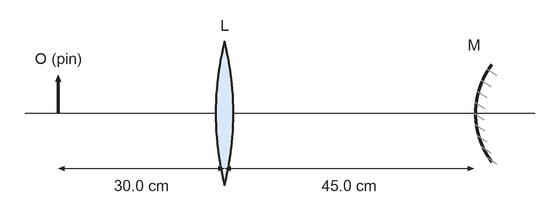
(a) Where would the lens alone form the image of ?
(b) Explain why the returning image coincides with in this position of the mirror.
(c) Find the radius of curvature and the focal length of the convex mirror.
- 251 mark
Question 25
Competency: Application
A road "cat's eye" sends a car's headlight beam back towards the driver. A simple model is a convex lens with a plane mirror behind it, the mirror perpendicular to the lens axis. The light from the headlight reaches the lens as a parallel beam, a little inclined to the axis. Where must the mirror be placed so that the light goes back along its original direction?
- 264 marks
Question 26
An equiconvex glass lens (, each face of radius ) forms a window in the side of an aquarium: air on one side of the lens and water () on the other. Treat the lens as thin.
(a) A parallel beam in air falls on the lens along its axis. Using refraction at each surface in turn, find where the beam is focused in the water.
(b) A parallel beam in the water falls on the lens along its axis. Find where it is focused in the air.
(c) Show that the ratio of the two focal distances equals the ratio of the refractive indices of the media they lie in.
(Hypothetical data.)
- 274 marks
Question 27
A telephoto lens is made of a convex lens of focal length followed by a concave lens of focal length , placed behind on the same axis.
(a) Light from a very distant object on the axis falls on . Find where the final image is formed.
(b) Using , find the equivalent focal length of the pair.
(c) The image of a distant object has size proportional to the equivalent focal length. Explain the advantage of this pair over a single convex lens of focal length .
(Hypothetical data.)
- 283 marks
Question 28
A convex surface of radius of curvature 40 cm separates two media of refractive indices 4/3 and 1.50. An object is kept in the first medium at a distance of 20 cm from the surface. Calculate the position of the image.
- 293 marks
Question 29
A sensitive recorder globe of 30 cm diameter is made of glass of . A ray enters the globe parallel to the axis. Find the position from the centre of the sphere where the ray crosses the axis.
- 303 marks
Question 30
On the surface of a glass sphere of radius 12 cm, an ink dot is put and viewed from air, through the other side of the sphere, along the diameter passing through the dot. The refractive index of glass is 1.5. Find the position of the image.
- 313 marks
Question 31
One end of a glass rod is ground such that it has the shape of a hemisphere of radius 6 cm. An object of height 1 cm is kept perpendicular to the axis of the rod at a distance of 25 cm from the rounded edge. If the refractive index of the material of the glass rod is 1.5, find the position of the image and its height.
- 323 marks
Question 32
Find the nature and position of the image formed when an object is kept at a distance of 60 cm from the optic centre of a convex lens of focal length 10 cm.
- 333 marks
Question 33
At what distance from a convex lens of focal length 15 cm should an object be placed in order that
(i) a real image is formed at a distance of 75 cm and
(ii) a virtual image is formed at a distance of 45 cm from the optic centre of the lens.
- 343 marks
Question 34
How far from a convex lens of focal length 20 cm would you place an object to get an image enlarged three times?
- 353 marks
Question 35
An object is placed at a distance of 75 cm from a screen. Where should a convex lens of focal length 12 cm be placed so as to obtain a real image of the object on the screen?
- 363 marks
Question 36
An object is kept in front of a convex lens and the distance between it and its real image is 54 cm. If the magnification produced is 2, calculate the focal length of the lens.
- 373 marks
Question 37
At what distance must an object be placed from a convex lens of power 4 dioptre to obtain a virtual image three times the size of the object?
- 383 marks
Question 38
A convex lens forms image of an object on a fixed screen 20 cm from the lens. On moving the lens 60 cm towards the object, the image is again formed on the screen. What is the focal length of the convex lens?
- 393 marks
Question 39
An object is kept 60 cm in front of a thin lens, the image being 300 cm on the other side of the lens. Calculate the displacement of the image when the object is moved 20 cm
(i) nearer to the lens and
(ii) away from the lens.
- 403 marks
Question 40
A needle placed 45 cm from a lens forms an image on a screen placed 90 cm on the other side of the lens. Identify the type of the lens and determine its focal length. What is the size of the image, if the size of the needle is 5.0 cm?
- 413 marks
Question 41
A convergent beam of light passes through a diverging lens of focal length 0.2 m and comes to focus at a distance 0.3 m behind the lens. Find the position of the point at which the beam would converge in the absence of the lens.
- 423 marks
Question 42
A convex lens is to be used to throw, on a screen 10 m from the lens, a magnified image of an object. If the magnification is to be 19, find the focal length of the lens.
- 433 marks
Question 43
A convex lens is placed on an optical bench and is moved till it gives a real image on an object at a minimum distance of 80 cm from the latter. Find the focal length of the lens. If an object is placed at a distance of 15 cm from the lens, find the nature and position of the image.
- 443 marks
Question 44
The image obtained with a convex lens is erect and its length is four times the length of the object. If the focal length of the lens is 20 cm, calculate the object and image distance.
- 453 marks
Question 45
A beam of light converges to a point . A diverging lens of focal length 20 cm is kept in the path of the convergent beam 15 cm from the point . At what point does the beam converge?
- 463 marks
Question 46
Two lenses of powers D and D are kept in contact. Find the focal length of the combination.
- 473 marks
Question 47
Two lenses of focal lengths 10 cm and cm are placed in contact. What is the total power of the combination?
- 483 marks
Question 48
Two lenses, of powers 15.5 D and D, are placed in contact. What is the power and focal length of the combination?
- 493 marks
Question 49
When a thin convex lens of focal length 10 cm is kept in contact with a diverging lens, the power of the combination is found to be D. Find the focal length of the other lens. Is it converging or diverging?
- 503 marks
Question 50
A diverging lens of power 1.5 D is combined with a converging lens to produce a combination of effective focal length 100 cm. What is the power of the converging lens?
- 513 marks
Question 51
A concave lens is placed in contact with a convex lens of focal length 25 cm. The combination produces a real image at a distance of 80 cm, when the object is at a distance of 40 cm. What is the focal length of the concave lens?
- 523 marks
Question 52
A double convex lens has radii of curvature of 40 cm and 10 cm. The refractive index of the material of the lens is 1.545. Calculate the focal length of the lens.
- 533 marks
Question 53
The focal length of a double convex lens is 15.3 cm. If the radius of curvature of the first surface is 40 cm, find the radius of curvature of the second surface. Given that the refractive index of the material of the lens is 1.523.
- 543 marks
Question 54
The focal length of a convex lens for red light is 50 cm. What is the focal length of the same lens for blue light? Given the refractive indices of glass for red and blue are and .
- 553 marks
Question 55
A convex lens of focal length 0.2 m and made of glass () is immersed in water (). Find the change in focal length of the lens.
- 564 marks
Question 56
A convex lens of refractive index 1.5 is immersed in a liquid of refractive index
(i) 1.6,
(ii) 1.3 and
(iii) 1.5.
What changes happen to the focal length of the lens in the three cases?
- 573 marks
Question 57
The refractive index of a material of a concave lens is . It is immersed in a medium of refractive index . A parallel beam of light is incident on the lens. Trace the path of emergent rays when
(i) ,
(ii) and
(iii) .
- 583 marks
Question 58
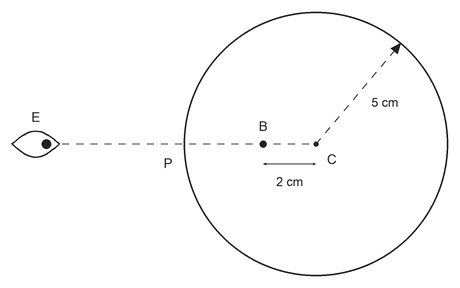
The given figure shows a solid glass sphere of radius 5 cm that has a small air bubble () trapped at a distance of 2 cm from the centre . The refractive index of the material of the glass is 1.5. Find the apparent position of the bubble where it will appear, when seen through the surface of the sphere from the outside point .
- 593 marks
Question 59
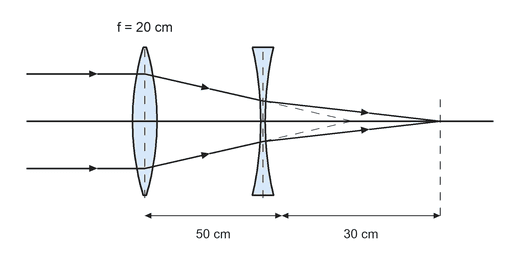
Calculate the focal length of the concave lens with the help of the given figure. Focal length of convex lens is 20 cm.