
Question 271 markEasy
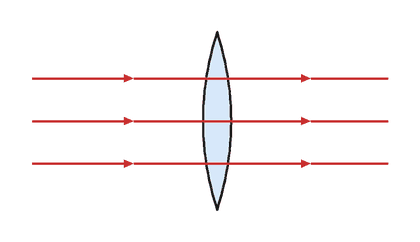
In the given figure, path of a parallel beam of light passing through a convex lens of refractive index kept in a medium of refractive index is shown. Is (i) or (ii) or (iii) ?
Confirming your payment
Sign up now and get 250 free tokens.
Refraction of Light at Spherical Surfaces - Lenses · Question 27 of 88
In the given figure, path of a parallel beam of light passing through a convex lens of refractive index kept in a medium of refractive index is shown. Is (i) or (ii) or (iii) ?
Solution:
Key idea: A lens bends light only if its refractive index differs from that of the surrounding medium. In a medium, , where is the refractive index of the surrounding medium.
Step 1 — Read the figure.
In the figure the parallel beam passes through the convex lens without any bending: it neither converges nor diverges.
Step 2 — Link this to the formula.
A beam that is not bent means the lens has no power, so . The second bracket is not zero for a convex lens, so the first bracket must be zero.
If the beam would converge, and if it would diverge, so (ii) and (iii) do not fit the figure.
Note: The stem calls the index of the surrounding medium and then ; both mean the refractive index of the medium in which the lens is kept.
Therefore, case (i) holds: , so the lens has no power and the beam passes through undeviated.