
Opening your dashboard
Class 11 Physics Chapter 18: Thermodynamics Solutions
58 textbook questions with step-by-step answers, free to read, for ISC 2026-27.
Get talked through Ch 18, not just shown the answer
Reading a finished solution is not the same as being able to do it. The AI tutor takes one question at a time and works it with you, in your own words, until you can.
- Ask it out loud, in your own words
- It gives you the next step, not the answer
- Stuck on part (ii)? Start there
58 questions with solutions
1–5 marks · Mixed difficulty
The first 34 solutions are on this page. This chapter is a long one, so the rest open on their own page to keep this one quick to load.
- 11 mark
Question 1
The internal energy is a unique function of any state because change in
Solve with AIAnswer
- Correct
(A) does not depend upon path
(B) depends upon path
(C) corresponds to an adiabatic process
(D) corresponds to an isothermal process
Answer: (A) does not depend upon path
Concept: A quantity is a function of state (a state function) when its value is fixed by the state of the system alone (its pressure, volume and temperature), however the system reached that state.
Step 1 — Recall how behaves. When a system goes from state 1 to state 2, the change is the same along every path joining the two states, although the heat and the work are different on different paths.
Step 2 — Draw the conclusion. Because the change in depends only on the end states and not on the path, has one definite value in each state; that is what "a unique function of state" means.
- (B) It is heat and work that depend on the path; if depended on the path, could not have a single value in a given state.
- (C) An adiabatic process is only one particular path (); is a state function for every kind of process.
- (D) An isothermal process is also only one particular path; for an ideal gas along it, but that is not why is a function of state.
Therefore, the answer is (A): U is a function of state because its change does not depend on the path.
- 21 mark
Question 2
Internal energy per mole of gas depends on
Solve with AIAnswer
(A) viscosity
(B) density
- Correct
(C) temperature
(D) thermal conductivity
Answer: (C) temperature
Concept: The internal energy of an ideal gas is the total kinetic energy of the random motion of its molecules. There are no forces between the molecules, so there is no potential energy, and the mean kinetic energy depends only on the absolute temperature.
Step 1 — Write the internal energy of one mole. For one mole of an ideal gas the internal energy is
For example, a monatomic gas has .
Step 2 — Read off what it depends on. The only variable in this expression is the absolute temperature , so the internal energy per mole depends on the temperature: when the temperature rises, the internal energy rises. (For a real gas it also depends slightly on the volume, because of the weak forces between the molecules, but the temperature is still the main factor.)
- (A) Viscosity describes how momentum is carried between layers of a flowing gas; it is not what fixes the energy stored in the molecules.
- (B) At a fixed temperature, the internal energy per mole of an ideal gas is the same whether the gas is compressed (dense) or expanded (rare).
- (D) Thermal conductivity describes how fast heat flows through the gas, not how much energy one mole contains.
Therefore, the answer is (C): the internal energy per mole of a gas depends on its temperature.
- 31 mark
Question 3
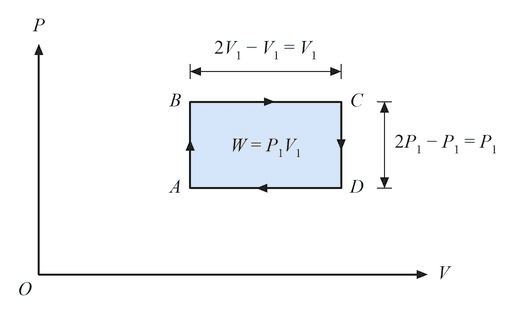
An ideal non-atomic gas is taken round the cycle in the diagram, as shown in the figure, where the coordinates of the points are:
; ; and .

The work done during the cycle is
Solve with AIAnswer
- Correct
(A)
(B)
(C)
(D) zero
Answer: (A)
Concept: In a cyclic process the net work done equals the area enclosed by the loop on the – diagram. It is positive (work done by the gas) when the loop is traced clockwise, with pressure up and volume across.
Step 1 — Find the sides of the loop. The loop is a rectangle. Its width is the change of volume from to :
Its height is the change of pressure from to :
Step 2 — Find the enclosed area. We multiply the width by the height:
Step 3 — Check the sign. The gas expands along at the higher pressure and is compressed along at the lower pressure , so the loop is traced clockwise and the net work done by the gas is positive.
- (B) is the work done in the expansion alone, ; it leaves out the work done on the gas during the compression .
- (C) would be the area of a triangle with these sides; the loop here is a rectangle.
- (D) In a cycle , but the net work is not zero; it equals the net heat taken in, which is the enclosed area.
Note: The word "non-atomic" in the stem is a misprint (probably "monoatomic"); the work done is the enclosed area for any gas, so the answer does not depend on the kind of gas.
Therefore, the answer is (A): the work done during the cycle is .
- 41 mark
Question 4
A given system undergoes a change in which the work done by the system equals the decrease in its internal energy. The system must have undergone an
Solve with AIAnswer
(A) isothermal change
- Correct
(B) adiabatic change
(C) isobaric change
(D) isochoric change
Answer: (B) adiabatic change
Concept: By the first law of thermodynamics, , where is the heat supplied to the system, the increase in its internal energy and the work done by it.
Step 1 — Write the given condition. The work done equals the decrease in internal energy:
Step 2 — Put it into the first law. We substitute this value of in the first law:
Step 3 — Name the process. A change in which no heat enters or leaves the system is an adiabatic change.
- (A) In an isothermal change of an ideal gas , so the work done equals the heat taken in, not a decrease in internal energy.
- (C) In an isobaric change heat is generally exchanged (, not zero), so the work done is not equal to the fall in internal energy.
- (D) In an isochoric change the volume is constant, so no work is done at all.
Therefore, the answer is (B): the system has undergone an adiabatic change.
- 51 mark
Question 5
The first law of thermodynamics is a special case of
Solve with AIAnswer
(A) Newton's law
- Correct
(B) the law of conservation of energy
(C) Charles's law
(D) the law of heat exchange
Answer: (B) the law of conservation of energy
Concept: The first law, , says that the heat given to a system is used partly to raise its internal energy and partly to do work. Heat, internal energy and work are all forms of energy.
Step 1 — Read the law as an energy balance. The energy put in as heat equals the energy stored plus the energy given out as work, so no energy is created or destroyed.
Step 2 — Identify the general law. This is exactly the law of conservation of energy, applied to processes that involve heat and work.
- (A) Newton's laws deal with forces and motion; they say nothing about heat or internal energy.
- (C) Charles's law relates the volume and temperature of a gas at constant pressure; it is a gas law, not an energy law.
- (D) The law of heat exchange (heat lost = heat gained in calorimetry) is itself a narrow case of energy conservation with no work done; the first law is the more general statement that includes work, so it cannot be a special case of it.
Therefore, the answer is (B): the first law of thermodynamics is a special case of the law of conservation of energy.
- 61 mark
Question 6
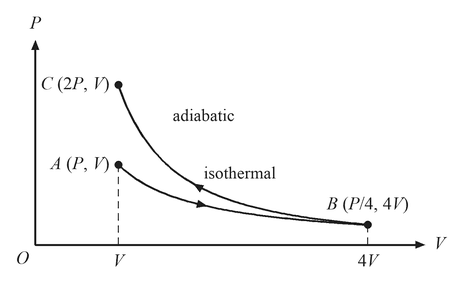
A mass of ideal gas at pressure is expanded isothermally to four times the original volume and then slowly compressed adiabatically to its original volume. Assuming to be 1.5, the new pressure of the gas is
Solve with AIAnswer
- Correct
(A)
(B)
(C)
(D)
Answer: (A)
Concept: In an isothermal change = constant (Boyle's law).
In an adiabatic change = constant.
Step 1 — Find the pressure after the isothermal expansion. Let the original volume be . The volume becomes at constant temperature, so
Step 2 — Apply the adiabatic relation to the compression. The gas is compressed adiabatically from volume (pressure ) back to volume , reaching pressure :
Step 3 — Substitute the given value of . Here is 1.5; since is 2 and is 8, the factor is 8:
- (B) is what an isothermal compression back to would give, ; an adiabatic compression heats the gas, so the pressure rises more.
- (C) comes from raising 4 to the power 2 instead of 1.5, since .
- (D) comes from using the power of in the – relation, or 0.5, instead of ; then .
Therefore, the answer is (A): the new pressure of the gas is 2P.
- 71 mark
Question 7
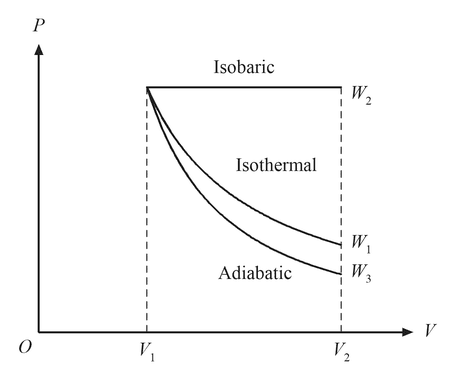
Starting from the same initial conditions, an ideal gas expands from volume to in three different ways, as shown in the figure. The work done by the gas is if the process is purely isothermal, if purely isobaric and if purely adiabatic.
Then
Solve with AIAnswer
- Correct
(A)
(B)
(C)
(D)
Answer: (A)
Concept: The work done by a gas in an expansion equals the area under its curve on the – diagram, between the volumes and .
Step 1 — Compare how the pressure falls. All three processes start from the same point. In the isobaric expansion the pressure stays at its starting value. In the isothermal expansion it falls as . In the adiabatic expansion it falls faster still, as with , because the gas also cools.
Step 2 — Compare the areas. So, between and , the isobaric line lies highest, the isothermal curve next, and the adiabatic curve lowest. The areas under them are in the same order.
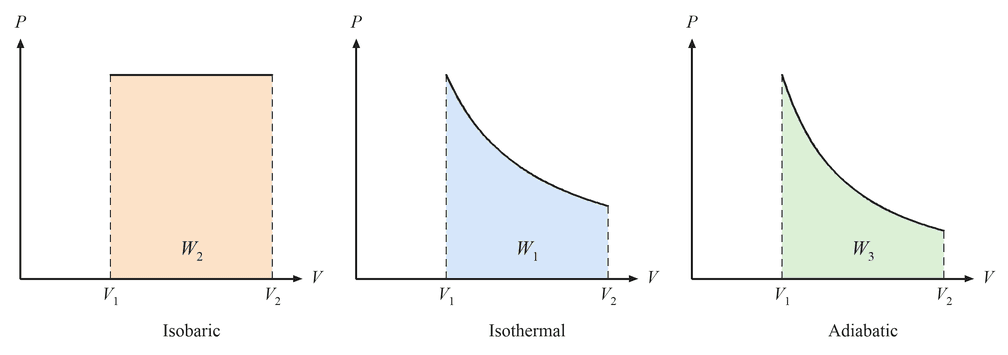
Step 3 — Write the order of the works. The isobaric work is , the isothermal work and the adiabatic work :
- (B) This puts the adiabatic work above the isothermal work, but the adiabatic curve lies below the isothermal curve, so its area is smaller.
- (C) This puts the isothermal work above the isobaric work, but the pressure stays highest in the isobaric process, so its area is the largest.
- (D) This makes the isobaric work the smallest, when it is in fact the largest of the three.
Therefore, the answer is (A): W₂ > W₁ > W₃.
- 81 mark
Question 8
plots for two gases during adiabatic processes are shown in the given figure.

Plots 1 and 2 should correspond respectively to
Solve with AIAnswer
(A) He and O
- Correct
(B) O and He
(C) He and Ar
(D) O and N
Answer: (B) O and He
Concept: For an adiabatic process = constant. Differentiating, the slope of an adiabatic curve is
So, at the same point, the curve with the larger falls more steeply.
Step 1 — Write the values of . A monatomic gas such as He has , about 1.67.
A diatomic gas such as O has , or 1.4.
Step 2 — Compare the two plots. Both plots start from the same point, and plot 2 falls more steeply than plot 1. So plot 2 belongs to the gas with the larger (He) and plot 1 to the gas with the smaller (O).

- (A) This is the reverse: it gives the steeper plot 2 to O, which has the smaller .
- (C) He and Ar are both monatomic, with the same , so their adiabatic curves from the same point would coincide.
- (D) O and N are both diatomic, with the same , so their curves would also coincide.
Note: The book's printed key is "He and O₂", with a hint that the slope is proportional to T. The slope of an adiabatic curve is −γP/V, so the steeper plot 2 must be helium; the correct answer is O₂ for plot 1 and He for plot 2.
Therefore, the answer is (B): plot 1 is O₂ and plot 2 is He.
- 91 mark
Question 9
In an adiabatic change, the pressure and temperature of monatomic gas are related as where equal
Solve with AIAnswer
(A)
- Correct
(B)
(C)
(D)
Answer: (B)
Concept: For an adiabatic change of an ideal gas, = constant and .
Eliminating between them gives = constant.
Step 1 — Eliminate . From , . We put this into = constant:
Step 2 — Write as a power of . Taking the power of both sides gives as a power of :
Comparing this with gives the power :
Step 3 — Put in for a monatomic gas. A monatomic gas has , so :
- (A) is the reciprocal: it is the power in , not in .
- (C) is , the power that appears in , not in the – relation.
- (D) is itself, the power of in = constant.
Therefore, the answer is (B): C = 5/2.
- 101 mark
Question 10
Slope of and for an isobaric process will be
Solve with AIAnswer
(A)
- Correct
(B) zero
(C)
(D)
Answer: (B) zero
Concept: An isobaric process takes place at constant pressure. On a graph of pressure against volume (the – diagram) it is therefore a horizontal straight line.
Step 1 — Read the stem as the – graph. We take the graph between and . During the process the volume changes from to , while the pressure keeps one value .
Step 2 — Find the slope. The slope of the graph is the change in divided by the change in :
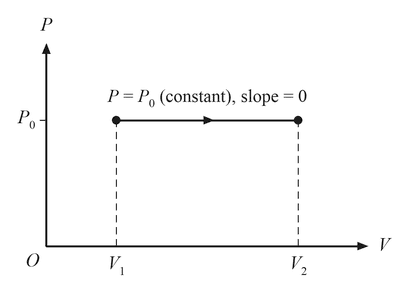
- (A) A slope of belongs to the – graph of an isothermal process ( = constant), not to an isobaric process.
- (C) A slope of would mean the pressure grows in step with the volume; at constant pressure it does not change at all.
- (D) is the value of the product for an ideal gas, not the slope of a graph.
Note: The book's printed key is +1. On the P–V graph an isobar is horizontal, so its slope is 0; if the stem is read as the graph of the product PV against V, the slope is P itself, which is not +1 either. The correct answer is zero.
Therefore, the answer is (B): the slope is zero.
- 111 mark
Question 11
“A matchstick can be lighted by rubbing it against a rough surface”. Why?
Solve with AIWritten solution
Solution:
Concept: Work done against friction is converted into heat; this is one example of the equivalence of work and heat.
Step 1 — Follow the energy. When the match head is rubbed against the rough surface, work is done against friction. This work is converted into heat at the head.
Step 2 — See why it lights. The heat raises the temperature of the match head to its ignition temperature, so the chemicals in it catch fire.
Therefore, the work done against friction is converted into heat, which raises the match head to its ignition temperature and lights it.
- 121 mark
Question 12
“Water is slightly warmer at the base of a water fall than at the top”. Why?
Solve with AIWritten solution
Solution:
Concept: Energy is conserved: mechanical energy that disappears appears as internal energy (heat).
Step 1 — Follow the energy of the falling water. As the water falls, its potential energy becomes kinetic energy. When it strikes the bottom and comes to rest, this kinetic energy is converted into heat, which warms the water.
Step 2 — Estimate the size of the effect. If all the energy stays in the water, , so .
With and , this is about for every of fall, which is why the water is only slightly warmer.
Therefore, the potential energy of the water at the top is converted into heat at the bottom, which raises its temperature slightly.
- 131 mark
Question 13
“It is not advisable to put on wet clothes”. Why?
Solve with AIWritten solution
Solution:
Concept: To evaporate, water needs a large amount of heat (latent heat of vaporisation, about at body temperature), and water also has a high specific heat capacity.
Step 1 — See how the clothes take heat from the body. The water in wet clothes must first be warmed by the body, which takes much heat because of the high specific heat of water. The water then evaporates, and the large latent heat needed for this is also taken from the body.
Step 2 — State the result. The body loses much more heat than usual, so its temperature can fall below normal and the person may catch a chill.
Therefore, wet clothes take away a large amount of heat from the body (to warm the water, which has a high specific heat, and above all to evaporate it), so the body temperature may fall below normal.
- 141 mark
Question 14
Is it possible that the specific heat capacity of a gas is zero as well as infinity?
Solve with AIWritten solution
Solution:
Concept: The specific heat capacity of a gas in a process is , the heat supplied per unit mass per unit rise in temperature. Its value depends on the process.
Step 1 — Find a process with zero specific heat. In an adiabatic process no heat is supplied (), but the temperature changes, so .
Step 2 — Find a process with infinite specific heat. In an isothermal process heat is supplied but the temperature does not change (), so is infinite.
Therefore, yes: the specific heat of a gas is zero in an adiabatic process and infinite in an isothermal process.
- 151 mark
Question 15
Is it possible to heat a body without causing any rise in temperature?
Solve with AIWritten solution
Solution:
Concept: Heat supplied to a body need not raise its temperature; it may be used to change its state or to do work (first law, ).
Step 1 — Give a change of state. While ice melts at or water boils at , heat is supplied but the temperature stays constant; the heat (latent heat) changes the state.
Step 2 — Give a gas example. In an isothermal expansion of an ideal gas, all the heat supplied is used to do work, and the temperature does not rise.
Therefore, yes: during a change of phase (melting, boiling) or an isothermal expansion of a gas, heat is supplied without any rise in temperature.
- 161 mark
Question 16
Mention two factors on which the degrees of freedom of a gas depends.
Solve with AIWritten solution
Solution:
Concept: The degrees of freedom of a molecule are the independent ways in which it can move and store energy (translation, rotation, vibration).
Step 1 — First factor: atomicity (structure of the molecule). A monatomic molecule has 3 (translational) degrees of freedom; a diatomic or linear molecule has 5 at ordinary temperatures (3 translational, 2 rotational); a non-linear molecule has 6.
Step 2 — Second factor: temperature. At high temperatures the vibrational motions are also excited, which adds more degrees of freedom.
Therefore, the degrees of freedom of a gas depend on the atomicity (structure) of its molecules and on the temperature.
- 171 mark
Question 17
Which gas has higher specific heat capacity, a monatomic or diatomic gas at room temperature?
Solve with AIWritten solution
Solution:
Concept: By the law of equipartition of energy, each degree of freedom contributes to the molar specific heat at constant volume, .
Step 1 — Find for each gas. A monatomic gas has 3 degrees of freedom, so . A diatomic gas at room temperature has 5, so .
Step 2 — Compare them. Since , the diatomic gas has the higher molar specific heat (and likewise against ).
Note: Per kilogram the comparison also depends on the molar mass; helium, with a very small molar mass, has a larger specific heat per kilogram than oxygen.
Therefore, the diatomic gas has the higher (molar) specific heat capacity: C_v = 5R/2 for a diatomic gas against 3R/2 for a monatomic gas.
- 181 mark
Question 18
“An iron nail becomes hot when it is hammered”. Why?
Solve with AIWritten solution
Solution:
Concept: Mechanical work can be converted into internal energy (heat).
Step 1 — Follow the energy of the hammer. Each blow brings the moving hammer to rest on the nail. Its kinetic energy does work in deforming the nail and is converted into heat.
Step 2 — State the result. This heat increases the internal energy of the nail, so its temperature rises.
Therefore, the kinetic energy of the hammer is converted into heat in the nail, which raises its temperature.
- 191 mark
Question 19
What is the change in internal energy of a system undergoing a cyclic process at the end of a cycle?
Solve with AIWritten solution
Solution:
Concept: Internal energy is a function of state: it depends only on the state of the system, not on how the state was reached.
Step 1 — Use the definition of a cycle. At the end of a cyclic process the system is back in its initial state.
Step 2 — Find the change. Since the final and initial states are the same, their internal energies are equal, so .
Therefore, the change in internal energy at the end of a cycle is zero.
- 201 mark
Question 20
Name the process during which there is no change in internal energy, even though heat is absorbed by the system.
Solve with AIWritten solution
Solution:
Concept: The internal energy of an ideal gas depends only on its temperature, and the first law gives .
Step 1 — Find when . If the temperature stays constant, , so : all the heat absorbed is used to do work.
Step 2 — Name the process. A process at constant temperature in which the gas absorbs heat and expands is an isothermal expansion.
Therefore, the process is an isothermal expansion (of an ideal gas).
- 211 mark
Question 21
Is it possible to increase the temperature of a gas without adding heat to it? If so, how?
Solve with AIWritten solution
Solution:
Concept: By the first law, , where is the heat given to the gas and is the work done by the gas.
When no heat is added, is zero, so this becomes .
Step 1 — Do work on the gas without heat. If the gas is compressed adiabatically, no heat is added, but work is done on it, so is negative and is positive.
Step 2 — State the result. The internal energy increases, so the temperature of the gas rises (a bicycle pump becomes warm for this reason).
Therefore, yes: by compressing the gas adiabatically, the work done on it raises its internal energy and so its temperature.
- 221 mark
Question 22
“On removing the valve, the air escaping from a cycle tube becomes cool”. Why?
Solve with AIWritten solution
Solution:
Concept: In an adiabatic expansion no heat enters the gas, so the work it does comes out of its internal energy ().
Step 1 — See why the expansion is adiabatic. The high-pressure air rushes out through the narrow valve very quickly, so there is no time for heat to flow into it.
Step 2 — Explain the cooling. As the air expands it does work against the atmosphere. This work is taken from its internal energy, so its temperature falls.
Therefore, the compressed air undergoes a sudden (adiabatic) expansion, does work at the expense of its internal energy and so cools.
- 231 mark
Question 23
at one atmosphere pressure and temperature is compressed isothermally. Does it go through a liquid phase?
Solve with AIWritten solution
Solution:
Concept: On the phase diagram of carbon dioxide, liquid can exist only above the triple point, at and . At solid sublimes at , so at and the is a vapour.
Step 1 — Follow the isothermal line at . Compressing at constant temperature moves the state straight up the phase diagram. At the line meets the solid–vapour curve (at about ), and above it lies the solid region.
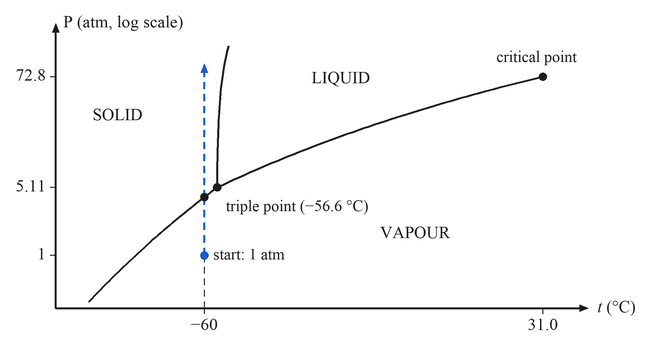
Step 2 — Compare with the triple point. Since is below the triple-point temperature of , the line never enters the liquid region, however high the pressure.
Therefore, no: the CO₂ vapour condenses directly into solid (dry ice) without passing through the liquid phase.
- 241 mark
Question 24
Milk is poured into a cup of tea and is mixed with a spoon. Is this an example of a reversible process? Give reason in support of your answer.
Solve with AIWritten solution
Solution:
Concept: A process is reversible only if it can be retraced in the opposite direction, through the same states, so that the system and its surroundings both return to their initial states.
Step 1 — Look at the mixing. Once milk and tea are mixed, they never separate again by themselves; stirring the other way does not unmix them.
Step 2 — Look at the energy. The work done by the spoon in stirring is converted into heat in the liquid by friction (viscosity), and this heat cannot be turned back into that work.
Therefore, no: it is an irreversible process, because the mixing cannot undo itself and the work done in stirring is turned into heat that we cannot get back.
- 251 mark
Question 25
What is the effect of pressure on the fusion and boiling point of water?
Solve with AIWritten solution
Solution:
Concept: A substance that contracts on melting (as ice does) has its melting point lowered by pressure; for every liquid, the boiling point is the temperature at which its vapour pressure equals the external pressure.
Step 1 — Effect on the melting point. Ice contracts when it melts (water is denser than ice), so an increase of pressure lowers the melting point of ice, by about per atmosphere.
Step 2 — Effect on the boiling point. An increase of pressure raises the boiling point of water (to about in a pressure cooker); a decrease lowers it.
Therefore, an increase of pressure raises the boiling point of water and lowers its melting (fusion) point.
- 261 mark
Question 26
What is the effect of decrease of pressure on the fusion and boiling point of ?
Solve with AIWritten solution
Solution:
Concept: Carbon dioxide expands on melting (its solid is denser than its liquid), so, unlike ice, its melting point rises with pressure and falls when the pressure is lowered. The boiling point of every liquid falls when the pressure falls.
Step 1 — Effect on the melting point. A decrease of pressure lowers the melting point of .
Step 2 — Effect on the boiling point. A decrease of pressure also lowers the boiling point of liquid .
Note: Below the triple-point pressure of 5.11 atm, liquid CO₂ cannot exist at all; at 1 atm solid CO₂ (dry ice) changes directly into vapour at −78.5 °C.
Therefore, a decrease of pressure lowers both the melting (fusion) point and the boiling point of CO₂.
- 272 marks
Question 27
Explain first law of thermodynamics. What is its physical significance?
Solve with AIWritten solution
Solution:
Concept: Heat and work are both ways of transferring energy, and the internal energy of a system is the energy stored in it. The first law of thermodynamics links these three quantities.
Step 1 — State the law. When a quantity of heat is supplied to a system, part of it increases the internal energy of the system by and the rest is used by the system to do external work :
Here is positive when heat is given to the system, and is positive when the system does work (for example, when a gas expands).
Step 2 — Give its physical significance. The law is the principle of conservation of energy applied to heat and work. It shows that heat is a form of energy, that work can be obtained only at the expense of heat supplied or of the internal energy of the system, and that heat can be produced only by using up some other form of energy.
Step 3 — Name the consequence. No machine can produce work continuously without an equal input of energy, so a perpetual motion machine of the first kind is impossible.
Therefore, the first law states that the heat given to a system equals the increase in its internal energy plus the work done by it (Q = ΔU + W); physically it is the law of conservation of energy, so heat can be produced or work obtained only at the expense of some other form of energy.
- 282 marks
Question 28
Define internal energy of a gas.
Solve with AIWritten solution
Solution:
Concept: The molecules of a gas move at random (kinetic energy) and, in a real gas, also attract one another weakly (potential energy).
Step 1 — Define internal energy. The internal energy of a gas is the sum of the kinetic energies and the potential energies of all its molecules. It is the total energy content of the gas due to the motion and the arrangement of its molecules (not counting the motion of the gas as a whole).
Step 2 — Apply it to an ideal gas. In an ideal gas there are no forces between the molecules, so there is no potential energy and the internal energy is purely kinetic. It then depends only on the temperature: for moles, .
Step 3 — Note its nature. Internal energy is a function of state: its change depends only on the initial and final states, not on the path.
Therefore, the internal energy of a gas is the sum of the kinetic and potential energies of all its molecules; for an ideal gas it is purely kinetic and depends only on temperature.
- 292 marks
Question 29
Show that heat is a path function.
Solve with AIWritten solution
Solution:
Concept: By the first law, . The change depends only on the initial and final states, but the work equals the area under the path on the – diagram, so it depends on the path.
Step 1 — Take two paths between the same states. Let a gas go from state A to state B in two ways, shown in the figure: path 1, (expansion at the higher pressure, then cooling at constant volume), and path 2, (cooling at constant volume, then expansion at the lower pressure).
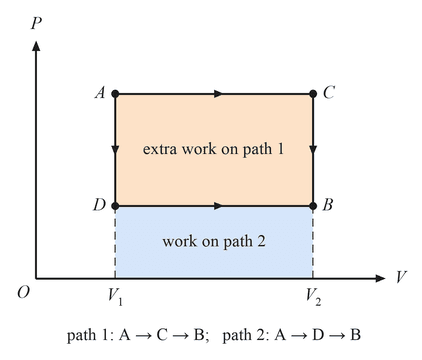
Step 2 — Compare the work done. On path 1 the gas expands at the higher pressure, so the area under the path (the work) is larger; on path 2 it expands at the lower pressure, so the work is smaller:
Step 3 — Compare the heat taken in. Both paths start at A and end at B, so is the same for both. The first law gives the heat taken in along each path:
Since while is the same, it follows that .
Therefore, the heat taken in between the same two states is different along different paths (it depends on the intermediate stages the system passes through), so heat is a path function.
- 302 marks
Question 30
Explain what is meant by a diagram. What information do you get from a diagram?
Solve with AIWritten solution
Solution:
Concept: The state of a fixed mass of gas is described by its pressure and volume (its temperature then follows from the gas equation).
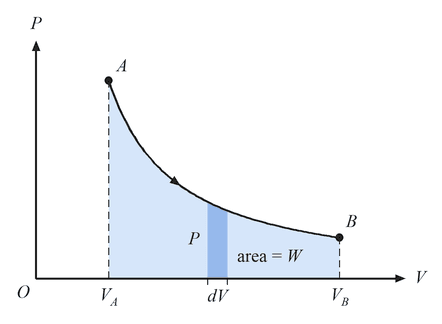
Step 1 — Say what a diagram is. A graph drawn by taking the volume of a system along the -axis and its pressure along the -axis is called a diagram (or indicator diagram). Each point on it is a state of the system, and a curve on it shows a process.
Step 2 — Read the work done from it. In a small change of volume at pressure , the work done is , the area of a thin strip under the curve. So the work done in a process is the area under the curve between the initial and final volumes:
Step 3 — List the other information. The diagram also shows the kind of process (horizontal line: isobaric; vertical line: isochoric; = constant: isothermal), whether work is done by the gas (volume increasing) or on it (volume decreasing), and, for a cycle, the net work as the area enclosed by the loop.
Therefore, a PV diagram is a graph of pressure against volume of a system; the area under its curve gives the work done by or on the system (the area enclosed by a loop gives the net work in a cycle).
- 312 marks
Question 31
What is the difference between (i) heat capacity, (ii) specific heat capacity and (iii) molar specific heat capacity?
Solve with AIWritten solution
Solution:
Concept: All three measure how much heat is needed to raise the temperature of a substance; they differ in the amount of substance considered.
Step 1 — Define heat capacity. The heat capacity of a body is the quantity of heat needed to raise the temperature of the whole body through 1 K (, unit ). It depends on the mass of the body.
Step 2 — Define specific heat capacity. The specific heat capacity is the heat needed to raise the temperature of unit mass (1 kg) of the substance through 1 K (, unit ).
Step 3 — Define molar specific heat capacity. The molar specific heat capacity is the heat needed to raise the temperature of 1 mole of the substance through 1 K (, unit ). It equals the specific heat capacity multiplied by the molar mass.
Therefore, heat capacity refers to the whole body, specific heat capacity to unit mass (1 kg) and molar specific heat capacity to one mole of the substance, each for a 1 K rise in temperature.
- 322 marks
Question 32
“A gas can have infinite number of specific heat capacities”. Justify this statement.
Solve with AIWritten solution
Solution:
Concept: The specific heat capacity of a gas is . A gas can be heated in many ways (its pressure and volume can both change), and by the first law the heat needed for the same rise in temperature depends on how much work the gas does.
Step 1 — Take the extreme cases. If the gas is compressed suddenly so that while the temperature rises by , then . If the gas absorbs heat while expanding at constant temperature, so that , then is infinite.
Step 2 — See the values in between. For one mole of an ideal gas taken along a path = constant, the molar specific heat is
This gives for (isobaric), for very large (isochoric), zero for (adiabatic) and an infinite value for (isothermal). It is even negative for .
Step 3 — Conclude. Since there are infinitely many possible paths, there are infinitely many values of the specific heat, from to .
Therefore, the specific heat of a gas depends on the process: it is zero in an adiabatic change, infinite in an isothermal change and has a different value for every other path, so a gas can have an infinite number of specific heats.
- 332 marks
Question 33
Define molar specific heat capacities of a gas at constant pressure and constant volume.
Solve with AIWritten solution
Solution:
Concept: Because a gas can be heated in many ways, two particular processes are used to define its principal specific heats: heating at constant volume and heating at constant pressure.
Step 1 — Define . The molar specific heat capacity at constant volume, , is the quantity of heat needed to raise the temperature of 1 mole of a gas through 1 K when its volume is kept constant:
Step 2 — Define . The molar specific heat capacity at constant pressure, , is the quantity of heat needed to raise the temperature of 1 mole of a gas through 1 K when its pressure is kept constant:
Step 3 — Compare them. At constant pressure the gas also expands and does work, so more heat is needed: , and for an ideal gas . Both are measured in .
Therefore, C_v is the heat needed to raise 1 mole of gas through 1 K at constant volume, and C_p is the heat needed to raise 1 mole through 1 K at constant pressure (C_p > C_v).
- 342 marks
Question 34
What is ? Obtain the value of for (i) monatomic, (ii) diatomic and (iii) triatomic gas.
Solve with AIWritten solution
Solution:
Concept: The quantity is the ratio of the two principal specific heats of a gas, . By the law of equipartition, a molecule with degrees of freedom has , and , so
Step 1 — Monatomic gas. A monatomic molecule has 3 translational degrees of freedom, so :
Step 2 — Diatomic gas. At ordinary temperatures a diatomic molecule has 3 translational and 2 rotational degrees of freedom, so :
Step 3 — Triatomic gas. A non-linear triatomic molecule (such as ) has 3 translational and 3 rotational degrees of freedom, so :
Note: A linear triatomic molecule such as CO₂ has only 2 rotational degrees of freedom, so, leaving out vibration, it has f = 5 and γ = 7/5. In practice the bending vibrations of CO₂ are already partly excited at room temperature, so its measured γ is about 1.29, and γ falls further as the temperature rises.
Therefore, γ = C_p/C_v, and its values are (i) 5/3 for a monatomic gas, (ii) 7/5 for a diatomic gas and (iii) 4/3 for a (non-linear) triatomic gas.
- 352 marks
Question 35
Derive an expression for the work done during an isothermal process.
- 362 marks
Question 36
Explain why adiabatic compression produces heating?
- 372 marks
Question 37
Derive an expression for the work done during adiabatic process.
- 382 marks
Question 38
Write down the relation for an adiabatic process in terms of (i) and (ii) and and (iii) and .
- 392 marks
Question 39
Explain the difference between isobaric and isochoric processes.
- 402 marks
Question 40
Draw diagrams to show (i) isobaric process and (ii) isochoric process.
- 412 marks
Question 41
The coolant in a chemical or nuclear plant should have high specific heat. Why?
- 422 marks
Question 42
Air pressure in a car tyre increases during driving. Why?
- 432 marks
Question 43
The climate of a harbour town is more temperate than that of a town in a desert at the same latitude. Why?
- 442 marks
Question 44
Two bodies at different temperatures and , if brought in thermal contact do not necessarily settle to the mean temperature . Why?
- 452 marks
Question 45
What is the value of specific heat during an adiabatic change?
- 462 marks
Question 46
What is the value of specific heat during an isothermal process?
- 472 marks
Question 47
Calculate the value of the ratio of final to initial volume of a gas, when it is compressed adiabatically till its temperature is doubled.
- 483 marks
Question 48
What is meant by thermal equilibrium? State and explain zeroth law of thermodynamics.
- 493 marks
Question 49
What is internal energy? State first law of thermodynamics. Express first law in mathematical form. Give its limitations.
- 503 marks
Question 50
Derive an expression for the work done during an isothermal process.
- 513 marks
Question 51
Derive an expression for the work done during an adiabatic process.
- 523 marks
Question 52
What is diagram? Show that the area bounded by graph gives the work done.
- 535 marks
Question 53
What are the two specific heat capacities of a gas and why are they different? Find the difference between the two molar heat capacities in terms of the constant .
- 545 marks
Question 54
An ideal gas has its volume doubled under (i) isothermal conditions and (ii) isobaric (constant pressure) conditions:
(i) Write down expressions for the work done by the gas in the two cases and calculate their ratio.
(ii) In which case does the internal energy of the gas increase?
- 555 marks
Question 55
Carefully bring out the concept of temperature from the Zeroth law of thermodynamics. State the first law of thermodynamics and differentiate between the internal energy and heat energy. To which of these energies is the temperature related?
- 565 marks
Question 56
The volume of an ideal gas is filled in a cylinder fitted with a piston at pressure . The volume of the gas is changed to each time by three different processes: (i) Change at constant pressure (ii) Adiabatic change (iii) Isothermal changes. Show these changes on diagram. State giving reason in which change the work done is maximum.
- 575 marks
Question 57
What is meant by (i) an adiabatic and (ii) an isothermal change of state of a gas.
An ideal gas is expanded adiabatically from volume to volume is then compressed isothermally to its original volume . Draw the curves representing the above changes. How will you show in your graph the net work done by the gas?
- 585 marks
Question 58
What are the two principal specific heat capacities of a gas and why are they different? Show that the difference between these specific heat capacities is given by , where , , are the pressure, density and temperature respectively.
What Class 11 Physics Ch 18 covers
The sections of the chapter, in the order the book takes them. Every question above comes from one of these.
- 01Thermal Equilibrium and the Zeroth Law
- 02Internal Energy
- 03Work and Heat
- 04Specific Heat Capacities of Gases
- 05First Law of Thermodynamics
- 06Isothermal Process
More ways to study this chapter
The same chapter asked three other ways. Practise it, revise it, and see what the board has set on Ch 18 before.
Class 11 Physics Ch 18 questions students ask
How many questions are there in Class 11 Physics Ch 18?
58 questions. Every one is solved step by step on this page.
Are these Class 11 Physics solutions free?
Yes. Every question and its full working is free to read, with no account needed.
Can I download the Class 11 Physics Ch 18 solutions as a PDF?
There is no PDF to download. Every solution is on this page instead, which means it is searchable, always the current syllabus, and readable on a phone. Use your browser's print option if you want it on paper.