Solution:
Concept: In an adiabatic change PVγ = constant; in an isothermal change PV = constant. The slope of an adiabatic curve, −γVP, is γ times the slope of an isothermal curve through the same point, −VP.
Step 1 — Define an adiabatic change. An adiabatic change is one in which no heat enters or leaves the gas (Q=0). It happens when the gas is in a perfectly insulated vessel or when the change is very sudden. The temperature changes: the gas cools on expansion and warms on compression, and PVγ = constant.
Step 2 — Define an isothermal change. An isothermal change is one in which the temperature of the gas stays constant. It happens when the gas is in a conducting vessel in contact with a large heat reservoir and the change is very slow, so heat can flow in or out. For an ideal gas ΔU=0 and PV = constant.
Step 3 — Draw the two curves. Starting at A (P1,V1), the gas expands adiabatically to B at volume V2, cooling as it does so. From B it is compressed isothermally (at the lower temperature of B) back to C at volume V1. Both curves pass through B, and the adiabatic curve is steeper, so towards smaller volumes it rises faster: the adiabatic curve AB lies above the isothermal curve BC. Hence C lies below A (the final pressure is lower than P1).
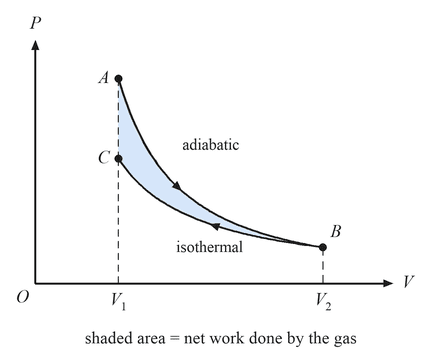
Step 4 — Find the net work done. In the adiabatic expansion the gas does work equal to the area under AB. In the isothermal compression work equal to the area under BC is done on the gas. The net work done by the gas is the difference:
Wnet=WAB−WBC
Since AB lies above BC, this is positive, and it equals the shaded area between the two curves (bounded by AB, BC and the line CA at volume V1).
Therefore, an adiabatic change takes place with no heat exchanged (PV^γ = constant) and an isothermal change at constant temperature (PV = constant); on the PV graph the adiabatic expansion AB lies above the isothermal compression BC, and the net work done by the gas is the area enclosed between the two curves and the line CA at V₁.
