Solution:
Concept: The principal specific heat capacities of a gas are cv, the heat needed to raise unit mass of the gas through 1 K at constant volume, and cp, the heat needed for the same rise at constant pressure. Here they are taken per unit mass (1 kg), because the density ρ appears in the result.
Step 1 — Explain why they differ. At constant volume the gas does no work, so all the heat increases its internal energy. At constant pressure the gas expands and does work against the outside pressure, so extra heat is needed for the same rise in temperature. Hence cp>cv.
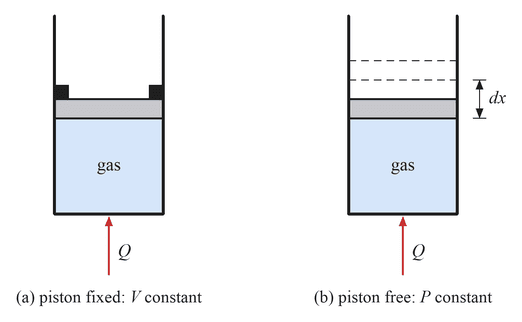
Step 2 — Write the first law for both heatings. Take 1 kg of an ideal gas of molar mass M, so it contains M1 moles. Heated at constant volume through dT, it does no work, so cvdT=dU. Heated through the same dT at constant pressure p, its internal energy rises by the same dU (it depends only on temperature), and it does work pdV:
cpdT=dU+pdV
cpdT=cvdT+pdV
Step 3 — Find pdV. For 1 kg of gas the gas equation is pV=MRT. At constant pressure a change dT gives
pdV=MRdT
Putting this into the result of Step 2 and dividing by dT gives the difference per kilogram:
cpdT=cvdT+MRdT
cp−cv=MR
Step 4 — Bring in the density. The density of the gas is ρ=volumemass, so for 1 kg, V=ρ1. The gas equation becomes
ρp=MRT
MR=ρTp
Step 5 — Combine. We put this into the result of Step 3:
cp−cv=ρTp
As a check, for air at 0∘C and 1 atm (p=1.013×10⁵ Pa, ρ=1.293 kg m−3, T=273 K) we get:
ρTp=1.293×2731.013×105 J kg−1K−1
ρTp≈287 J kg−1K−1
This equals MR for air (0.02908.31≈287).
Therefore, the two principal specific heats are c_v (constant volume) and c_p (constant pressure); c_p is larger because at constant pressure the gas also does work in expanding, and per unit mass their difference is Cp−Cv=ρTp (which equals R/M).
