Solution:
Concept: On a P–V diagram the work done in an expansion is the area under the curve. At constant pressure the line is horizontal; for an isothermal change PV = constant; for an adiabatic change PVγ = constant with γ>1.
Step 1 — Find the final pressure in each process. All three start at A (P,V) and end at volume 4V.
(i) At constant pressure the final pressure is P.
(iii) Isothermally, P×V=P3×4V, so P3=4P.
(ii) Adiabatically, PVγ=P2(4V)γ, so P2=4γP, which is less than 4P because γ>1 (for example, P2≈0.144P for γ=1.4).
Step 2 — Draw the three changes. The constant-pressure change is a horizontal line, the isothermal change a curve PV = constant, and the adiabatic change a steeper curve PVγ = constant, drawn below the isothermal curve (here for γ=1.4).
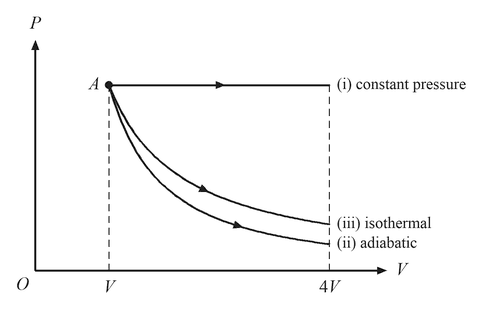
Step 3 — Compare the areas. Between V and 4V the horizontal line lies highest, the isothermal curve next and the adiabatic curve lowest, so the areas under them, and hence the works, are in the same order. For example, with γ=1.4:
W(i)=P(4V−V)
W(i)=3PV
W(iii)=PVln4
W(iii)≈1.39PV
W(ii)=γ−1PV−P2(4V)
W(ii)≈1.06PV
Step 4 — Give the reason. At constant pressure the pressure does not fall at all as the gas expands. In the isothermal change it falls as V1, and in the adiabatic change it falls even faster (as Vγ1) because the gas also cools, its work being paid for from its internal energy.
Therefore, the work done is maximum in the change at constant pressure (i), because its pressure stays highest throughout and so the area under its PV graph is the largest; the isothermal change comes next and the adiabatic change does the least work.
