Solution:
Concept: Bodies in thermal contact exchange heat until they reach thermal equilibrium, when there is no net flow of heat between them.
Step 1 — State the zeroth law. If two bodies A and B are each in thermal equilibrium with a third body C, then A and B are in thermal equilibrium with each other.
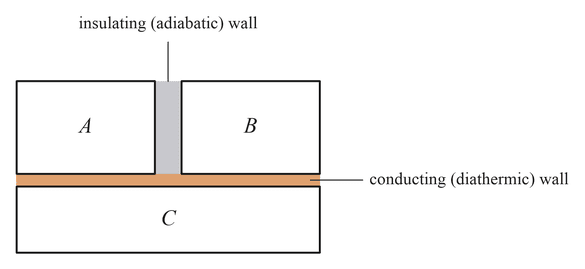
Step 2 — Bring out the concept of temperature. The zeroth law shows that all bodies in thermal equilibrium with one another share some property that has the same value for all of them. This property is called temperature. Two bodies are at the same temperature if no heat flows between them when they are placed in contact; if heat flows, it flows from the body at the higher temperature to the body at the lower temperature. The law also allows a thermometer (body C) to compare the temperatures of bodies that are never brought into contact.
Step 3 — State the first law. The heat ΔQ supplied to a system equals the increase ΔU in its internal energy plus the work ΔW done by the system:
ΔQ=ΔU+ΔW
Step 4 — Differentiate internal energy and heat. Internal energy is the energy contained in a system: the total kinetic and potential energy of its molecules. It is a property of the state of the system (a function of state). Heat is energy in transit: the energy that flows from one body to another because of a difference in temperature. A body "has" internal energy but does not "contain" heat; the heat exchanged depends on the path followed, not only on the initial and final states.
Step 5 — Relate temperature to one of them. Temperature is related to the internal energy. For an ideal gas the internal energy is the kinetic energy of random motion of the molecules, and the absolute temperature is proportional to their mean kinetic energy (21mv2=23kT), so U depends only on T.
Therefore, the zeroth law shows that bodies in thermal equilibrium share a common property, temperature; the first law is ΔQ = ΔU + ΔW; internal energy is the energy stored in a system (a state property) while heat is energy in transit due to a temperature difference; and temperature is related to the internal energy (the mean kinetic energy of the molecules).
