Solution:
Concept: The work done by a gas is the area under its curve on the P–V diagram. Isothermally, W=nRTlnV1V2; at constant pressure, W=P(V2−V1). The internal energy of an ideal gas depends only on its temperature.
Step 1 — Work done in the isothermal case. Let n moles of gas start at pressure P, volume V and temperature T, so PV=nRT. Doubling the volume isothermally (V→2V):
Wiso=nRTlnV2V
Wiso=nRTln2
Wiso=PVln2
Step 2 — Work done in the isobaric case. Doubling the volume at the constant pressure P:
Wp=P(2V−V)
Wp=PV
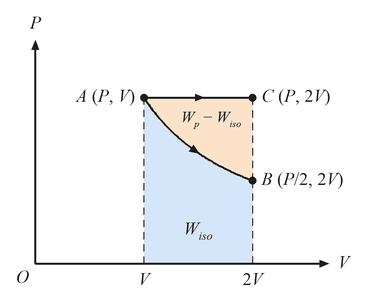
Step 3 — Find the ratio. We divide the two works:
WpWiso=PVPVln2
WpWiso=ln2
WpWiso≈0.693
So Wiso:Wp≈0.693:1; the isobaric expansion does more work, as the figure shows (its area is larger).
Step 4 — Compare the internal energies. In the isothermal case the temperature does not change, so ΔU=0. In the isobaric case TV is constant, so doubling the volume doubles the absolute temperature, from T to 2T; the internal energy increases by
ΔU=nCv(2T−T)
ΔU=nCvT
Therefore, (i) the isothermal work is nRT ln 2 (or PV ln 2) and the isobaric work is PV, so their ratio W_iso : W_p is ln 2 : 1, about 0.693 : 1; (ii) the internal energy increases only in the isobaric case, where the temperature doubles (in the isothermal case it does not change).
