
Question 535 marksMedium
What are the two specific heat capacities of a gas and why are they different? Find the difference between the two molar heat capacities in terms of the constant .
Confirming your payment
Sign up now and get 250 free tokens.
Thermodynamics · Question 53 of 58
What are the two specific heat capacities of a gas and why are they different? Find the difference between the two molar heat capacities in terms of the constant .
Solution:
Concept: A gas can be heated at constant volume or at constant pressure. The molar specific heat at constant volume, , is the heat needed to raise 1 mole of the gas through 1 K at constant volume; the molar specific heat at constant pressure, , is the heat needed for the same rise at constant pressure.
Step 1 — Name the two specific heats. The two principal specific heats of a gas are (at constant volume) and (at constant pressure).
Step 2 — Explain why they differ. When the gas is heated at constant volume, it does no work, so all the heat raises its internal energy. When it is heated at constant pressure, it expands and does work against the outside pressure, so extra heat is needed for the same rise in temperature. Hence .
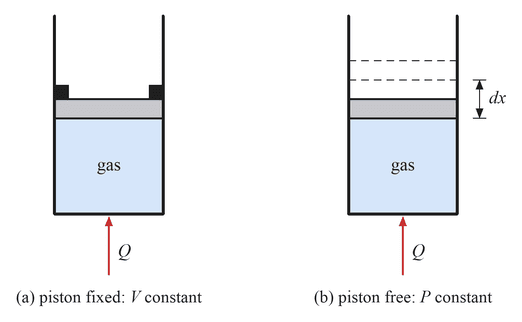
Step 3 — Heat one mole at constant volume. Let 1 mole of an ideal gas be heated through at constant volume. No work is done (), so by the first law
Step 4 — Heat one mole at constant pressure. Now let the same mole be heated through the same at constant pressure . Its volume increases by . The internal energy of an ideal gas depends only on temperature, so it again increases by , and the first law gives
Step 5 — Find from the gas equation. For 1 mole, . At constant pressure a change gives
Step 6 — Find the difference. We put this into the result of Step 4:
This is Mayer's relation. With , exceeds by for every ideal gas.
Therefore, the two specific heats are C_v (constant volume) and C_p (constant pressure); C_p is greater because at constant pressure part of the heat is used to do work in expansion, and the difference between the molar heat capacities is C_p − C_v = R.