Opening your dashboard
Class 11 Physics Chapter 18 Thermodynamics: Practice Questions
121 questions on Chapter 18, each worked through on its own page with the AI tutor. Class 11 Physics, ICSE 2026-27.
121 questions
1–4 marks · Mixed difficulty
- 11 mark
Question 1
Two rigid containers of gas, and , share a fixed copper wall. All their other walls are thermally insulating, as shown.
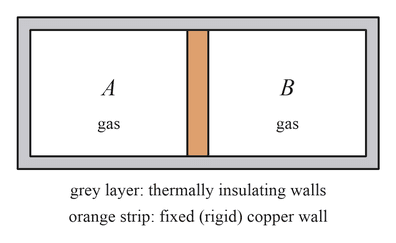
At first gas is hotter than gas . After a long time, nothing measurable about either gas changes any more. Which statement about the two gases is now correct?
- 23 marks
Question 2
(Hypothetical data.) A uniform copper rod, well lagged along its length, has one end in boiling water at and the other end in melting ice at . After some time the temperature at every point of the rod stops changing. It now falls uniformly along the rod, from at one end to at the other.
(a) Is the rod now in thermal equilibrium? Give a reason.
(b) Both ends are then taken out and covered with lagging, so that the whole rod is thermally insulated. Describe what happens, and find the final temperature of the rod. Take the specific heat capacity of copper to be the same at all these temperatures.
- 31 mark
Question 3
(Hypothetical data.) A block of copper and a block of aluminium, both at , are pressed together inside an insulated box. Copper conducts heat better than aluminium, and the specific heat capacity of aluminium () is more than twice that of copper (). What happens next?
- 41 mark
Question 4
(Hypothetical data.) One mole of helium at and one mole of nitrogen at are each treated as an ideal gas. Take the internal energy of helium as and that of nitrogen as , with . Which sample has the greater internal energy, and what are the two values?
- 51 mark
Question 5
(Hypothetical data.) A fixed amount of an ideal gas is sealed in a rigid container. It is warmed until its pressure is higher than at the start. What happens to its internal energy?
- 63 marks
Question 6
(Hypothetical data.) A fixed mass of an ideal monatomic gas, with , can be brought into any of these three states:
- state : and ;
- state : and ;
- state : and .
(a) Find the internal energy of the gas in each state.
(b) Find the change in internal energy for each of the changes , and , and add the three changes.
(c) A student says that the change in internal energy from to cannot be found without knowing how the gas was taken from to . Is the student right? Explain.
- 73 marks
Question 7
(Hypothetical data.) Two rigid, thermally insulated flasks are joined by a narrow tube with a closed tap, as shown.
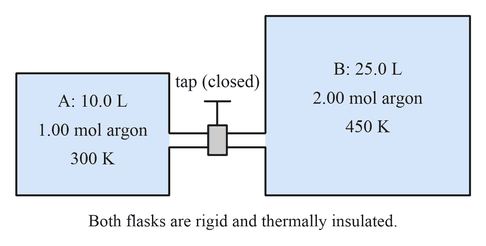
Flask () holds of argon at , and flask () holds of argon at . The tap is opened, and the gas is left until it is all at one temperature. Treat argon as an ideal monatomic gas with , take , and neglect the volume of the tube and any heat taken by the flasks.
(a) Explain why the total internal energy of the argon does not change.
(b) Find the final temperature.
(c) Find the final pressure.
- 83 marks
Question 8
(Hypothetical data.) of argon, an ideal monatomic gas with , is sealed in a rigid container. It is taken from to in two different ways.
- Way 1: the container has conducting walls and is warmed by a flame.
- Way 2: the container is thermally insulated, and a paddle wheel inside it, turned through a sealed shaft by a motor outside, stirs the gas.
Take .
(a) Find the change in the internal energy of the argon in each way.
(b) Find and for the argon in each way, with their signs.
(c) What do these results show about internal energy, heat and work?
- 91 mark
Question 9
Heat is energy that passes from one body to another only because of a difference in temperature. Consider these four cases.
P: A beaker of water warms up when a gas flame burns below it.
Q: A metal rod warms up when it is rubbed hard with sandpaper.
R: A black metal plate left in strong sunlight warms up.
S: The air in a bicycle pump warms up when the handle is pushed in quickly.
In which of them is the energy that warms the substance transferred as heat?
- 103 marks
Question 10
(Hypothetical data.) On a long drive in hot weather, the air in a car tyre warms up. Its pressure rises from to , and the tyre stretches a little, so the volume of the air rises from to . Assume that during this change the pressure rises steadily (linearly) with the volume, and that no air leaks. Treat the air as an ideal diatomic gas with .
(a) Find the work done by the air.
(b) Find the change in its internal energy.
(c) Find the heat absorbed by the air, and the fraction of this heat that is used in doing work.
- 111 mark
Question 11
To derive Mayer's relation , one mole of an ideal gas is heated through , first at constant volume and then at constant pressure. The extra heat needed at constant pressure is then set equal to the work done by the gas, . For this step to be valid, the gas must satisfy which condition?
- 121 mark
Question 12
(Hypothetical data.) Heliox, a breathing mixture of helium and oxygen, is used in medicine and in diving. A sample contains of helium () and of oxygen (). Treat the mixture as an ideal gas whose molar heat capacity is its total heat capacity at constant volume divided by the total number of moles. The ratio for the mixture is about
- 134 marks
Question 13
(Hypothetical data.) A student traps of a gas in a cylinder fitted with an electric heater and a piston, and does two runs. In run 1 the piston is clamped, and of heat raises the temperature of the gas by . In run 2 the piston is free, so the pressure stays constant, and of heat raises the temperature by the same . Heat taken by the cylinder can be neglected. Take .
(a) Find the molar heat capacities and of the gas.
(b) Find and compare it with .
(c) Find , and decide whether the gas behaves as a monatomic gas () or as a diatomic gas ().
(d) Find the work done by the gas in run 2.
- 141 mark
Question 14
Two light balloons hold equal volumes of helium and nitrogen at the same temperature and pressure. Each gas is then heated at constant pressure through the same small rise in temperature. Take for helium and for nitrogen. The ratio of the heat taken in by the helium to the heat taken in by the nitrogen is
- 151 mark
Question 15
(Hypothetical data.) A gas is compressed by doing of work on it, while of heat flows out of it into the surroundings. The first law is written , where is the heat supplied to the gas and is the work done by the gas. Which set of values is correct?
- 161 mark
Question 16
(Hypothetical data.) In each cycle, the gas in an engine absorbs of heat from a hot source and gives out of heat to the surroundings, and at the end of each cycle it is back in its starting state. The net work done by the gas in each cycle is
- 171 mark
Question 17
(Hypothetical data.) A sealed, rigid, thermally insulated box holds a gas and a small resistor of negligible heat capacity. Wires from the resistor pass through the wall of the box to a battery outside, as shown.

The battery drives a current through the resistor and delivers of electrical energy to it. Write the first law as , with the work done by the system. Which entry is correct, first taking the system to be the gas alone, and then taking it to be the gas together with the resistor?
- 183 marks
Question 18
(Hypothetical data.) A gas is taken once round a cycle and returns to its starting state.
- Along it absorbs of heat and does of work.
- Along it gives out of heat while of work is done on it.
- Along no heat enters or leaves it.
(a) Find the change in the internal energy of the gas along and along .
(b) Find the change in internal energy along , and the work done by the gas along .
(c) Find the net work done by the gas in one cycle, and check that it equals the net heat absorbed.
- 193 marks
Question 19
(Hypothetical data.) The outlet of a bicycle pump is blocked. The barrel holds of air at and . The handle is pushed in quickly, doing of work on the air, and during the push of heat leaks from the air into the barrel. Treat air as an ideal diatomic gas with , and take .
(a) Find the number of moles of air in the pump.
(b) Write and for the air, with their signs, and find .
(c) Find the rise in the temperature of the air.
- 203 marks
Question 20
(Hypothetical data.) During a -minute session on a rowing machine, a student does of work on the machine. Over the same time the chemical energy stored in the student's body falls by . Take the student's body as the system, and count its stored chemical energy as part of its internal energy.
(a) Write and for the body, with their signs.
(b) Use the first law to find the heat exchanged between the body and the surroundings, and say which way it flows.
(c) Find the efficiency of the body as a machine, and the average rate at which heat leaves the body.
- 213 marks
Question 21
(Hypothetical data.) of nitrogen, treated as an ideal diatomic gas with , is in a cylinder fitted with a piston. It absorbs of heat, and its temperature rises by . Take .
(a) Find the increase in its internal energy.
(b) Find the work done by the gas.
(c) A student claims that the gas was heated at constant pressure. Use to show that this cannot be true.
- 222 marks
Question 22
(Hypothetical data.) A gas absorbs of heat and does of work. A student writes and concludes that the internal energy of the gas falls by units.
(a) Explain the student's mistake.
(b) Find the correct change in internal energy, in joules and in calories. Take .
- 233 marks
Question 23
(Hypothetical data.) A high-speed blender can make hot soup without a stove. Its blades stir of soup and do work on it at a steady . The soup's specific heat capacity is , and its volume hardly changes.
(a) At the start the soup is at room temperature, so no heat flows between the jar and the room. Taking the soup as the system, write , and for one second of blending, and find the rate at which the soup's temperature rises.
(b) Later, when the soup is at , heat leaks from it to the room at . Write , and for one second at this stage, and find the new rate of temperature rise.
(c) The soup gets hot although no heat is given to it. Explain how this fits the first law.
- 241 mark
Question 24
A student wants to compress some air in a cylinder as nearly isothermally as possible. Which arrangement comes closest to an isothermal compression?
- 253 marks
Question 25
A cylinder standing in a large water bath holds of air at and at the temperature of the bath, under a piston. The piston is pushed in very slowly, so that the air stays at the temperature of the bath, and during this the air gives out of heat to the bath. Treat the air as an ideal gas. (Hypothetical data.)
(a) How much work is done on the air?
(b) Find the final volume of the air.
(c) Find its final pressure.
- 261 mark
Question 26
One mole of an ideal gas at expands slowly and isothermally from to , and then, still at , from to . Take . The work done by the gas in the second stage is
- 272 marks
Question 27
The isothermal bulk modulus of a gas is , where the change is made at constant temperature.
(a) Show that for an ideal gas the isothermal bulk modulus is equal to the pressure of the gas.
(b) Air at is compressed slowly at constant temperature until its pressure is . By what percentage does its volume decrease?
- 281 mark
Question 28
of an ideal gas at absorbs of heat while it expands slowly at constant temperature. Take . The final volume of the gas is about how many times its initial volume?
- 293 marks
Question 29
The figure shows two isotherms, 1 and 2, of the same of an ideal gas. At a volume of the pressure on isotherm 1 is and on isotherm 2 it is . Take .
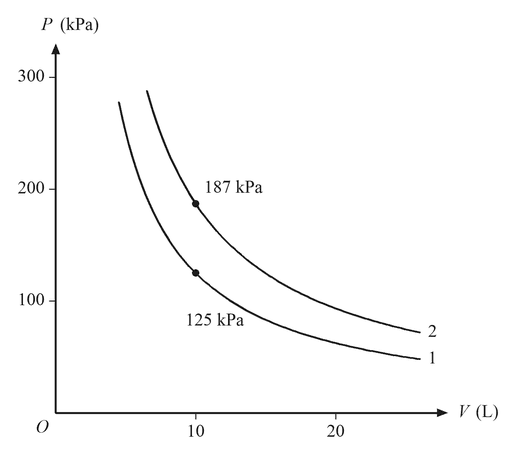
(a) Find the temperature of each isotherm. Which isotherm is the hotter one, and how can you tell this from the graph alone?
(b) The gas expands slowly along isotherm 2 from to . Find the heat it absorbs and its final pressure.
- 303 marks
Question 30
A diesel engine has no spark plug. Air drawn into a cylinder at and is compressed so quickly that hardly any heat escapes, and fuel is then sprayed into the hot air. A designer wants the air to be at least at the end of the compression stroke. Treat the compression as a reversible adiabatic change of an ideal gas with . (Hypothetical data.)
(a) Find the smallest compression ratio that does this.
(b) Find the pressure of the air at the end of this compression.
(c) Explain why the engine does not need a spark plug.
- 311 mark
Question 31
Helium () is in the state , . On a – graph, the slope of the reversible adiabatic curve through this state is
- 323 marks
Question 32
On a sunny day a parcel of dry air near the ground, at and , rises in a column of warm air. It rises so fast that it exchanges almost no heat with the air around it, and it expands adiabatically until its pressure has fallen to . Treat air as an ideal diatomic gas with , and take . (Hypothetical data.)
(a) Find the temperature of the parcel at the lower pressure.
(b) Find the work done by each mole of the air as it expands.
(c) Where does the energy for this work come from?
- 331 mark
Question 33
Air () at is squeezed so quickly that no heat can flow in or out, and its pressure rises by a small amount, . By about what percentage does its volume decrease?
- 341 mark
Question 34
Two identical cylinders hold the same amount of air () in the same initial state, with volume . The air in one is compressed slowly and isothermally, and the air in the other is compressed adiabatically, until in each case its pressure has doubled. The final volumes are about
- 351 mark
Question 35
The figure shows how the pressure of the same sample of an ideal gas changes with its absolute temperature in two separate experiments, 1 and 2, each carried out at a constant volume. At the pressure is on line 1 and on line 2.

Which statement is correct?
- 363 marks
Question 36
A constant-volume gas thermometer has a rigid glass bulb holding of helium, joined by a thin tube to a pressure sensor, as shown in the figure. With the bulb at the triple point of water, , the sensor reads ; with the bulb in a hot liquid it reads . Treat the helium as an ideal monatomic gas with , take , and ignore the gas in the tube and the expansion of the bulb. (Hypothetical data.)

(a) Find the temperature of the hot liquid.
(b) How much work does the helium do, and how much heat does it absorb, as it warms from to this temperature?
(c) Why is such a thermometer filled with a gas like helium at a low pressure?
- 373 marks
Question 37
(a) For an ideal gas heated at constant volume, show that the heat absorbed is , where is the molar specific heat at constant volume and is the rise in pressure.
(b) A rigid flask is closed with air inside at and . It is warmed until the pressure is . Taking for air and ignoring the expansion of the flask, find the heat absorbed by the air and its final temperature.
- 381 mark
Question 38
An ideal gas in a cylinder is compressed slowly at constant pressure, so that its volume falls. Which statement about the heat exchanged with the surroundings is correct?
- 393 marks
Question 39
In a laboratory experiment, of an ideal diatomic gas is heated slowly in a cylinder fitted with a freely moving piston. Its volume is at , at and at , as plotted in the graph. Take and . (Hypothetical data.)

(a) What does the straight line through the origin tell you about the process?
(b) Find the pressure of the gas.
(c) Find the work done by the gas and the heat it absorbs as it is heated from to .
- 403 marks
Question 40
A person breathes in of air at . Inside the lungs the air warms to body temperature, , while its pressure stays at . Treat the air as an ideal diatomic gas with , and ignore the water vapour that the lungs add to it. (Hypothetical data.)
(a) Find the volume of this air at body temperature.
(b) Find the work it does on its surroundings as it expands.
(c) Find the heat that the body gives to this air.
- 411 mark
Question 41
An ideal gas is taken once round the cycle shown in the figure, passing through state twice. is in litres and in units of .

The net work in one cycle is
- 421 mark
Question 42
A gas is taken once round the clockwise cycle shown, whose path on the – graph is an ellipse. Its volume varies between and and its pressure between and . Take , and the area of an ellipse with semi-axes and as .
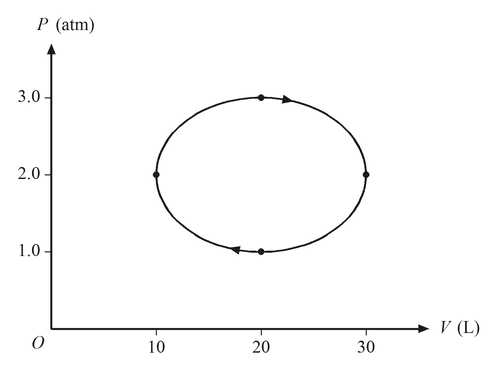
The net work done by the gas in one cycle is about
- 431 mark
Question 43
A student traces the indicator diagram of one cycle of a small engine onto graph paper. The loop is traversed clockwise and encloses squares; each square stands for along the pressure axis and along the volume axis. Taking , the net work done by the gas in one cycle is about
- 444 marks
Question 44
of an ideal gas expands slowly at from (state ) through (state ) to (state ), along the isotherm shown in the figure. Take .
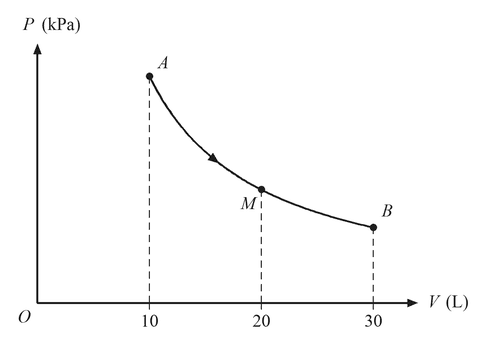
(a) Find the pressures at , and .
(b) Find the exact work done by the gas from to .
(c) Estimate the same work as the area under the indicator diagram by replacing the curve with (i) the single straight chord , (ii) the two chords and .
(d) Explain why both estimates are too large, and which one is better.
- 453 marks
Question 45
A student claims that an ideal gas with can be taken round a closed cycle in just two steps: a slow isothermal expansion from (, ) to (, ), followed by a reversible adiabatic compression from back to .
(a) Find the pressure the gas would actually reach when the adiabatic compression from brings its volume back to .
(b) Using the – indicator diagram, show that an isotherm and an adiabat of an ideal gas can meet at only one point, so that the student's cycle is impossible.
- 462 marks
Question 46
Distinguish between a closed system and an open system.
- 472 marks
Question 47
What is meant by zero isothermal?
- 482 marks
Question 48
Show that
- 492 marks
Question 49
Distinguish between isobaric and isochoric process.
- 502 marks
Question 50
Adiabatic expansion produces cooling, why?
- 512 marks
Question 51
Define latent heat of fusion and latent heat of vaporisation.
- 522 marks
Question 52
Can you cool a room by keeping the fridge open?
- 532 marks
Question 53
What is the use of the indicator diagram or diagram?
- 541 mark
Question 54
What is meant by a cyclic process?
- 552 marks
Question 55
What is significance of first law of thermodynamics?
- 562 marks
Question 56
Give the limitations of the first law of thermodynamics.
- 573 marks
Question 57
In the temperature range 0 to 1000°C, the average specific heat of copper is . If 2 kg of copper is heated from 0 to 1000°C, by how much does its mass increase?
- 583 marks
Question 58
The variation of specific heat capacity of a substance with temperature is given by , where and are constants and is the temperature. Calculate the mean specific heat in a temperature range to and the specific heat at the mid-point .
- 593 marks
Question 59
A geyser heats water flowing at the rate of 3.0 litre per minute from 27°C to 77°C. If the geyser operates on a gas burner, what is the rate of consumption of the fuel if its heat of combustion is J/g?
- 603 marks
Question 60
A 10 kW drilling machine is used to drill a bore in a small aluminium block of mass 8.0 kg. How much is the rise in temperature of the block in 2.5 minutes, assuming 50% of power is used up in heating the machine itself or lost to the surroundings? Specific heat of aluminium = .
- 613 marks
Question 61
The specific heat at constant volume of He is . Calculate its . Given .
- 623 marks
Question 62
A cylinder of fixed capacity contains 67.2 litres of helium gas at standard pressure and temperature. What is the amount of heat needed to raise the temperature of the gas by 30°C? Given .
- 633 marks
Question 63
Calculate the amount of heat that must be supplied to 40 g of nitrogen to raise its temperature by 45°C at constant pressure if it is at room temperature. .
- 643 marks
Question 64
Calculate the specific heat capacities at constant volume and at constant pressure for helium. Given , .
- 653 marks
Question 65
The specific heat capacity of hydrogen at constant pressure and constant volume are and respectively. Calculate the value of the universal gas constant.
- 663 marks
Question 66
The gas constant for one kg of oxygen is . Find the value of and in . .
- 673 marks
Question 67
Calculate the difference between the two principal specific heat capacities for hydrogen. Given density of hydrogen at a temperature of 270 K and pressure is .
- 683 marks
Question 68
If the ratio of principal specific heat capacities of a certain gas is 1.4 and its density at STP is , calculate the values of specific heat capacity at constant pressure and constant volume. [Standard atmospheric pressure = ]
- 693 marks
Question 69
Calculate the difference in temperature between the water at the top and bottom of Niagara falls of height 500 m assuming that the whole K.E. due to fall is converted into heat. Specific heat capacity of water is .
- 703 marks
Question 70
From what height must a piece of lead be dropped if the heat generated on impact with the ground is just sufficient to melt it. Assume that all the heat is confined to lead. The initial temperature of lead is 27°C and its final temperature is 327°C. Specific heat capacity of lead = J/kg/K. Latent heat of fusion of lead = J/kg.
- 713 marks
Question 71
A bullet moving with a velocity of 230 m/s is stopped by a block of wood. Calculate the rise in temperature of the bullet assuming that all the heat generated is retained by the bullet. Specific heat capacity of lead = 126 J/kg/K.
- 723 marks
Question 72
A lead bullet just melts when stopped by an obstacle. Assuming that 25% of heat is absorbed by the obstacle, find the velocity of the bullet if the initial temperature was 27°C. Melting point of lead = 327°C, specific heat of lead = . Latent heat of fusion of lead = .
- 733 marks
Question 73
From what height should a piece of ice be dropped so that three quarters of it may melt? Assume that 80% of energy of fall is retained by ice and latent heat J/kg.
- 743 marks
Question 74
One litre of air at 76 cm of mercury is compressed to a pressure of 152 cm of mercury under isothermal conditions. What is the new volume?
- 753 marks
Question 75
The volume of a given mass of gas at NTP is compressed adiabatically to 1/5th of its original volume. What is the new pressure? .
- 763 marks
Question 76
A motor car tyre pumped to a pressure of three atmosphere suddenly bursts. Calculate the fall in temperature, if the temperature of air before expansion was 27 °C.
- 773 marks
Question 77
A given mass of air at one atmosphere is allowed to expand to four times its original volume adiabatically. Calculate the final temperature.
- 783 marks
Question 78
The pressure () of air filled in a vessel is decreased adiabatically so as to increase its volume three times. Calculate the pressure of air. Given for air = 1.4
- 793 marks
Question 79
When a gas is heated, its volume increases from 100 cc to 500 cc at a constant pressure of 1 atmosphere. Calculate the heat needed for doing external work.
- 803 marks
Question 80
For a particular gas, and is heated at constant pressure. Calculate the percentage of total heat supplied, used for external work.
- 813 marks
Question 81
A gas occupying a volume of at a pressure of 5 atmospheres expands isothermally to a pressure of 1 atmosphere. Calculate the work done.
- 823 marks
Question 82
An ideal gas of volume 1 litre and at a pressure 8 atm undergoes an adiabatic expansion until its pressure drops to 1 atm and volume increase to 4 litres. Calculate the work done in the process ().
- 831 mark
Question 83
of water is heated from to ignoring the slight expansion of the water, the change in its internal energy is (specific heat of water is )
- 841 mark
Question 84
If , and denote respectively the heat added, change in internal energy and the work done in a closed cycle process, then
- 851 mark
Question 85
Which of the following cannot determine the state of a thermodynamic system?
- 861 mark
Question 86
In an isothermal expansion
- 871 mark
Question 87
An ideal gas and a real gas have their volumes increased from to under isothermal conditions. The increase in internal energy
- 881 mark
Question 88
A gas is compressed isothermally to half its initial volume. The same gas is compressed separately through an adiabatic process until its volume is again reduced to half. Then
- 891 mark
Question 89
During an adiabatic process, the pressure of a gas is found to be proportional to the cube of its absolute temperature. The ratio for the gas is
- 901 mark
Question 90
A sample of gas expands from volume to . The amount of work done by the gas is greatest when the expansion is
- 911 mark
Question 91
Initial pressure and volume of a gas are and respectively. First it is expanded isothermally to volume and then compressed adiabatically to volume . The final pressure of gas will be (given )
- 921 mark
Question 92
A sample of of water at and normal pressure () requires of heat energy to convert to steam at . If the volume of the steam produced is , the change in internal energy of the sample is
- 931 mark
Question 93
Half mole of an ideal monoatomic gas is heated at constant pressure of from to . Work done by gas is close to (gas constant )
- 941 mark
Question 94
A rigid diatomic ideal gas undergoes an adiabatic process at room temperature. The relation between temperature and volume of this process is , then is
- 951 mark
Question 95
For the given cyclic process as shown for a gas, the work done is
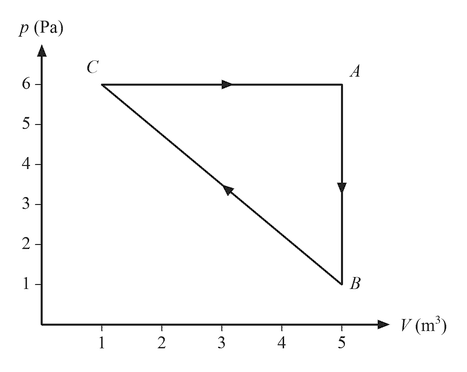
- 961 mark
Question 96
When heat is supplied to a diatomic gas of rigid molecules at constant volume, its temperature increases by . The heat required to produce the same change in temperature, at a constant pressure is
- 971 mark
Question 97
The given figure shows four processes i.e., isochoric, isobaric, isothermal and adiabatic. The correct assignment of the processes, in the same order is given by
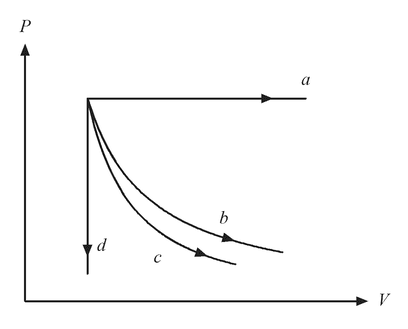
- 981 mark
Question 98
A diatomic gas with rigid molecules does of work when expanded at constant pressure. What would be the heat energy absorbed by the gas in this process?
- 991 mark
Question 99
A thermodynamic cycle is shown on a – diagram.
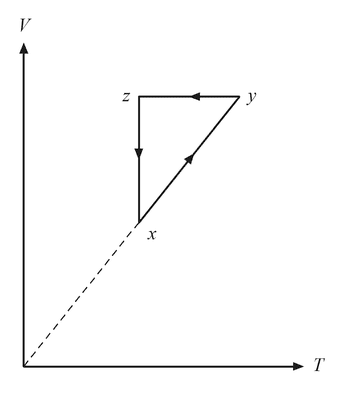
The – diagram that best describes this cycle is (The given diagrams are schematic and not to scale)
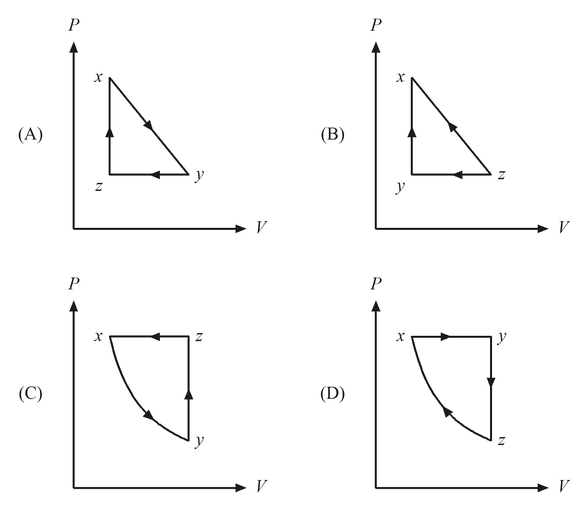
- 1001 mark
Question 100
Which of the following is an equivalent cyclic process corresponding to the thermodynamic cyclic given in the figure, where is adiabatic (graphs are schematic and are not to scale)
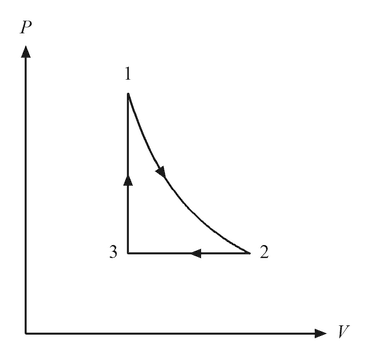
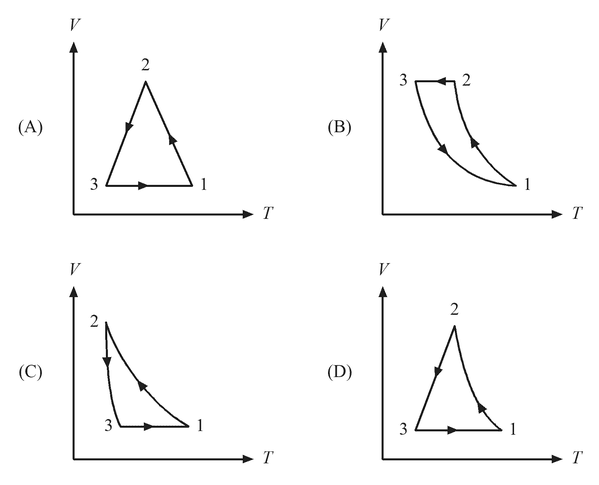
- 1011 mark
Question 101
Two cylinders and of equal capacity are connected to each other via a stop cock. contains an ideal gas at standard temperature and pressure. is completely evacuated. The entire system is thermally insulated. The stop cock is suddenly opened. The process is
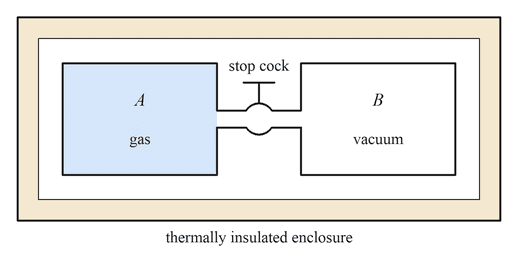
- 1021 mark
Question 102
Match the thermodynamics processes taking place in a system with the correct conditions. In the table: is the heat supplied, is the work done and is change in internal energy of the system.
Match the following
(I) Adiabatic (P)
(II) Isothermal (Q)
(III) Isochoric (R)
(IV) Isobaric (S)
- 1031 mark
Question 103
In an adiabatic process, the density of a diatomic gas becomes 32 times its initial value. The final pressure of the gas is found to be times the initial pressure. The value of is
- 1041 mark
Question 104
The quantities of heat required to raise the temperature of two solid copper spheres of radii and () through are in the ratio
- 1051 mark
Question 105
Match List-I with List-II
List-I List-II
(P) Isothermal (1) Pressure constant
(Q) Isochoric (2) Temperature constant
(R) Adiabatic (3) Volume constant
(S) Isobaric (4) Heat content is constant
Choose the correct answer from the options given below:
- 1061 mark
Question 106
In thermodynamics, heat and work are
- 1071 mark
Question 107
The – diagram of a diatomic ideal gas system going under cyclic process as shown in the given figure. The work done during an adiabatic process is (Use )

- 1081 mark
Question 108
For an adiabatic expansion of an ideal gas, the fractional change in its pressure is equal to (where is the ratio of specific heats)
- 1091 mark
Question 109
The amount of heat needed to raise the temperature of 4 moles of a rigid diatomic gas from to when no work is done is ______ ( is the universal gas constant).
- 1101 mark
Question 110
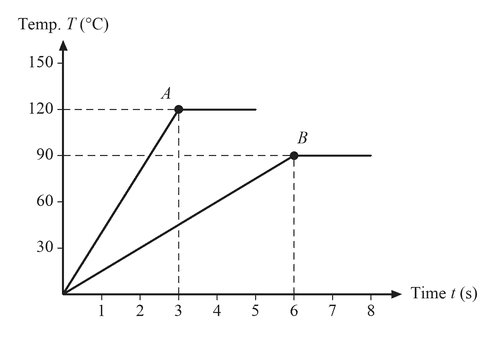
Two different metal bodies and of equal mass are heated at a uniform rate under similar conditions. The variation of temperature of the bodies is graphically represented as shown in the figure. The ratio of specific heat capacities is
- 1111 mark
Question 111
An electric appliance supplies heat to the system. If the system delivers a power of . How long it would take to increase the internal energy by ?
- 1121 mark
Question 112
Starting with the same initial conditions, an ideal gas expands from volume to in three different ways. The work done by the gas is , if the process is purely isothermal, if the process is purely adiabatic and if the process is purely isobaric. Then choose the correct option
- 1131 mark
Question 113
A cylinder of fixed capacity of litres contains helium gas at standard temperature and pressure. The amount of heat needed to raise the temperature of gas in the cylinder by will be (given gas constant )
- 1141 mark
Question 114
Given below are two statements. One is labelled as Assertion A and the other is labelled as Reason R.
Assertion A: If and represent the heat supplied to the system and the work done on the system respectively, then according to the first law of thermodynamics, .
Reason R: First law of thermodynamics is based on the law of conservation of energy.
In the light of the above statements, choose the correct answer from the options given below:
- 1151 mark
Question 115
According to the law of equipartition of energy, the molar specific heat of a diatomic gas at constant volume where the molecule has one additional vibrational mode is
- 1161 mark
Question 116
The bicycle tyre is filled with air having pressure of at . The approximate pressure of the air in the tyre when the temperature increases to is
- 1171 mark
Question 117
Heat is given to an ideal gas in an isothermal process.
(P) Internal energy of the gas will decrease.
(Q) Internal energy of the gas will increase.
(R) Internal energy of the gas will not change.
(S) The gas will do positive work.
(T) The gas will do negative work.
Choose the correct answer from the options given below:
- 1181 mark
Question 118
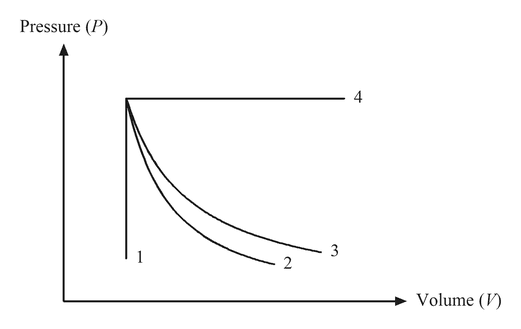
An ideal gas undergoes four different processes from the same initial state as shown in the figure. Those processes are adiabatic, isothermal, isobaric and isochoric. The curve which represents the adiabatic process among 1, 2, 3 and 4 is
- 1191 mark
Question 119
One mole of an ideal gas expands adiabatically from an initial state to final state . Another mole of the same gas expands isothermally from a different initial state to the same final state . The ratio of the specific heats at constant pressure and constant volume of this gas is . What is the ratio ?
- 1201 mark
Question 120
A monatomic gas performs a work of where is the heat supplied to it. The molar heat capacity of the gas will be ______ during this transformation, where is the gas constant.
- 1211 mark
Question 121
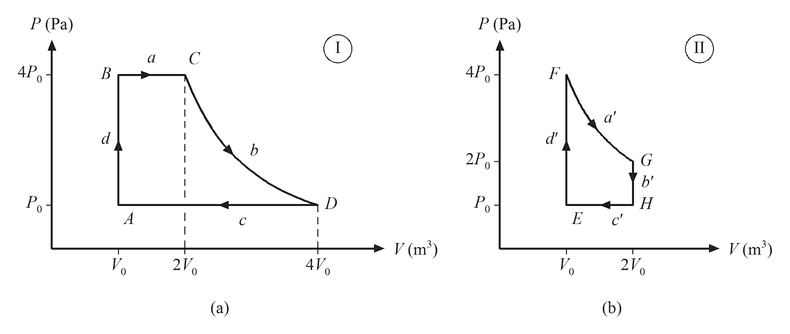
One mole of an ideal gas undergoes two different cyclic processes I and II as shown in Figs. (a) and (b) in the – diagram. In cycle I, processes , , and are isobaric, isothermal, isobaric and isochoric, respectively. In cycle II, processes , , , are isothermal, isochoric, isobaric and isochoric respectively. The total work done during cycle I is and that during cycle II is . The ratio is ______.