
Question 513 marksMedium
Derive an expression for the work done during an adiabatic process.
Confirming your payment
Sign up now and get 250 free tokens.
Thermodynamics · Question 51 of 58
Derive an expression for the work done during an adiabatic process.
Solution:
Concept: In an adiabatic process no heat enters or leaves the gas, and for an ideal gas (a constant), where .
The work done by a gas in a small expansion at pressure is .
Step 1 — Write the work as an integral. Let moles of an ideal gas expand adiabatically from state to state . The work done is the area under the adiabatic curve:
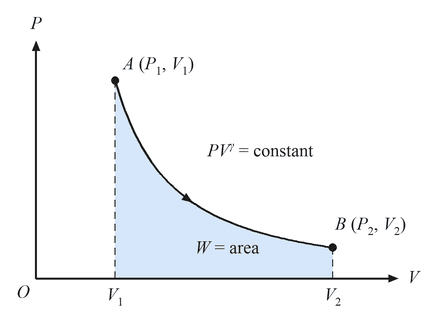
Step 2 — Put in and integrate. We take the constant outside the integral:
Step 3 — Remove . Since , we have ; similarly, :
Step 4 — Write it in terms of temperature. We use and :
Step 5 — Interpret the result. In an adiabatic expansion the work done by the gas comes from its internal energy, so and is positive; in an adiabatic compression and is negative (work is done on the gas, which warms up).
Therefore, the work done in an adiabatic process is , or .