
Question 503 marksMedium
Derive an expression for the work done during an isothermal process.
Confirming your payment
Sign up now and get 250 free tokens.
Thermodynamics · Question 50 of 58
Derive an expression for the work done during an isothermal process.
Solution:
Concept: In an isothermal process the temperature of the gas stays constant; for an ideal gas, with constant. The gas must be in a conducting cylinder and the change must be slow, so that heat can flow in to keep the temperature steady.
Step 1 — Find the work in a small expansion. Let moles of an ideal gas at temperature be in a cylinder fitted with a frictionless piston of area . If the gas at pressure pushes the piston out through a small distance , the force on the piston is and the work done is
Here is the small increase in volume swept out by the piston.
Step 2 — Add up the small works. As the gas expands from to , the total work is the area under the isothermal curve:
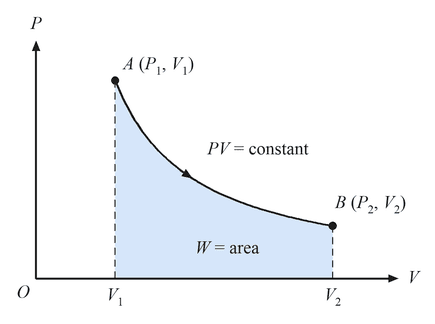
Step 3 — Put in the pressure and integrate. We rewrite the gas equation as (where is constant) and integrate:
Step 4 — Write the other forms. We use and, by Boyle's law, :
Step 5 — Link it with heat. Since is constant, , so by the first law the heat absorbed equals the work done: .
Therefore, the work done in an isothermal expansion from V₁ to V₂ is , or , and it equals the heat absorbed by the gas.