Opening your dashboard
Class 11 Physics Chapter 18 Thermodynamics: Competency-Based Questions (CBQ)
45 questions on Chapter 18, each worked through on its own page with the AI tutor. Class 11 Physics, ICSE 2026-27.
45 questions
1–4 marks · Mixed difficulty
- 11 mark
Question 1
Competency: Analysis & Evaluation
In a laboratory, three sealed samples , and are set side by side in a box, as shown. and are separated only by a thin copper sheet. and are separated by a thick sheet of expanded polystyrene, a very good thermal insulator, and all the outer walls are of thick polystyrene too.
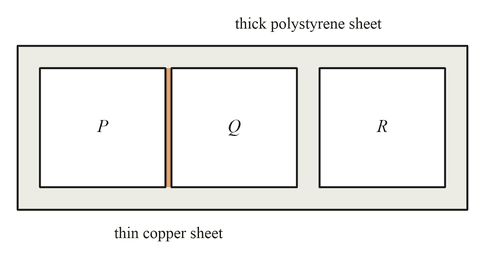
After several hours, nothing measurable about any of the three samples changes any more. Which conclusion is justified by these observations?
- 21 mark
Question 2
Competency: Analysis & Evaluation
A technician checks two large tanks in different rooms with the same small thermometer. The technician dips it into a tank of oil and waits until the reading is steady at . The technician then dips it into a tank of water and again waits until the reading is steady at . The thermometer is far too small to change the temperature of either tank noticeably.
Assertion (A): If the two tanks were joined by a well-lagged copper bar, then, once the bar itself had warmed up, no heat would flow along it from one tank to the other.
Reason (R): Two systems that are each in thermal equilibrium with a third system are in thermal equilibrium with each other.
- 34 marks
Question 3
Competency: Analysis & Evaluation
(Hypothetical data.) A company designs a small car that runs on compressed air. Its tank holds of air at and . The air drives a motor and leaves it at atmospheric pressure, . Treat air as an ideal diatomic gas with , and take .
(a) Find the number of moles of air in the full tank, and the internal energy of this air.
(b) A student says: “The air comes out of the motor at the same temperature, , as it had in the tank. So its internal energy has not changed, and it cannot have done any work.” Explain what is wrong with this argument.
(c) If all the air expanded slowly at from the tank pressure down to atmospheric pressure , the work it would do is , where is the volume of the tank. Find , compare it with your answer to (a), and say where the energy for this work comes from.
- 41 mark
Question 4
Competency: Analysis & Evaluation
A bowl of crushed ice and water stands in a warm room. It is stirred now and then, and while any ice is left the mixture stays at .
Assertion (A): As the ice melts, the internal energy of the ice–water mixture increases, even though its temperature stays at .
Reason (R): Ice is less dense than water, so the volume of the mixture decreases slightly as the ice melts.
- 53 marks
Question 5
Competency: Application
(Hypothetical data.) In a crash test, a car carrying a sealed, thermally insulated cylinder of oxygen moves at and hits a barrier, stopping almost at once. The cylinder is fixed to the car and stops with it, but the gas inside keeps moving forward for a moment, swirls about and then settles down. Treat oxygen as an ideal diatomic gas with molar mass and , and take . Ignore any heat passing to the walls of the cylinder while the gas settles.
(a) While the car moved at a steady , every oxygen molecule had this extra forward velocity. Explain why the gas was nevertheless no hotter than when the car stood still.
(b) Find the rise in the temperature of the oxygen after it has settled.
(c) Find the rise if the cylinder held helium (molar mass , ) instead, and explain why it is smaller.
- 63 marks
Question 6
Competency: Application
(Hypothetical data.) A vertical cylinder with a cross-sectional area of is closed at the top by a smooth piston of mass , with the atmosphere at above it, as shown.
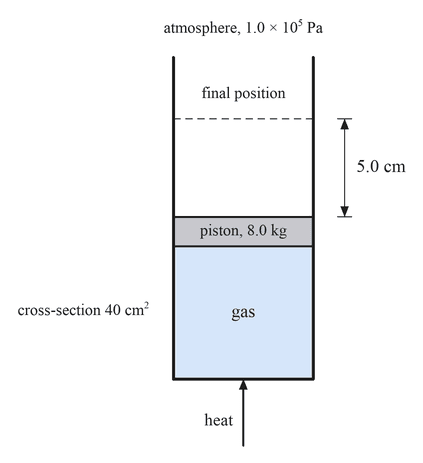
A small heater warms the gas below the piston slowly, and the piston rises steadily through . During this the heater supplies of heat to the gas. Take , and treat the gas as ideal.
(a) Find the pressure of the gas while the piston rises.
(b) Find the work done by the gas.
(c) Find the increase in the internal energy of the gas, and decide whether the gas behaves as a monatomic or a diatomic ideal gas.
- 73 marks
Question 7
Competency: Application
(Hypothetical data.) A child blows up a rubber party balloon from almost zero volume to . Outside the balloon the air pressure is . While the balloon fills, the stretched rubber squeezes the air inside, so that its pressure is, on average, above the outside pressure. Treat the filling as slow.
(a) Find the work done in pushing back the surrounding atmosphere as the balloon grows.
(b) Find the work done in stretching the rubber.
(c) Find the total work done by the air inside the balloon on the rubber and the atmosphere, and the fraction of it that goes into pushing back the atmosphere.
- 81 mark
Question 8
Competency: Analysis & Evaluation
A data logger in a school laboratory records only the pressure and the absolute temperature of a gas while it is taken slowly from one state to another, and a student plots against .
Assertion (A): The area between this – graph and the -axis does not give the work done by the gas.
Reason (R): The work done by a gas is , so it is given by the area under a graph of pressure against volume.
- 91 mark
Question 9
Competency: Application
Engine designers know that the ratio for the hot gas in the cylinder of a car engine is about , less than the value for air at room temperature. Treat the hot gas as an ideal gas with , and take . Its molar heat capacity at constant volume is about
- 103 marks
Question 10
Competency: Application
(Hypothetical data.) A hair dryer draws in room air at and at a rate of every second, and its heating coil gives of heat to this air. The air flows out at the same (atmospheric) pressure. Treat air as an ideal diatomic gas with , and take . Ignore heat lost from the body of the dryer and the energy given to the fan.
(a) Find the number of moles of air heated each second.
(b) Explain whether or should be used for this air, and find the temperature of the air leaving the dryer.
(c) A student uses the other heat capacity by mistake. Find the temperature the student gets, and explain why it is too high.
- 111 mark
Question 11
Competency: Analysis & Evaluation
(Hypothetical data.) A gas in a cylinder is heated by a small flame while it expands and pushes a piston outwards. A student finds that during this change the gas absorbs of heat and does of work, and that its temperature falls. Treat the gas as ideal.
Assertion (A): For this process the molar heat capacity of the gas, , is negative.
Reason (R): The gas does more work than the heat it absorbs, so its internal energy, and with it its temperature, falls even though heat is supplied.
- 123 marks
Question 12
Competency: Analysis & Evaluation
(Hypothetical data.) A cook heats of water in an open saucepan from to at atmospheric pressure, . The density of water is at and at , and its specific heat capacity is . Ignore evaporation and the heat taken by the pan.
(a) Find the heat absorbed by the water.
(b) Find the work done by the water as it expands against the atmosphere.
(c) Use the first law of thermodynamics to find the increase in the internal energy of the water, and explain why, for liquids and solids heated in the open, the change in internal energy is very nearly equal to the heat supplied.
- 131 mark
Question 13
Competency: Analysis & Evaluation
A strong steel vessel with rigid walls is sealed and thermally insulated. It contains a small amount of fuel and plenty of oxygen. A spark of negligible energy ignites the fuel, and the temperature of the gases inside rises sharply. Take everything inside the vessel (fuel, oxygen and the products of burning) as the system. Which statement about the change in the internal energy of the system is correct?
- 141 mark
Question 14
Competency: Analysis & Evaluation
A student compares two ways in which a gas in a cylinder can expand by the same amount: slowly, while a piston is eased out, and quickly, when a clamp is released and the piston shoots out, so that the gas swirls about before it settles.
Assertion (A): The first law of thermodynamics, , applies to both expansions.
Reason (R): In a slow (reversible) expansion the gas passes through a series of equilibrium states, so its pressure and volume have definite values at every stage.
- 153 marks
Question 15
Competency: Application
(Hypothetical data.) A diver at a depth of in a lake breathes out a small bubble of air of volume . The water is at the same temperature, , all the way to the surface, and the small bubble rises slowly enough to stay at this temperature. Take atmospheric pressure as , the density of water as and . Treat the air as an ideal gas, and ignore surface tension and water vapour.
(a) Find the pressure of the air in the bubble at depth, and the volume of the bubble just below the surface.
(b) Find the work done by the air in the bubble as it rises to the surface.
(c) Find the heat taken in by the air from the water, and explain why its internal energy does not change.
- 161 mark
Question 16
Competency: Application
(Hypothetical data.) A metal cylinder holding of an ideal gas stands in a well-insulated mixture of ice and water at , as shown.
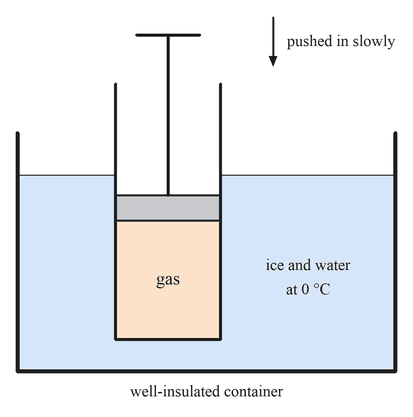
The piston is pushed in very slowly, so that the gas stays at , until its volume has fallen from to . Some ice still remains at the end. Take and the specific latent heat of fusion of ice as . The mass of ice that melts is about
- 171 mark
Question 17
Competency: Analysis & Evaluation
Water boils steadily in an open pan at while a burner keeps supplying heat to it.
Assertion (A): The change of water into steam in the pan is an isothermal process, even though the water keeps absorbing heat.
Reason (R): In every isothermal process the internal energy of the substance stays constant, so all the heat absorbed is used to do work.
- 184 marks
Question 18
Competency: Application
(Hypothetical data.) In a laboratory air gun, a reservoir holds of air at and . Pulling the trigger opens a valve, and the air pushes a light plastic pellet along a barrel of internal diameter , as shown.

By the time the pellet leaves the open end, the air fills the reservoir and the barrel, in all. This happens so quickly that no heat is exchanged; treat it as a reversible adiabatic expansion of an ideal gas with . Ahead of the pellet, the air in the barrel is at atmospheric pressure, , and the pellet must push it out of the barrel. Ignore friction.
(a) Find the pressure and the temperature of the air behind the pellet when the pellet leaves the barrel.
(b) Find the work done by the expanding air.
(c) Find the speed of the pellet as it leaves the barrel.
- 193 marks
Question 19
Competency: Analysis & Evaluation
(Hypothetical data.) Two identical, thermally insulated cylinders each hold of gas at and : one holds helium (, ) and the other nitrogen (, ). Each gas is compressed so quickly that no heat flows, to one-quarter of its starting volume. Treat both compressions as reversible adiabatic changes of ideal gases, and take .
(a) Find the final temperature of each gas.
(b) Find the final pressure of each gas.
(c) Find the work done on each gas, and explain, using a – diagram, why the helium needs more work although both gases are squeezed by the same amount.
- 201 mark
Question 20
Competency: Analysis & Evaluation
An ideal gas in a thermally insulated cylinder can be expanded either slowly, or so quickly that eddies form in it, between the same starting temperature and the same final temperature.
Assertion (A): In any adiabatic process, the work done by an ideal gas depends only on its starting and final temperatures, not on how quickly the process takes place.
Reason (R): With no heat exchanged, the first law makes the work done by the gas equal to the decrease in its internal energy, and the internal energy of an ideal gas depends only on its temperature.
- 213 marks
Question 21
Competency: Analysis & Evaluation
(Hypothetical data.) A refrigerator door is opened, and warm kitchen air at and fills its cabinet, of volume . The door is then shut. Suppose that the door seal were perfectly airtight, and that the air in the cabinet then cooled to at constant volume. Treat air as an ideal diatomic gas with , and take .
(a) Find the pressure of the air in the cabinet after it has cooled.
(b) The door is wide and high. Find the net force that the air inside and the air outside exert on the door.
(c) Find the heat removed from the air as it cools, and explain why, in practice, a refrigerator door is hard to open again only for a short time after it has been shut.
- 221 mark
Question 22
Competency: Analysis & Evaluation
A gas in a cylinder fitted with a freely sliding piston is heated slowly, so that its pressure stays constant while its volume increases.
Assertion (A): In this process the heat absorbed by the gas equals the increase in its internal energy.
Reason (R): In an isobaric process the work done by the gas is , where is the increase in its volume.
- 231 mark
Question 23
Competency: Analysis & Evaluation
In a computer simulation of an ideal gas, the gas is warmed slowly while its pressure is held at a fixed value , and the program records the internal energy of the gas and its volume as it warms. When is plotted against , the points lie on
- 244 marks
Question 24
Competency: Analysis & Evaluation
(Hypothetical data.) A fixed amount of an ideal gas is taken slowly from state (, ) to state (, ) along the straight line shown on the – diagram.
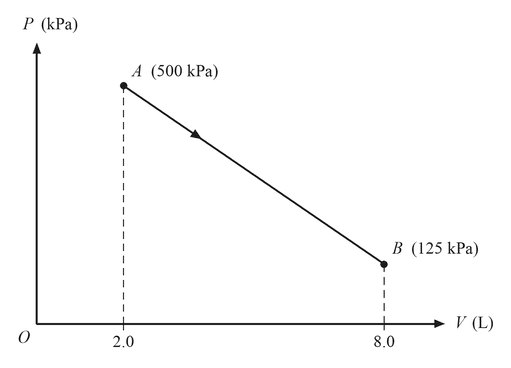
(a) Show that the gas has the same temperature at and at .
(b) Find the volume at which the temperature of the gas is highest along , and the ratio of this highest temperature to the temperature at .
(c) Find the work done by the gas from to , and compare it with the work it would do between the same two states along the isotherm through them.
- 251 mark
Question 25
Competency: Analysis & Evaluation
(Hypothetical data.) A student's computer plots the expansion of a gas from state (, ) to state (, ) as the straight line shown. To make the line fill the screen, the computer starts the pressure axis at , not at zero.
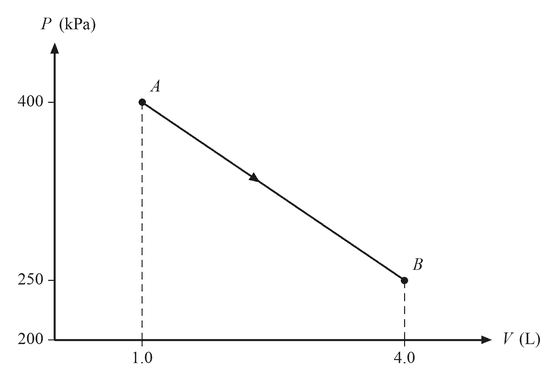
The work done by the gas from to is
- 263 marks
Question 26
(Hypothetical data.) of an ideal gas is heated slowly from to in such a way that its volume is always proportional to the square of its absolute temperature: , where is a constant. Take .
(a) Show that the pressure of the gas falls as it is heated, and find the ratio of its final to its initial pressure.
(b) Using , show that the work done by the gas is , and find its value.
(c) Compare this with the work the same gas would do if it were heated through the same temperature range at constant pressure.
- 274 marks
Question 27
(Hypothetical data.) An ideal monatomic gas, with , is at a pressure of and occupies . It expands slowly to in such a way that stays constant throughout.
(a) Find the final pressure.
(b) Using , find the work done by the gas.
(c) Find the ratio of the final to the initial absolute temperature.
(d) Find the change in the internal energy of the gas and the heat exchanged, saying whether heat enters or leaves the gas.
- 284 marks
Question 28
A large glass flask holds air, and a sensor measures the pressure inside, as shown in the figure.

Air is pumped in through the tap until the pressure is steady at at room temperature. The tap is then opened for about a second, so that the pressure drops quickly to the outside value , and closed again. Over the next few minutes the pressure in the closed flask rises and settles at . (Hypothetical data.)
(a) Explain why the air left in the flask is cooler than the room just after the tap is closed.
(b) Explain why the pressure then rises to .
(c) For the air that stays in the flask, use for the quick change and between the first and last states to show that . Find for air.
- 294 marks
Question 29
A model engine takes a fixed amount of air (, , ) round the cycle shown. From state (, ) the air is heated at constant volume to state , at . It then expands adiabatically to state , where its pressure is again , and is finally cooled at constant pressure back to . (Hypothetical data.)
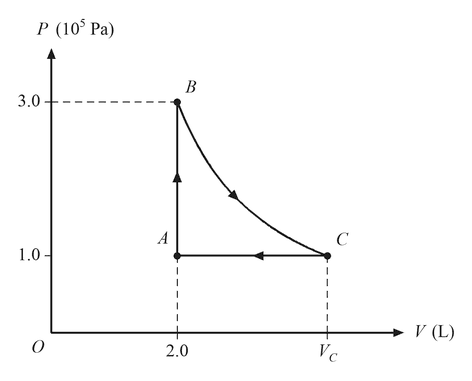
(a) Find the volume .
(b) Find the work done by the air in each of the three steps and the net work in one cycle.
(c) Find the heat taken in from to and the heat given out from to , and show that the first law holds for the whole cycle.
- 304 marks
Question 30
A small piston compressor fills a workshop air tank. Its cylinder holds of air at when the piston is fully out. The outlet valve opens when the air in the cylinder reaches the tank pressure, ; after that, the air is pushed into the tank at this constant pressure until the piston reaches the end of the cylinder. The figure shows the indicator diagram of one slow stroke, during which the air stays at room temperature. Treat the air as an ideal gas, take the tank pressure as constant, and ignore the small volume left at the end of the stroke. (Hypothetical data.)

(a) Find the volume at which the valve opens.
(b) Find the work done on the air in the cylinder in one slow stroke.
(c) In a very fast stroke the compression from is adiabatic, with . Find the volume at which the valve now opens and the work done on the air in this stroke.
(d) Use the indicator diagram to explain why the fast stroke needs more work.
- 313 marks
Question 31
1 kg of water having a volume of becomes of steam when boiled at a pressure of one atmosphere. The heat of vaporisation at this pressure is 540 kcal/kg. Calculate the increase in internal energy and the work done in expansion.
- 323 marks
Question 32
A quantity of dry air at 27 °C is compressed
(a) slowly and
(b) suddenly
to 1/3 of its volume. Find the change in temperature in each case assuming for dry air.
- 333 marks
Question 33
A given mass of gas at a pressure of 0.75 m of mercury is compressed isothermally until its volume is reduced to 3/4th of its volume. It is then made to expand adiabatically to a volume 1/5 times greater than its original volume. Calculate the final temperature if its initial temperature was 290 K.
- 343 marks
Question 34
The pressure of a certain mass of ideal gas is increased from 1 atm to 20 atm adiabatically. If ,
(i) by what factor does the volume change and
(ii) by what factor does the temperature change?
- 353 marks
Question 35
A glass bulb at 30°C contains air at atmospheric pressure. If the bulb can withstand a pressure of 2 atm, find the temperature at which it will burst. Neglect the expansion of the vessel.
- 363 marks
Question 36
An ideal gas having initial pressure , volume and temperature is allowed to expand adiabatically until its volume becomes while the temperature falls to . How many degrees of freedom do the gas molecule have?
- 373 marks
Question 37
In changing the state of a gas adiabatically from an equilibrium state A to another equilibrium state B, an amount of work equal to 22.3 J is done on the system. If the gas is taken from state A to B, via a process in which the net heat absorbed by the system is 9.35 cal, how much is the net work done by the system in the latter case?
- 383 marks
Question 38
A certain quantity of air is adiabatically compressed so that its pressure increases from 1 atmosphere to 150 atmosphere. If the initial temperature of air is 27°C, calculate
(i) rise in temperature and
(ii) the work done ( of air = 1.4).
- 393 marks
Question 39
Calculate the minimum work that must be done to compress 1.0 g of hydrogen at N.T.P. to half its initial volume. Given .
- 404 marks
Question 40
The diagram for cyclic process is a triangle ; see the given figure drawn in order. The co-ordinates of , and are (4, 1), (2, 4) and (2, 1). The co-ordinates are in order of and in which is and volume in litre. Calculate the work done during the process from to , to and to . Also calculate the work done in the complete cycle.

- 414 marks
Question 41
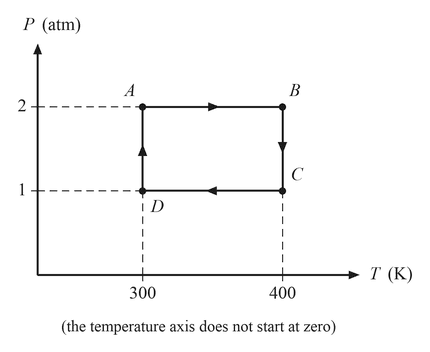
Two moles of helium gas undergo a cyclic process as shown in the given figure. Assuming the gas to be ideal, calculate the following quantities in this process:
(a) the net change in heat energy,
(b) the net work done and
(c) the net change in internal energy.
()
- 423 marks
Question 42
An ideal gas is taken around the cycle as shown in the – diagram. Find the net work done by the gas during one cycle.
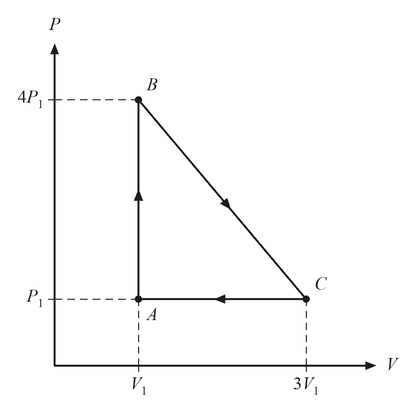
- 434 marks
Question 43
An ideal gas undergoes a thermodynamic process as shown in the given figure. The process consists of two isobaric and two isothermal steps. Show that the net work done during the whole process is

- 443 marks
Question 44
A gas expands from to along three different paths as shown in the given figure. What is the work done by the gas along the path , and ?
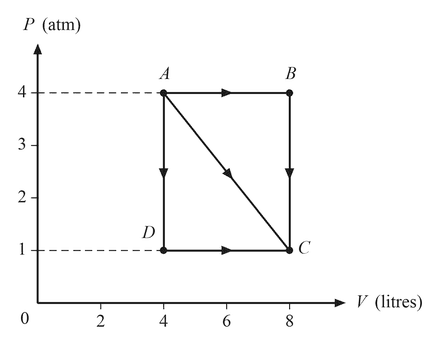
- 453 marks
Question 45
Four moles of an ideal gas undergoes a cyclic process as shown in the given figure. The temperatures of the gas at and are 303 K and 503 K respectively. If two kilo joule of heat is supplied to the gas, calculate the work done by the gas during the process represented by . []