
Question 483 marksMedium
What is meant by thermal equilibrium? State and explain zeroth law of thermodynamics.
Confirming your payment
Sign up now and get 250 free tokens.
Thermodynamics · Question 48 of 58
What is meant by thermal equilibrium? State and explain zeroth law of thermodynamics.
Solution:
Concept: Two bodies are in thermal contact when heat can flow between them, for example through a conducting (diathermic) wall. An insulating (adiabatic) wall allows no heat to flow.
Step 1 — Define thermal equilibrium. When two bodies are in thermal contact, heat flows from one to the other until their macroscopic properties (pressure, volume, temperature) stop changing. They are then said to be in thermal equilibrium: there is no net flow of heat between them.
Step 2 — State the zeroth law. If two bodies A and B are each separately in thermal equilibrium with a third body C, then A and B are also in thermal equilibrium with each other.
Step 3 — Explain it with an arrangement. Let A and B be separated by an insulating wall, while each is in contact with C through a conducting wall, as in the figure. Heat flows until A comes into equilibrium with C and B comes into equilibrium with C. If the insulating wall between A and B is now replaced by a conducting wall, no heat flows between A and B: they are already in equilibrium with each other.
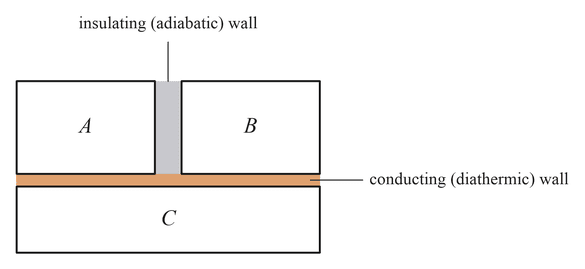
Step 4 — See what it means. The zeroth law shows that there is a property which has the same value for all bodies in thermal equilibrium with one another. This property is the temperature. It also explains how a thermometer works: the thermometer (body C) is brought into equilibrium with a body, and two bodies that give the same reading are at the same temperature.
Therefore, thermal equilibrium is the state in which there is no net heat flow between bodies in thermal contact; the zeroth law states that two bodies each in thermal equilibrium with a third body are in thermal equilibrium with each other, and it gives us the concept of temperature.