
Question 61 markMCQMedium
A mass of ideal gas at pressure is expanded isothermally to four times the original volume and then slowly compressed adiabatically to its original volume. Assuming to be 1.5, the new pressure of the gas is
Confirming your payment
Sign up now and get 250 free tokens.
Thermodynamics · Question 6 of 58
A mass of ideal gas at pressure is expanded isothermally to four times the original volume and then slowly compressed adiabatically to its original volume. Assuming to be 1.5, the new pressure of the gas is
(A)
(B)
(C)
(D)
Answer: (A)
Concept: In an isothermal change = constant (Boyle's law).
In an adiabatic change = constant.
Step 1 — Find the pressure after the isothermal expansion. Let the original volume be . The volume becomes at constant temperature, so
Step 2 — Apply the adiabatic relation to the compression. The gas is compressed adiabatically from volume (pressure ) back to volume , reaching pressure :
Step 3 — Substitute the given value of . Here is 1.5; since is 2 and is 8, the factor is 8:
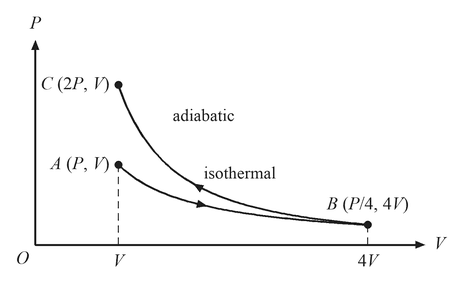
Therefore, the answer is (A): the new pressure of the gas is 2P.