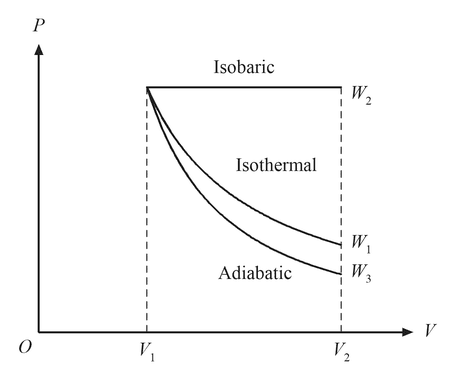
Answer: (A) W2>W1>W3
Concept: The work done by a gas in an expansion equals the area under its curve on the P–V diagram, between the volumes V1 and V2.
Step 1 — Compare how the pressure falls. All three processes start from the same point. In the isobaric expansion the pressure stays at its starting value. In the isothermal expansion it falls as P∝V1. In the adiabatic expansion it falls faster still, as P∝Vγ1 with γ>1, because the gas also cools.
Step 2 — Compare the areas. So, between V1 and V2, the isobaric line lies highest, the isothermal curve next, and the adiabatic curve lowest. The areas under them are in the same order.
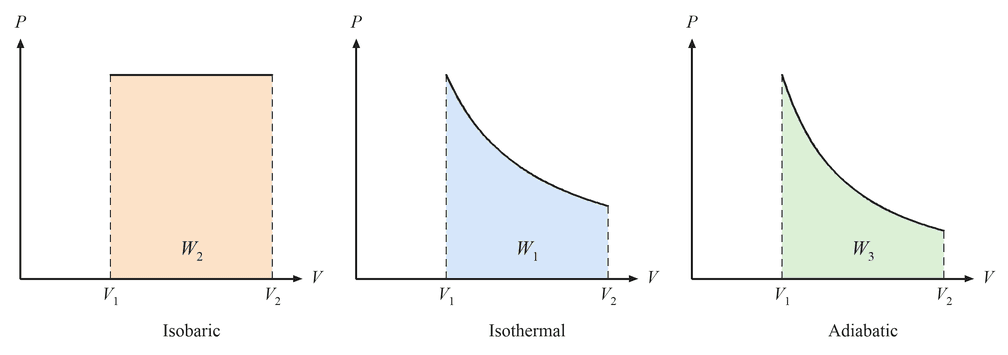
Step 3 — Write the order of the works. The isobaric work is W2, the isothermal work W1 and the adiabatic work W3:
W2>W1>W3
- (B) This puts the adiabatic work above the isothermal work, but the adiabatic curve lies below the isothermal curve, so its area is smaller.
- (C) This puts the isothermal work above the isobaric work, but the pressure stays highest in the isobaric process, so its area is the largest.
- (D) This makes the isobaric work the smallest, when it is in fact the largest of the three.
Therefore, the answer is (A): W₂ > W₁ > W₃.