
Opening your dashboard
Class 10 Chemistry Chapter 11: Study of Compounds – Sulphuric Acid Solutions
49 textbook questions with step-by-step answers, free to read, for ICSE 2026-27.
Get talked through Ch 11, not just shown the answer
Reading a finished solution is not the same as being able to do it. The AI tutor takes one question at a time and works it with you, in your own words, until you can.
- Ask it out loud, in your own words
- It gives you the next step, not the answer
- Stuck on part (ii)? Start there
49 questions with solutions
1–5 marks · Mixed difficulty
- 14 marks
Question 1
Comment, sulphuric acid is referred to as :
(a) King of chemicals,
(b) Oil of vitriol.
Solve with AIWritten solution
Solution:
Concept: Sulphuric acid has two old popular names. One comes from how widely the acid is used in industry; the other comes from how it was first made and what it looks like.
Step 1 — (a) See how widely the acid is used.
We first list the industries that depend on sulphuric acid. It is needed to make:
- fertilisers, such as ammonium sulphate and superphosphate of lime;
- other acids, such as hydrochloric, nitric and phosphoric acid;
- dyes, drugs, artificial fibres (such as rayon) and explosives (such as TNT and picric acid);
- it is also used for refining petroleum, pickling metals (cleaning their surfaces) and in lead storage batteries.
Step 2 — (a) Explain the name King of chemicals.
Almost every chemical industry uses sulphuric acid at some stage, so no other manufactured compound is as important. That is why it is called the King of chemicals. The amount of sulphuric acid a country uses is even taken as a sign of how developed its industry is.
Step 3 — (b) Recall how the acid was first made.
In the later Middle Ages the acid was obtained by heating crystals of green vitriol (hydrated iron (II) sulphate, ). On heating, the crystals decompose and give off sulphur trioxide:
The sulphur trioxide given off was then dissolved in water to form the acid:
Step 4 — (b) Explain the name oil of vitriol.
The acid obtained was a dense, oily, viscous liquid, and it had been made from vitriol. So it was named oil of vitriol.
Watch out: Here “vitriol” means green vitriol (iron (II) sulphate crystals). Blue vitriol is copper sulphate and white vitriol is zinc sulphate; the old name does not come from those.
Therefore, (a) sulphuric acid is the King of chemicals because nearly every major industry depends on it; (b) it is oil of vitriol because it was first made from green vitriol and is a dense, oily liquid.
- 25 marks
Question 2
Sulphuric acid is manufactured by Contact process.
(a) Give two balanced equations to obtain in this process,
(b) Give the conditions for the oxidation of ,
(c) Name the catalyst used.
(d) Why is not obtained by directly reacting with water ?
(e) Name the chemical used to dissolve and also name the product formed. Give all the main reactions of this process.
Solve with AIWritten solution
Solution:
Concept: The Contact process has four chemical stages: make → oxidise it to on a catalyst → absorb in conc. to form oleum → dilute the oleum with water.
Step 1 — (a) Obtain sulphur dioxide.
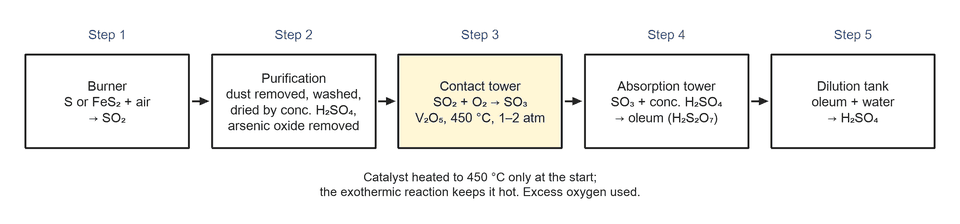
The flow chart shows the whole plant. Sulphur dioxide is made in the burner (Step 1 of the chart) in either of two ways.
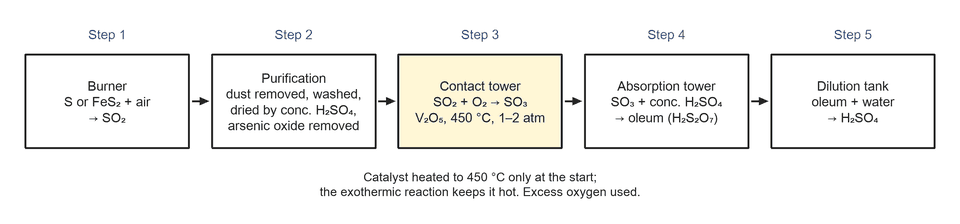
Sulphur is burnt in air:
Or iron pyrites is roasted in air:
Step 2 — (b) State the conditions for oxidising sulphur dioxide.
The oxidation of is reversible and exothermic, so the conditions are chosen to give a good yield at a useful speed:
- Temperature about 410–450 °C. A low temperature favours the yield of an exothermic reaction, but below this the catalyst works too slowly. The catalyst is heated only at the start; the heat given out then keeps it at about 450 °C.
- Pressure 1–2 atm. A high pressure would help (3 volumes of gas give 2 volumes), but acid-resistant towers that stand a high pressure are hard to build.
- Excess of oxygen (air), which pushes more to change into .
- Purified, dry gases, so that the catalyst is not poisoned.
Step 3 — (c) Name the catalyst.
The catalyst used is vanadium pentoxide, . Platinum also works, but it is costly and is easily poisoned by arsenic (III) oxide, so is preferred.
Step 4 — (d) Explain why sulphur trioxide is not added directly to water.
does not dissolve in water smoothly. The reaction gives out so much heat that the acid forms a dense fog of tiny droplets (an acid mist). This fog is very hard to condense, so most of the acid would be lost.

Step 5 — (e) Name the absorbing liquid and the product.
is dissolved in concentrated sulphuric acid (98%). The product is oleum, also called pyrosulphuric acid, :
The oleum is then diluted with the calculated amount of water to give sulphuric acid:
Step 6 — (e) Put all the main reactions in order.
Written one after another, the four main reactions of the Contact process are:
Watch out: Oleum is , not . The goes into conc. sulphuric acid, never straight into water.
Therefore, (a) S + O₂ → SO₂ and 4FeS₂ + 11O₂ → 2Fe₂O₃ + 8SO₂; (b) about 450 °C, 1–2 atm, excess oxygen and pure, dry gases; (c) vanadium pentoxide, V₂O₅; (d) SO₃ with water forms an acid mist that is hard to condense; (e) SO₃ is dissolved in conc. H₂SO₄ to form oleum, H₂S₂O₇, which is diluted to H₂SO₄.
- 32 marks
Question 3
Why the impurity of arsenic oxide must be removed before passing the mixture of and air through the catalytic chamber ?
Solve with AIWritten solution
Solution:
Concept: A catalyst poison is an impurity that sticks to the surface of a catalyst and destroys its activity.
Step 1 — Say what arsenic oxide does to the catalyst.
Arsenic (III) oxide is a catalyst poison. If it reaches the contact tower, it settles on the vanadium pentoxide (or platinum) catalyst and destroys its activity.
Step 2 — Say what this does to the process.
A poisoned catalyst can no longer speed up the change of to . The reaction becomes very slow, so the yield of falls and the plant makes much less acid.
Step 3 — See how the plant removes it.
So before the contact tower the gases pass through a dust chamber, a water scrubber, a drying tower (conc. ), and an arsenic purifier containing ferric hydroxide, which removes the arsenic oxide. A testing box then checks that the gas is pure.

Watch out: The catalyst is not used up by the poison in a reaction; it simply stops working, so a tiny trace of arsenic oxide is enough to do the damage.
Therefore, arsenic oxide must be removed because it poisons the catalyst, which then stops speeding up the change of SO₂ to SO₃, so the yield falls.
- 45 marks
Question 4

(a) Name the catalyst which helps in the conversion of sulphur dioxide to sulphur trioxide in step C.
(b) In the Contact process for the manufacture of sulphuric acid, sulphur trioxide is not converted to sulphuric acid by reacting it with water. Instead a two-steps procedure is used. Write the equations for the two steps involved in D.
(c) What type of substance will liberate sulphur dioxide from sodium sulphite in step E ?
(d) Write the equation for the reaction by which sulphur dioxide is converted to sodium sulphite in step F.
Solve with AIWritten solution
Solution:
Concept: Steps C and D are the Contact process. Step E is a dilute acid acting on a sulphite, and step F is sulphur dioxide (an acidic oxide) reacting with an alkali.
Step 1 — Read the flow chart.
The completed chart shows what happens along each arrow; the red arrows are the ones asked about.
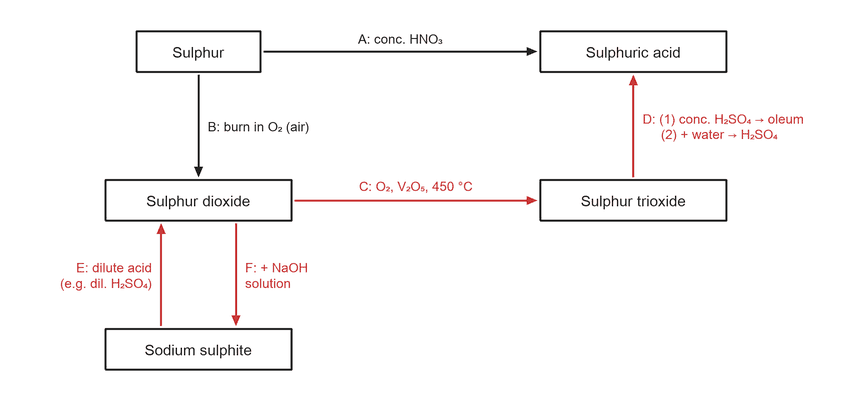
Step 2 — (a) Name the catalyst for step C.
Step C is the oxidation of sulphur dioxide in the contact tower. The catalyst is vanadium pentoxide, , at about 450 °C:
Step 3 — (b) Write the first step of D.
Sulphur trioxide is not added to water, because that forms an acid mist which is hard to condense. Instead it is first absorbed in concentrated sulphuric acid, giving oleum:
Step 4 — (b) Write the second step of D.
The oleum is then diluted with water to give sulphuric acid:
Step 5 — (c) Name the substance for step E.
Every sulphite gives sulphur dioxide with a dilute acid, such as dilute sulphuric acid or dilute hydrochloric acid:
Step 6 — (d) Write the equation for step F.
Sulphur dioxide is an acidic oxide, so when it is passed into sodium hydroxide solution it forms the salt sodium sulphite and water:
Watch out: In step F the alkali must be in excess; with excess sulphur dioxide the acid salt sodium hydrogen sulphite, , forms instead.
Therefore, (a) V₂O₅; (b) SO₃ + H₂SO₄ → H₂S₂O₇, then H₂S₂O₇ + H₂O → 2H₂SO₄; (c) a dilute acid (e.g. dilute H₂SO₄); (d) SO₂ + 2NaOH → Na₂SO₃ + H₂O.
- 51 mark
Question 5
The gas evolved when dil. sulphuric acid reacts with iron sulphide :
Solve with AIAnswer
- Correct
(A) Hydrogen sulphide
(B) Sulphur dioxide
(C) Sulphur trioxide
(D) Vapour of sulphuric acid
Answer: (A) Hydrogen sulphide
Concept: A dilute acid reacts with a metal sulphide to give a salt and hydrogen sulphide gas.
Step 1 — Recognise the type of reactant.
Iron sulphide () is a metal sulphide, so dilute sulphuric acid acts on it as a typical acid and gives iron (II) sulphate and hydrogen sulphide:
Step 2 — Confirm the gas.
The gas smells of rotten eggs and turns moist lead acetate paper black (lead sulphide forms), which are the tests for hydrogen sulphide.

Watch out: A sulphide gives ; a sulphite gives . The endings -ide and -ite are easy to mix up.
Why the other options are wrong:
- (B) Sulphur dioxide: sulphur dioxide comes from a sulphite with a dilute acid, or from the hot concentrated acid acting as an oxidising agent, not from a sulphide.
- (C) Sulphur trioxide: sulphur trioxide is not formed in any reaction of a dilute acid.
- (D) Vapour of sulphuric acid: sulphuric acid is non-volatile (boiling point about 338 °C), so no acid vapour is given off here.
Therefore, the gas evolved is hydrogen sulphide, option (A).
- 61 mark
Question 6
In the given equation – : Identify the role played by conc. .
Solve with AIAnswer
(A) Non-volatile acid
- Correct
(B) Oxidising agent
(C) Dehydrating agent
(D) None of the above
Answer: (B) Oxidising agent
Concept: An oxidising agent adds oxygen to, or removes hydrogen from, another substance and is itself reduced. On heating, conc. gives nascent oxygen:
Step 1 — See where the oxygen comes from.
Conc. sulphuric acid breaks down and supplies nascent oxygen, written [O]:
Step 2 — Follow the hydrogen sulphide.
The nascent oxygen removes hydrogen from hydrogen sulphide as water and leaves yellow sulphur, so is oxidised:
Step 3 — Follow the acid.
The sulphuric acid itself is reduced to sulphur dioxide. A substance that oxidises another and is itself reduced is the oxidising agent.
Why the other options are wrong:
- (A) Non-volatile acid: that property is used to drive a volatile acid (such as HCl) out of its salt; no volatile acid is formed here.
- (C) Dehydrating agent: the acid does not pull the elements of water out of a single compound; the water here comes from a redox reaction.
- (D) None of the above: option (B) fits, so “none of the above” cannot be right.
Therefore, conc. sulphuric acid acts as an oxidising agent, option (B).
- 71 mark
Question 7
Dilute sulphuric acid will produce a white precipitate when added to a solution of :
Solve with AIAnswer
(A) Copper nitrate
(B) Zinc nitrate
- Correct
(C) Lead nitrate
(D) Sodium nitrate
Answer: (C) Lead nitrate
Concept: Dilute sulphuric acid gives a precipitate only with a metal whose sulphate is insoluble (lead, barium, and calcium sulphate, which is only slightly soluble). All other common sulphates stay dissolved.
Step 1 — Check lead nitrate.
Lead sulphate is insoluble, so with lead nitrate solution it forms at once as a white precipitate:
Step 2 — Check the other three.
Copper, zinc and sodium sulphates are all soluble in water, so those solutions stay clear.
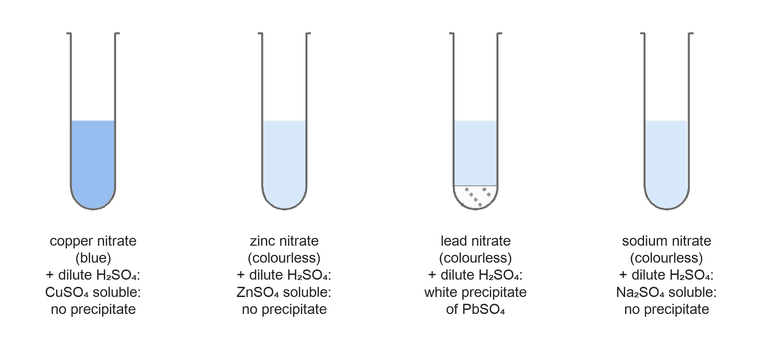
Watch out: Lead chloride and lead sulphate are both white precipitates, but only lead sulphate stays undissolved on heating.
Why the other options are wrong:
- (A) Copper nitrate: copper sulphate is soluble, so the solution stays clear (and blue).
- (B) Zinc nitrate: zinc sulphate is soluble, so no precipitate forms.
- (D) Sodium nitrate: sodium sulphate is soluble, so no precipitate forms.
Therefore, the white precipitate forms with lead nitrate, option (C).
- 81 mark
Question 8
On passing through chlorine water, the acid produced is :
Solve with AIAnswer
(A)
(B)
- Correct
(C)
(D)
Answer: (C)
Concept: Chlorine water is an oxidising agent. It oxidises sulphur dioxide (in water) to sulphuric acid and is itself reduced to hydrochloric acid.
Step 1 — Write the reaction.
Sulphur dioxide, water and chlorine react to give two acids:
Step 2 — Note what you see.
The yellowish green colour of the chlorine water fades, because the chlorine is used up.

Step 3 — Pick the acid asked for.
The acid formed from the sulphur dioxide is ; the HCl comes from the chlorine.
Why the other options are wrong:
- (A) : forms when dissolves in plain water, but chlorine oxidises it further to .
- (B) : contains nitrogen, which is not present in any reactant.
- (D) : contains phosphorus, which is not present in any reactant.
Therefore, the acid produced is H₂SO₄, option (C).
- 91 mark
Question 9
When HCl is prepared by the reaction of NaCl with , the property of exhibited is :
Solve with AIAnswer
(A) Dehydrating agent
(B) Drying agent
(C) Oxidising property
- Correct
(D) Non volatile acid
Answer: (D) Non volatile acid
Concept: Conc. sulphuric acid has a high boiling point (about 338 °C), so it is non-volatile. When heated with a salt of a volatile acid, it drives that acid out as a gas.
Step 1 — Look at the salt.
Sodium chloride is the salt of the volatile acid HCl. Heating it with conc. sulphuric acid gives:
Step 2 — See which acid leaves.
The HCl gas escapes from the flask, while the non-volatile sulphuric acid stays behind.
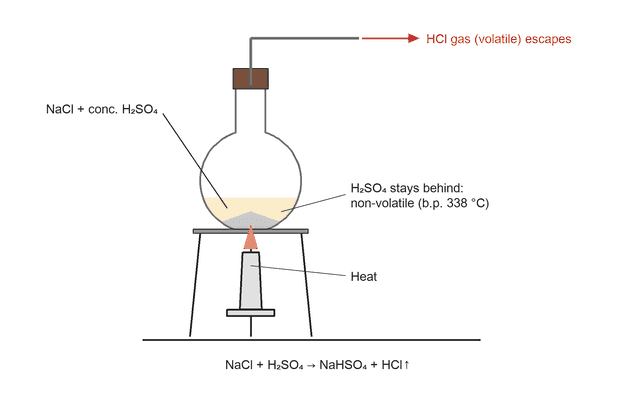
Why the other options are wrong:
- (A) Dehydrating agent: no elements of water are removed from a compound.
- (B) Drying agent: no moisture is being absorbed from a gas.
- (C) Oxidising property: the chloride is not oxidised to chlorine; HCl comes off unchanged.
Therefore, the property shown is that of a non-volatile acid, option (D).
- 101 mark
Question 10
The catalyst preferred in contact process is :
Solve with AIAnswer
(A) Pt
- Correct
(B)
(C) Fe
(D) Pd
Answer: (B)
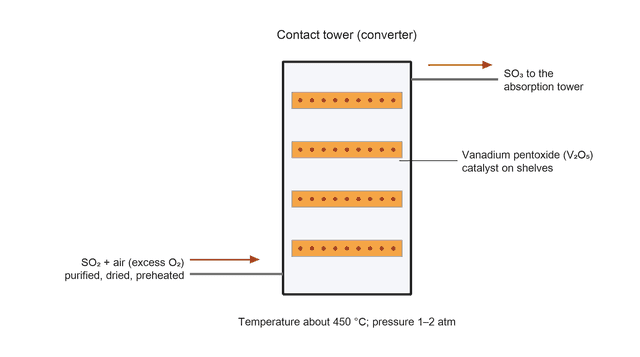
Concept: In the Contact process a catalyst speeds up the oxidation of sulphur dioxide to sulphur trioxide in the contact tower:
Step 1 — Write the catalysed step.
The step that needs the catalyst is:
Step 2 — Compare the two possible catalysts.
Platinum is a slightly better catalyst, but it is expensive and is easily poisoned by arsenic (III) oxide. Vanadium pentoxide is cheaper and is not poisoned so easily, so it is the preferred catalyst.
Why the other options are wrong:
- (A) Pt: platinum works, but its high cost and easy poisoning mean it is not the preferred catalyst.
- (C) Fe: iron is the catalyst in Haber's process for ammonia, not in the Contact process.
- (D) Pd: palladium is not used in the Contact process.
Therefore, the preferred catalyst is V₂O₅, option (B).
- 111 mark
Question 11
The substance added to to manufacture by contact process is :
Solve with AIAnswer
(A)
- Correct
(B)
(C)
(D)
Answer: (B)
Concept: is absorbed in conc. sulphuric acid (98%), not in water, to form oleum.
Step 1 — Absorb the sulphur trioxide.
In the absorption tower is dissolved in conc. sulphuric acid, giving oleum (pyrosulphuric acid):
Step 2 — Dilute the oleum.
The oleum is then diluted with water to get sulphuric acid:

Watch out: Water is added to the oleum, not to the . The substance added to itself is sulphuric acid.
Why the other options are wrong:
- (A) : added directly to , water forms a dense fog of acid droplets that is hard to condense.
- (C) : oleum is the product of absorbing , not the substance added to it.
- (D) : plays no part in the Contact process.
Therefore, the substance added to SO₃ is H₂SO₄, option (B).
- 121 mark
Question 12
The role of sulphuric acid in the reaction given below is :
Solve with AIAnswer
(A) Non volatile acid
- Correct
(B) Oxidising agent
(C) Dehydrating agent
(D) None of the above
Answer: (B) Oxidising agent
Concept: Hot conc. sulphuric acid gives nascent oxygen and oxidises non-metals such as sulphur and carbon; the acid itself is reduced to sulphur dioxide.
Step 1 — Follow the sulphur.
Sulphur gains oxygen and becomes , so sulphur is oxidised:
Step 2 — Follow the acid.
The acid loses oxygen and is reduced to . The substance that gives the oxygen is the oxidising agent.
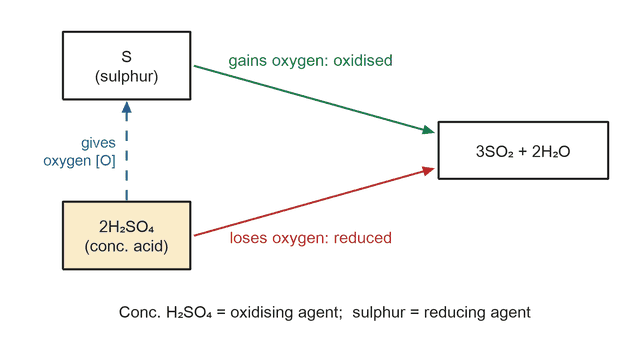
Watch out: All three molecules are the same gas, but one comes from the sulphur (oxidised) and two come from the acid (reduced).
Why the other options are wrong:
- (A) Non volatile acid: no volatile acid is driven out of a salt.
- (C) Dehydrating agent: no elements of water are removed from a compound.
- (D) None of the above: option (B) fits, so “none of the above” cannot be right.
Therefore, sulphuric acid acts as an oxidising agent, option (B).
- 131 mark
Question 13
Dilute and conc. can be distinguished by:
Solve with AIAnswer
- Correct
(A) Copper
(B) Silver
(C) Gold
(D) Platinum
Answer: (A) Copper
Concept: A metal that reacts with one acid but not the other can tell them apart. Copper is below hydrogen in the activity series, so the dilute acid cannot attack it, but hot conc. , an oxidising agent, can.
Step 1 — Add copper to the dilute acid.
Copper does not displace hydrogen from the dilute acid, so there is no reaction.
Step 2 — Add copper to the hot concentrated acid.
Copper dissolves and sulphur dioxide is given off; turns acidified potassium dichromate paper from orange to green:

Watch out: The concentrated acid must be hot; cold conc. sulphuric acid hardly attacks copper.
Why the other options are wrong:
- (B) Silver: silver is a costly metal, and the standard laboratory test uses cheap copper. (Hot conc. sulphuric acid does attack silver too, so silver could work in principle, but it is not the expected answer.)
- (C) Gold: gold is a noble metal; it reacts with neither acid.
- (D) Platinum: platinum is a noble metal; it reacts with neither acid.
Therefore, the two acids are distinguished by copper, option (A).
- 141 mark
Question 14
On adding conc. to cane sugar, the colour observed is :
Solve with AIAnswer
(A) yellow
- Correct
(B) black
(C) green
(D) violet
Answer: (B) black
Concept: Conc. sulphuric acid is a dehydrating agent. It removes hydrogen and oxygen from sugar in the ratio 2 : 1 (as water) and leaves carbon.
Step 1 — Watch the change.
The white sugar turns yellow, then brown, and finally a black, spongy mass of carbon rises up. Steam is given off and the mass gets very hot:
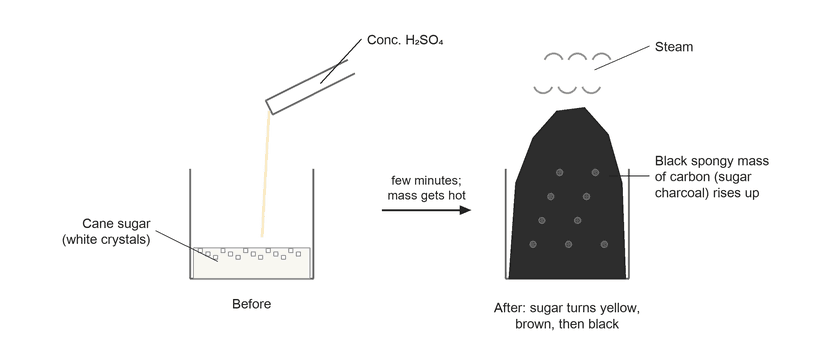
Step 2 — Name the final colour.
The black carbon left behind is sugar charcoal, so the colour finally observed is black.
Why the other options are wrong:
- (A) yellow: yellow is only a passing stage; the sugar does not stay yellow.
- (C) green: green does not appear at any stage.
- (D) violet: violet does not appear at any stage.
Therefore, the colour observed is black, option (B).
- 151 mark
Question 15
The acid which produces charcoal from sugar is :
Solve with AIAnswer
(A) conc.
(B) conc. HCl
- Correct
(C) conc.
(D) conc.
Answer: (C) conc.
Concept: Charcoal is made from sugar by removing the elements of water from it. Only a strong dehydrating agent can do this, and conc. sulphuric acid has a very great affinity for water.
Step 1 — Remove the water from sugar.
Conc. takes 11 molecules of water out of each sugar molecule:
Step 2 — Name the product.
The black carbon left behind is sugar charcoal.
Why the other options are wrong:
- (A) conc. : conc. nitric acid is an oxidising agent; it oxidises sugar (to oxalic acid) instead of charring it.
- (B) conc. HCl: conc. hydrochloric acid is volatile and has no dehydrating action.
- (D) conc. : conc. phosphoric acid is not the acid used to char sugar to charcoal.
Therefore, the acid that makes charcoal from sugar is conc. H₂SO₄, option (C).
- 161 mark
Question 16
The substance which can be used as a drying as well as dehydrating agent is :
Solve with AIAnswer
- Correct
(A) conc.
(B) conc.
(C) conc. HCl
(D) conc.
Answer: (A) conc.
Concept: A drying agent removes moisture (free water) from a substance such as a gas. A dehydrating agent removes the elements of water (combined hydrogen and oxygen) from a compound. Conc. sulphuric acid does both, because it has a very great affinity for water.
Step 1 — Use it as a drying agent.
Moist gases such as hydrogen chloride are bubbled through conc. sulphuric acid, which absorbs their water vapour.
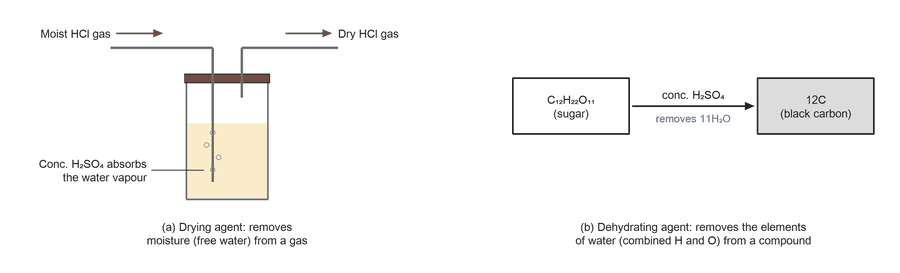
Step 2 — Use it as a dehydrating agent.
It also removes combined water, for example from sugar, and the water of crystallisation from blue vitriol:
Watch out: Drying removes free water; dehydrating removes water that is part of a compound.
Why the other options are wrong:
- (B) conc. : conc. nitric acid is an oxidising agent; it is used neither as a drying agent nor as a dehydrating agent.
- (C) conc. HCl: conc. hydrochloric acid is volatile and is neither a drying nor a dehydrating agent.
- (D) conc. : is a weak, unstable acid that exists only in solution; it is neither.
Therefore, the substance that is both a drying and a dehydrating agent is conc. H₂SO₄, option (A).
- 171 mark
Question 17
The compound formed by the oxidation of sulphur by nitric acid is :
P Sulphuric acid Q Nitrogen dioxide
R Sulphur dioxide
Solve with AIAnswer
(A) Only P
(B) Only Q
(C) Only R
- Correct
(D) Both P and Q
Answer: (D) Both P and Q
Concept: Conc. nitric acid oxidises sulphur all the way to sulphuric acid, and the nitric acid itself is reduced to nitrogen dioxide.
Step 1 — Write the reaction.
Sulphur is heated with conc. nitric acid:
Step 2 — Pick out the compounds formed.
Both sulphuric acid (P) and nitrogen dioxide (Q) are formed in this reaction, so the key is “Both P and Q”. Strictly, is the product of the oxidation of sulphur, while comes from the reduction of the nitric acid.
Watch out: Sulphur is not stopped at ; the strong oxidising acid takes it on to the +6 state in .
Why the other options are wrong:
- (A) Only P: only P leaves out nitrogen dioxide, which is also formed.
- (B) Only Q: only Q leaves out sulphuric acid, the main product.
- (C) Only R: sulphur dioxide is not formed; sulphur is oxidised past to sulphuric acid.
Therefore, the compounds formed are sulphuric acid and nitrogen dioxide, option (D).
- 181 mark
Question 18
The following questions are Assertion-Reason based questions. Choose the answer based on the codes given below.
(1) Both A and R are true and R is the correct explanation of A.
(2) Both A and R are true but R is not the correct explanation of A.
(3) A is true but R is false.
(4) A is false but R is true.
Assertion (A) : Sulphuric acid is known as the oil of vitriol.
Reason (R) : Sulphuric acid was first obtained by heating crystals of green vitriol.
Solve with AIAnswer
- Correct
(A) (1)
(B) (2)
(C) (3)
(D) (4)
Answer: (A) (1)
Concept: In an assertion–reason item, judge the Assertion (A) and the Reason (R) separately as true or false; only when both are true do we ask whether R correctly explains A.
Step 1 — Judge the Assertion.
Sulphuric acid is indeed called oil of vitriol. A is true.
Step 2 — Judge the Reason.
In the later Middle Ages it was obtained by heating crystals of green vitriol (); the given off was dissolved in water. R is true:
Step 3 — Decide whether R explains A.
The acid came out as an oily liquid made from vitriol, and that is exactly how it got the name. So R correctly explains A.
Why the other options are wrong:
- (B) (2): it says R does not explain A, but R gives the very origin of the name.
- (C) (3): it says R is false, but R is true.
- (D) (4): it says A is false, but A is true.
Therefore, both A and R are true and R explains A: code (1), option (A).
- 191 mark
Question 19
The following questions are Assertion-Reason based questions. Choose the answer based on the codes given below.
(1) Both A and R are true and R is the correct explanation of A.
(2) Both A and R are true but R is not the correct explanation of A.
(3) A is true but R is false.
(4) A is false but R is true.
Assertion (A) : or Pt is used in the catalytic oxidation of sulphur dioxide.
Reason (R) : The catalytic oxidation of is an exothermic reaction, so it requires to be heated to about 450°C only in the beginning.
Solve with AIAnswer
(A) (1)
- Correct
(B) (2)
(C) (3)
(D) (4)
Answer: (B) (2)
Concept: In an assertion–reason item, judge the Assertion (A) and the Reason (R) separately as true or false; only when both are true do we ask whether R correctly explains A.
Step 1 — Judge the Assertion.
(or platinum) is the catalyst for the oxidation of sulphur dioxide. A is true:
Step 2 — Judge the Reason.
The reaction is exothermic, so the catalyst is heated to about 450 °C only at the start; the heat given out then keeps it hot. R is true.
Step 3 — Decide whether R explains A.
R explains why heating is needed only at the beginning. It does not explain why a catalyst is used (the reason is that without one the reaction is far too slow). So R does not explain A.
Watch out: Two true statements about the same reaction are not enough for code (1); R must give the reason for A.
Why the other options are wrong:
- (A) (1): it says R explains A, but R is about the heating, not about the need for a catalyst.
- (C) (3): it says R is false, but R is true.
- (D) (4): it says A is false, but A is true.
Therefore, both A and R are true but R does not explain A: code (2), option (B).
- 201 mark
Question 20
The following questions are Assertion-Reason based questions. Choose the answer based on the codes given below.
(1) Both A and R are true and R is the correct explanation of A.
(2) Both A and R are true but R is not the correct explanation of A.
(3) A is true but R is false.
(4) A is false but R is true.
Assertion (A) : Sulphuric acid when dissolved in water forms a basic salt.
Reason (R) : Sulphuric acid ionises in two stages, it is a dibasic acid.
Solve with AIAnswer
(A) (1)
(B) (2)
(C) (3)
- Correct
(D) (4)
Answer: (D) (4)
Concept: In an assertion–reason item, judge the Assertion (A) and the Reason (R) separately as true or false; only when both are true do we ask whether R correctly explains A.
Step 1 — Judge the Assertion.
An acid dissolved in water forms ions, not a salt; a salt forms only when an acid reacts with a base. In water sulphuric acid ionises:
So “forms a basic salt” is wrong. A is false.
Step 2 — Judge the Reason.
Sulphuric acid ionises in two stages (shown above), so it is a dibasic acid. R is true. Being dibasic, it forms an acid salt and a normal salt with a base such as NaOH.

Watch out: A dibasic acid can form an acid salt (e.g. ) with a base, never a basic salt by dissolving in water.
Why the other options are wrong:
- (A) (1): code (1) needs A to be true, but A is false.
- (B) (2): code (2) needs A to be true, but A is false.
- (C) (3): it says A is true and R is false, the reverse of the facts.
Therefore, A is false but R is true: code (4), option (D).
- 211 mark
Question 21
The following questions are Assertion-Reason based questions. Choose the answer based on the codes given below.
(1) Both A and R are true and R is the correct explanation of A.
(2) Both A and R are true but R is not the correct explanation of A.
(3) A is true but R is false.
(4) A is false but R is true.
Assertion (A) : Pure sulphuric acid is almost a non-conductor of electricity.
Reason (R) : Dilute sulphuric acid is a good conductor of electricity.
Solve with AIAnswer
(A) (1)
- Correct
(B) (2)
(C) (3)
(D) (4)
Answer: (B) (2)
Concept: In an assertion–reason item, judge the Assertion (A) and the Reason (R) separately as true or false; only when both are true do we ask whether R correctly explains A.
Step 1 — Judge the Assertion.
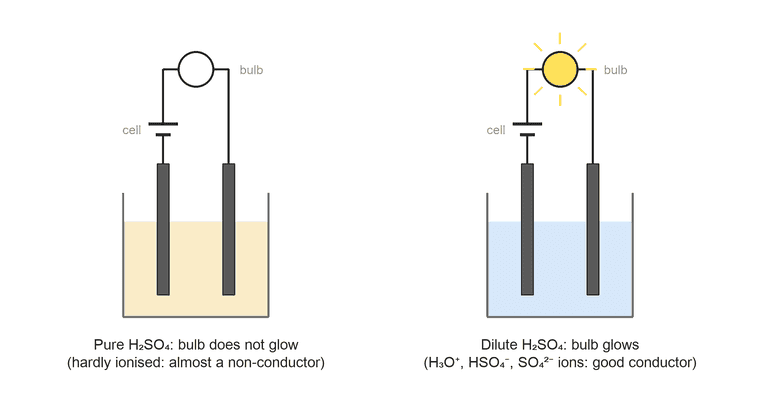
Electricity passes through a liquid only if it contains free ions. Pure (100%) sulphuric acid is hardly ionised, so it is almost a non-conductor. A is true.
Step 2 — Judge the Reason.
Dilute sulphuric acid is well ionised (, and ions), so it is a good conductor. R is true.
Step 3 — Decide whether R explains A.
R describes the dilute acid. It does not say why the pure acid fails to conduct (the reason is that the pure acid is not ionised). So R does not explain A.
Why the other options are wrong:
- (A) (1): it says R explains A, but R is about a different liquid.
- (C) (3): it says R is false, but R is true.
- (D) (4): it says A is false, but A is true.
Therefore, both A and R are true but R does not explain A: code (2), option (B).
- 221 mark
Question 22
The following questions are Assertion-Reason based questions. Choose the answer based on the codes given below.
(1) Both A and R are true and R is the correct explanation of A.
(2) Both A and R are true but R is not the correct explanation of A.
(3) A is true but R is false.
(4) A is false but R is true.
Assertion (A) : Impurity of arsenic oxide must be removed before passing the mixture of and air through the catalytic chamber.
Reason (R) : Arsenic oxide poisons the catalyst.
Solve with AIAnswer
- Correct
(A) (1)
(B) (2)
(C) (3)
(D) (4)
Answer: (A) (1)
Concept: In an assertion–reason item, judge the Assertion (A) and the Reason (R) separately as true or false; only when both are true do we ask whether R correctly explains A.
Step 1 — Judge the Assertion.
Before the contact tower the gases pass through an arsenic purifier, so the arsenic oxide is removed. A is true.

Step 2 — Judge the Reason.
Arsenic oxide is a catalyst poison: it destroys the activity of the catalyst, and the yield of falls. R is true.
Step 3 — Decide whether R explains A.
The impurity is removed precisely because it would poison the catalyst. So R correctly explains A.
Why the other options are wrong:
- (B) (2): it says R does not explain A, but R is the exact reason.
- (C) (3): it says R is false, but R is true.
- (D) (4): it says A is false, but A is true.
Therefore, both A and R are true and R explains A: code (1), option (A).
- 231 mark
Question 23
The following questions are Assertion-Reason based questions. Choose the answer based on the codes given below.
(1) Both A and R are true and R is the correct explanation of A.
(2) Both A and R are true but R is not the correct explanation of A.
(3) A is true but R is false.
(4) A is false but R is true.
Assertion (A) : Concentrated sulphuric acid is kept in air tight bottles.
Reason (R) : Air contains impurities, therefore will get spoiled.
Solve with AIAnswer
(A) (1)
- Correct
(B) (2)
(C) (3)
(D) (4)
Answer: (B) (2)
Concept: In an assertion–reason item, judge the Assertion (A) and the Reason (R) separately as true or false; only when both are true do we ask whether R correctly explains A.
Step 1 — Judge the Assertion.
Conc. sulphuric acid is kept in air-tight (stoppered) bottles. A is true.
Step 2 — Judge the Reason.
Air does contain impurities, including water vapour, and the key treats this statement as true.
Step 3 — Decide whether R explains A.
The real reason is that conc. sulphuric acid is hygroscopic: it absorbs water vapour from the air and gets diluted. “Impurities spoil it” does not state this, so R is not the correct explanation of A.
Watch out: The key word for this property is hygroscopic; always give that as the reason the bottle is kept closed.
Note: R is loosely worded; a reader who judges “the acid gets spoiled by impurities” as false would choose code (3). The book's key, code (2), is kept.
Why the other options are wrong:
- (A) (1): it says R explains A, but R does not give the actual reason (the hygroscopic nature).
- (C) (3): it would be chosen only if R were judged false; the key treats R as true, since air does contain impurities (water vapour among them).
- (D) (4): it says A is false, but A is true.
Therefore, both A and R are taken as true but R does not explain A: code (2), option (B).
- 241 mark
Question 24
The following questions are Assertion-Reason based questions. Choose the answer based on the codes given below.
(1) Both A and R are true and R is the correct explanation of A.
(2) Both A and R are true but R is not the correct explanation of A.
(3) A is true but R is false.
(4) A is false but R is true.
Assertion (A) : Sulphuric acid acts as an oxidising agent.
Reason (R) : Sulphuric acid produces hydrogen on reacting with zinc.
Solve with AIAnswer
(A) (1)
- Correct
(B) (2)
(C) (3)
(D) (4)
Answer: (B) (2)
Concept: In an assertion–reason item, judge the Assertion (A) and the Reason (R) separately as true or false; only when both are true do we ask whether R correctly explains A.
Step 1 — Judge the Assertion.
Hot conc. sulphuric acid oxidises carbon, sulphur and copper, and is itself reduced to . A is true:
Step 2 — Judge the Reason.
Dilute sulphuric acid gives hydrogen with zinc. R is true:
Step 3 — Decide whether R explains A.
Giving hydrogen with a metal shows the acidic nature of the dilute acid. Acting as an oxidising agent is a property of the hot concentrated acid. They are different properties, so R does not explain A.
Watch out: With zinc the dilute acid gives hydrogen, but the hot conc. acid gives sulphur dioxide instead.
Why the other options are wrong:
- (A) (1): it says R explains A, but R is about a different property.
- (C) (3): it says R is false, but R is true.
- (D) (4): it says A is false, but A is true.
Therefore, both A and R are true but R does not explain A: code (2), option (B).
- 255 marks
Question 25
Following are the typical properties of dilute acid. Complete them by inserting suitable words :
(a) Active metal + acid .............. + ..............
(b) Base + Acid .............. + ..............
(c) Carbonate/hydrogen carbonate + Acid .............. + .............. + ..............
(d) Sulphite/hydrogen sulphite + Acid .............. + .............. + ..............
(e) Sulphide + Acid .............. + ..............
Solve with AIWritten solution
Solution:
Concept: Dilute sulphuric acid shows all the typical properties of an acid. Each blank is completed from the general word equation, and an example with dilute is given under each.
Step 1 — (a) Active metal + acid.
A metal above hydrogen in the activity series displaces hydrogen from the acid, giving salt + hydrogen:
Step 2 — (b) Base + acid.
An acid neutralises a base, giving salt + water:
Step 3 — (c) Carbonate or hydrogen carbonate + acid.
The acid decomposes a carbonate, giving salt + water + carbon dioxide (brisk effervescence):
Step 4 — (d) Sulphite or hydrogen sulphite + acid.
In the same way, a sulphite gives salt + water + sulphur dioxide:
Step 5 — (e) Sulphide + acid.
A metal sulphide gives salt + hydrogen sulphide:
Watch out: A sulphite gives sulphur dioxide (with water), but a sulphide gives hydrogen sulphide (and no water).
Therefore, (a) salt + hydrogen; (b) salt + water; (c) salt + water + carbon dioxide; (d) salt + water + sulphur dioxide; (e) salt + hydrogen sulphide.
- 265 marks
Question 26
Name :
(a) The acid formed when sulphur dioxide dissolves in water.
(b) The gas released when sodium carbonate is added to a solution of sulphur dioxide.
(c) Liquid E can be dehydrated to produce ethene.
(d) The gas that can be oxidised to sulphur.
(c) The solution which liberates sulphur dioxide gas from sodium sulphite.
(f) The gas produced on reaction of dilute sulphuric acid with a metallic sulphide.
(g) A dilute mineral acid which forms a white precipitate when treated with barium chloride solution.
(h) The acid which produces sugar charcoal from sugar.
(i) The acid on mixing with lead nitrate solution produces white ppt. which is insoluble even on heating.
Solve with AIWritten solution
Solution:
Concept: Give one name for each description, and use the reaction behind it to check the name. (The fifth part is printed as a second “(c)”; it is answered here as (e).)
Step 1 — (a) Sulphur dioxide in water.
Sulphur dioxide is an acidic oxide; it dissolves in water to form sulphurous acid, :
Step 2 — (b) Sodium carbonate added to sulphur dioxide solution.
The solution of is acidic (sulphurous acid), and an acid gives carbon dioxide with a carbonate:
Step 3 — (c) Liquid E that gives ethene.
Liquid E is ethanol (ethyl alcohol). Conc. sulphuric acid removes a molecule of water from it at 170 °C, giving ethene:

Step 4 — (d) A gas that can be oxidised to sulphur.
Hydrogen sulphide, , loses its hydrogen to an oxidising agent such as conc. sulphuric acid and leaves sulphur:
Step 5 — (e) [printed as the second (c)] Solution that liberates SO₂ from sodium sulphite.
Any dilute acid does this, for example dilute sulphuric acid (or dilute hydrochloric acid):
Step 6 — (f) Gas from dilute sulphuric acid and a metallic sulphide.
A metal sulphide with a dilute acid gives hydrogen sulphide, :
Step 7 — (g) Dilute mineral acid giving a white precipitate with barium chloride.
Dilute sulphuric acid gives a white precipitate of barium sulphate, which does not dissolve in dilute HCl or :
Step 8 — (h) Acid that makes sugar charcoal.
Concentrated sulphuric acid removes the elements of water from sugar and leaves black sugar charcoal:
Step 9 — (i) Acid giving a white precipitate with lead nitrate that does not dissolve on heating.
Dilute sulphuric acid gives lead sulphate, which stays undissolved on heating (lead chloride, from dilute HCl, would dissolve):
Watch out: In (h) the acid must be concentrated; dilute sulphuric acid does not char sugar.
Therefore, (a) sulphurous acid; (b) carbon dioxide; (c) ethanol; (d) hydrogen sulphide; (e) dilute sulphuric acid; (f) hydrogen sulphide; (g) dilute sulphuric acid; (h) concentrated sulphuric acid; (i) dilute sulphuric acid.
- 272 marks
Question 27
What is the name given to the salts of :
(a) sulphurous acid, (b) sulphuric acid ?
Solve with AIWritten solution
Solution:
Concept: Acids whose names end in -ous give salts ending in -ite; acids ending in -ic give salts ending in -ate. Both acids here are dibasic, so each gives two kinds of salt.
Step 1 — (a) Name the salts of sulphurous acid.
Sulphurous acid, , gives sulphites (normal salts, e.g. ) and hydrogen sulphites or bisulphites (acid salts, e.g. ).
Step 2 — (b) Name the salts of sulphuric acid.
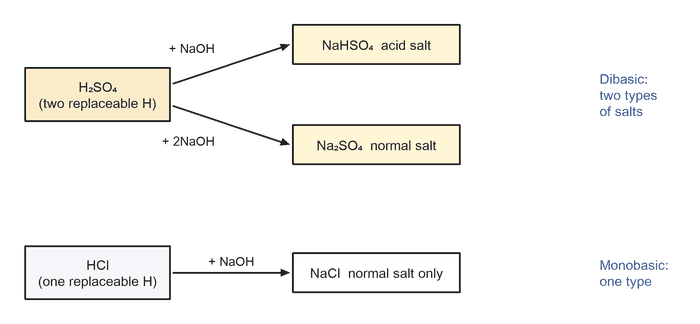
Sulphuric acid, , gives sulphates (normal salts, e.g. ) and hydrogen sulphates or bisulphates (acid salts, e.g. ). With sodium hydroxide, for example:
Watch out: Sulphite () and sulphate () differ by one oxygen atom; do not swap them.
Therefore, (a) the salts of sulphurous acid are sulphites (and hydrogen sulphites); (b) the salts of sulphuric acid are sulphates (and hydrogen sulphates).
- 282 marks
Question 28
What property of conc. :
(a) is used in the action when sugar turns black in its presence.
(b) allows it to be used in the preparation of HCl and acids.
Solve with AIWritten solution
Solution:
Concept: Charring sugar shows that the concentrated acid removes the elements of water; making HCl and uses its high boiling point.
Step 1 — (a) Sugar turning black.
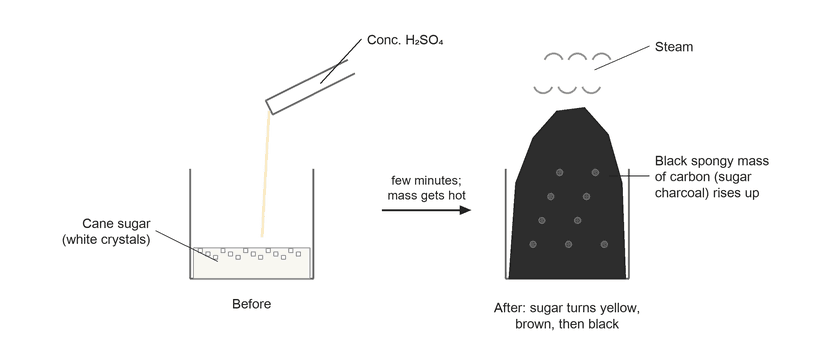
This is the dehydrating property. Conc. removes hydrogen and oxygen from sugar in the ratio 2 : 1 (as water), leaving black carbon (sugar charcoal):
Step 2 — (b) Preparing HCl and nitric acid.
This is its non-volatile nature. Conc. boils at about 338 °C, so on heating it drives the more volatile acids out of their salts:
Therefore, (a) the dehydrating property; (b) its non-volatile nature.
- 293 marks
Question 29
State the property of sulphuric acid shown by the reaction of conc. sulphuric acid when heated with
(a) potassium nitrate (b) carbon (c) ethanol
Solve with AIWritten solution
Solution:
Concept: Look at what happens to the other reactant: a volatile acid driven out shows a non-volatile acid; the reactant gaining oxygen shows an oxidising agent; water removed from a compound shows a dehydrating agent.
Step 1 — (a) Heated with potassium nitrate.
Volatile nitric acid is driven out of its salt, so the acid acts as a non-volatile acid:
Step 2 — (b) Heated with carbon.
Carbon is oxidised to carbon dioxide and the acid is reduced to sulphur dioxide, so the acid acts as an oxidising agent:
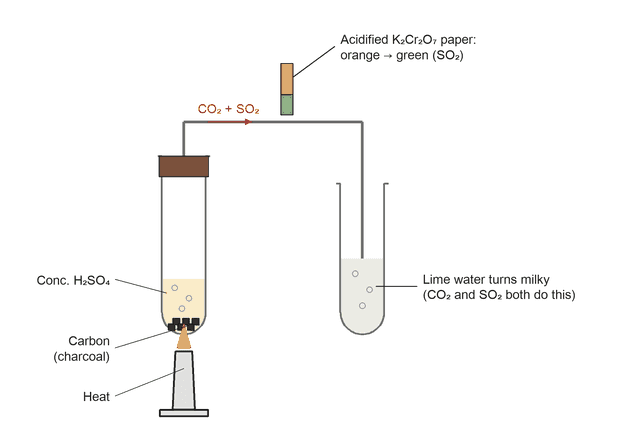
Step 3 — (c) Heated with ethanol.
A molecule of water is removed from ethanol, giving ethene, so the acid acts as a dehydrating agent:
Therefore, (a) non-volatile acid; (b) oxidising agent; (c) dehydrating agent.
- 304 marks
Question 30
Some properties of Sulphuric acid are listed below. Choose the property A, B, C or D which is responsible for the reactions (i) to (v). Some properties may be repeated :
A. Typical acid B. Dehydrating agent
C. Non-volatile acid D. Oxidizing agent
(i)
(ii)
(iii)
(iv)
Solve with AIWritten solution
Solution:
Concept: Ask what the acid does in each reaction: removes water from a compound (B), drives out a volatile acid (C), or reacts as an ordinary acid with a base or a carbonate (A).
Step 1 — (i) Sugar to carbon.
The acid removes 11 molecules of water from sugar and leaves carbon; the acid itself is unchanged (n on both sides). This is B, dehydrating agent.
Step 2 — (ii) Sodium chloride to HCl.
Non-volatile drives the volatile acid HCl out of its salt. This is C, non-volatile acid.
Step 3 — (iii) Copper (II) oxide.
Copper (II) oxide is a base: acid + base → salt + water. This is A, typical acid.
Step 4 — (iv) Sodium carbonate.
A carbonate with an acid gives salt + water + carbon dioxide. This is A, typical acid.
Watch out: D (oxidising agent) is not needed here; it would fit a reaction in which the acid gives , such as sulphur heated with the concentrated acid.
Note: the stem says “(i) to (v)”, but only four reactions are printed; all four are answered.
Therefore, (i) B; (ii) C; (iii) A; (iv) A.
- 315 marks
Question 31
Some properties of sulphuric acid are listed below. Choose the role played by sulphuric acid as A, B, C or D which is responsible for the reactions (i) to (v). Some role/s may be repeated.
(A) Dilute acid (B) Dehydrating agent
(C) Non-volatile acid (D) Oxidising agent
(a)
(b)
(c)
(d)
(e)
Solve with AIWritten solution
Solution:
Concept: Look at what happens to the other reactant in each reaction: water removed (B), oxygen given to it with formed (D), a volatile acid driven out (C), or an ordinary acid–base reaction (A).
Step 1 — (a) Blue vitriol.
Conc. removes the water of crystallisation, and the blue crystals turn dirty white. This is B, dehydrating agent.
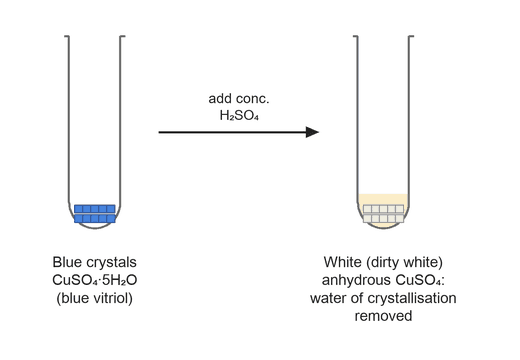
Step 2 — (b) Sulphur.
Sulphur gains oxygen and becomes , while the acid is reduced to . This is D, oxidising agent.
Step 3 — (c) Sodium nitrate.
The volatile acid is driven out of sodium nitrate below 200 °C. This is C, non-volatile acid.
Step 4 — (d) Magnesium oxide.
Magnesium oxide is a basic oxide: acid + base → salt + water. This is A, dilute acid (typical acid).
Step 5 — (e) Zinc with the concentrated acid.
Zinc with the conc. acid gives , not hydrogen. The acid is reduced, which shows its oxidising action. This is D, oxidising agent. With the dilute acid, zinc would give hydrogen instead:
Watch out: The same metal can show two different properties: zinc with the dilute acid shows A, but with the hot concentrated acid it shows D.
Note: the stem says “(i) to (v)”, but the reactions are labelled (a) to (e).
Therefore, (a) B; (b) D; (c) C; (d) A; (e) D.
- 322 marks
Question 32
Copy and complete the following table relating to an important industrial process and its final output.
Name of process Inputs Catalyst Equation for catalyzed reaction output Contact process Sulphur dioxide + oxygen Solve with AIWritten solution
Solution:
Concept: In the Contact process the step that needs a catalyst is the oxidation of sulphur dioxide to sulphur trioxide in the contact tower.
Step 1 — Name the catalyst.
The catalyst used is vanadium pentoxide, (platinum also works but is costly and easily poisoned).
Step 2 — Write the catalysed reaction.
The catalysed reaction is reversible and exothermic. It is carried out at about 450 °C and 1–2 atm, with excess oxygen; the catalyst is heated only at the start:
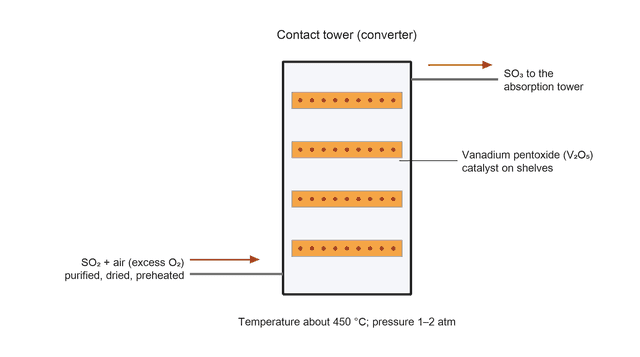
Step 3 — Complete the table.
Putting these into the table:
Name of process Inputs Catalyst Equation for catalyzed reaction output Contact process Sulphur dioxide + oxygen Vanadium pentoxide () Therefore, the catalyst is vanadium pentoxide (V₂O₅) and the equation is 2SO₂ + O₂ ⇌ 2SO₃.
- 333 marks
Question 33
Copy and complete the following table :
Column 1 Substance reacted with acid Column 2 Dilute or concentrated acid Column 3 Gas Hydrogen Carbon dioxide Only chlorine Solve with AIWritten solution
Solution:
Concept: Pick a substance that gives each gas with dilute sulphuric acid: an active metal gives hydrogen, a carbonate gives carbon dioxide, and bleaching powder gives chlorine.
Step 1 — Hydrogen.
Zinc is above hydrogen in the activity series, so it displaces hydrogen from the dilute acid:
Step 2 — Carbon dioxide.
Sodium carbonate with the dilute acid gives salt, water and carbon dioxide:
Step 3 — Only chlorine.
Bleaching powder gives up its available chlorine with dilute sulphuric acid, and chlorine is the only gas formed:
Step 4 — Complete the table.
Putting these into the table:
Column 1 Substance reacted with acid Column 2 Dilute or concentrated acid Column 3 Gas Zinc Dilute (sulphuric acid) Hydrogen Sodium carbonate Dilute (sulphuric acid) Carbon dioxide Bleaching powder Dilute (sulphuric acid) Only chlorine Watch out: Do not choose copper for hydrogen: copper is below hydrogen and gives no hydrogen with a dilute acid.
Therefore, zinc + dilute acid → hydrogen; sodium carbonate + dilute acid → carbon dioxide; bleaching powder + dilute acid → only chlorine.
- 345 marks
Question 34
Give reasons for the following :
(a) Sulphuric acid forms two types of salts with NaOH,
(b) A piece of wood becomes black when concentrated sulphuric acid is poured on it,
(c) Brisk effervescence is seen when oil of vitriol is added to sodium carbonate.
Solve with AIWritten solution
Solution:
Concept: (a) a dibasic acid gives two kinds of salt; (b) a dehydrating agent removes combined water and leaves carbon; (c) any acid with a carbonate gives carbon dioxide.
Step 1 — (a) Find the basicity of sulphuric acid.
Sulphuric acid has two replaceable hydrogen atoms (it ionises in two stages), so it is dibasic.
Step 2 — (a) Replace one hydrogen, then both.
Replacing one hydrogen atom by sodium gives the acid salt, sodium hydrogen sulphate:
Replacing both hydrogen atoms gives the normal salt, sodium sulphate:

Step 3 — (b) Explain why the wood turns black.
Wood is mostly cellulose, a carbohydrate made of carbon, hydrogen and oxygen. Conc. sulphuric acid has a very great affinity for water, so it removes hydrogen and oxygen from the cellulose in the ratio 2 : 1 (as water). Only carbon is left, so the wood turns black (charred).
Step 4 — (c) Explain the effervescence.
Oil of vitriol is conc. sulphuric acid. With sodium carbonate it liberates carbon dioxide gas, which escapes as bubbles (brisk effervescence):
Watch out: The number of salts depends on the number of replaceable hydrogen atoms (the basicity), not on the total number of hydrogen atoms in the formula.
Therefore, (a) H₂SO₄ is dibasic, giving NaHSO₄ and Na₂SO₄; (b) the acid dehydrates the wood's cellulose and leaves black carbon; (c) carbon dioxide is given off.
- 352 marks
Question 35
Why is water not added to concentrated in order to dilute it ?
Solve with AIWritten solution
Solution:
Concept: Conc. sulphuric acid has a very great affinity for water, and mixing the two gives out a large amount of heat.
Step 1 — See what happens if water is added to the acid.
If a little water is poured on the acid, the heat given out turns that water into steam at once. The steam makes the acid spurt out, which can cause serious burns, and the vessel may crack.
Step 2 — Use the safe method.
The acid is poured slowly into a large amount of water, with constant stirring. The heat then spreads through the whole mass of water, so the water does not boil. The heavier acid sinks as it mixes, and stirring stops it collecting at the bottom.
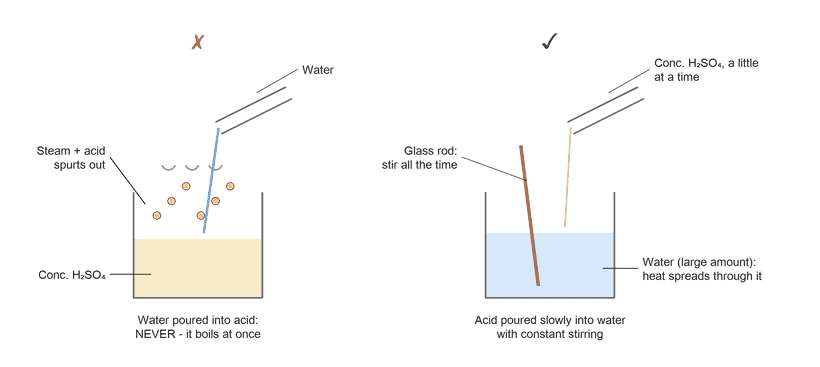
Watch out: Remember the order: always acid into water, never water into acid.
Therefore, water is not added to conc. H₂SO₄ because the heat given out boils the water instantly and the acid spurts out; the acid is instead added slowly to water with stirring.
- 365 marks
Question 36
Why is :
(a) concentrated sulphuric acid kept in air tight bottles ?
(b) is not used as a drying agent for ?
(c) sulphuric acid used in the preparation of HCl and ? Give equations in both cases.
Solve with AIWritten solution
Solution:
Concept: The three answers use three properties of conc. sulphuric acid: (a) it is hygroscopic, (b) it is an oxidising agent, (c) it is non-volatile.
Step 1 — (a) Explain the air-tight bottle.
Conc. sulphuric acid is hygroscopic: it absorbs moisture from the air. In an open bottle it would take up water vapour and get diluted (its volume even increases). An air-tight bottle prevents this.
Step 2 — (b) Explain why it cannot dry hydrogen sulphide.
Conc. sulphuric acid is an oxidising agent, and hydrogen sulphide is a reducing gas. So the acid reacts with the gas (oxidising it to sulphur) instead of just removing its moisture; the gas would be destroyed, not dried:
Step 3 — (c) Explain its use in making HCl and nitric acid.
Sulphuric acid is a non-volatile acid (boiling point about 338 °C). On heating it drives the more volatile acids out of their salts, and they distil over:
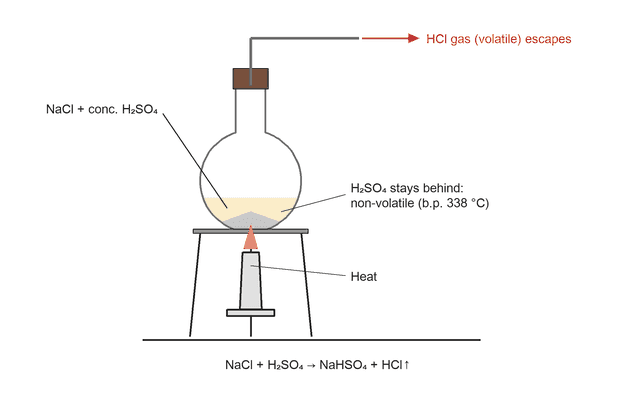
Watch out: A drying agent must not react with the gas being dried; that is why the acid is fine for HCl but not for .
Therefore, (a) it is hygroscopic and would absorb moisture from the air; (b) it oxidises H₂S to sulphur; (c) it is non-volatile, so it drives out volatile HCl and HNO₃ (equations above).
- 374 marks
Question 37
State your observation when –
(a) Sugar crystals are added to a hard glass test tube containing conc. sulphuric aicd.
(b) Conc. is added to a crystal of hydrated copper sulphate.
Solve with AIWritten solution
Solution:
Concept: Both changes show the dehydrating property of conc. sulphuric acid: it removes the elements of water from sugar, and the water of crystallisation from blue vitriol.
Step 1 — (a) Sugar crystals in conc. sulphuric acid.
The white sugar turns yellow, then brown, and finally a black, spongy mass of carbon (sugar charcoal) that rises up the tube. Steam is given off and the mass gets very hot:
Step 2 — (b) Conc. sulphuric acid on hydrated copper sulphate.
The blue crystal turns white (dirty white anhydrous copper sulphate), because its water of crystallisation is removed:
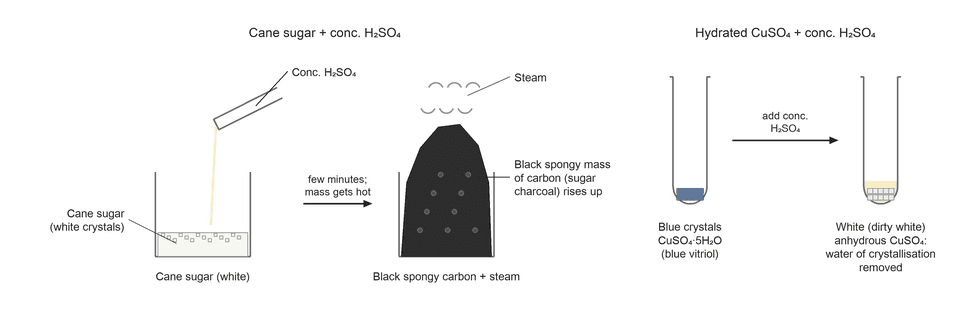
Therefore, (a) the sugar chars to a black, spongy mass with steam and heat; (b) the blue crystal turns white.
- 385 marks
Question 38
Give balanced equation(s) for :
(a) Reaction of dilute sulphuric acid when poured over sodium sulphite.
(b) Manufacture of sulphuric acid by the contact process.
(c) Heating sulphur with conc. sulphuric acid.
(d) Dehydration of sugar crystals by concentrated sulphuric acid.
(e) Action of concentrated sulphuric acid on carbon.
Solve with AIWritten solution
Solution:
Concept: These reactions show sulphuric acid as an acid (a), its manufacture (b), an oxidising agent (c, e) and a dehydrating agent (d).
Step 1 — (a) Dilute sulphuric acid on sodium sulphite.
A sulphite with a dilute acid gives salt, water and sulphur dioxide:
Step 2 — (b) Contact process: make and oxidise sulphur dioxide.
Sulphur is burnt to sulphur dioxide, which is then oxidised in the contact tower over the catalyst:

Step 3 — (b) Contact process: absorb and dilute.
The sulphur trioxide is absorbed in conc. sulphuric acid to give oleum, which is then diluted with water:
Step 4 — (c) Sulphur heated with conc. sulphuric acid.
Sulphur is oxidised to sulphur dioxide and the acid is reduced to sulphur dioxide:
Step 5 — (d) Dehydration of sugar.
The acid removes the elements of water and leaves black sugar charcoal:
Step 6 — (e) Conc. sulphuric acid on carbon.
Carbon is oxidised to carbon dioxide and the acid is reduced to sulphur dioxide:
Watch out: In (b) is absorbed in sulphuric acid, not in water; write the oleum step.
Therefore, the balanced equations for (a) to (e) are the ones shown in Steps 1 to 6.
- 395 marks
Question 39
Write the equations for the following reactions :
(a) dil. and barium chloride
(b) dil. and sodium sulphide
(c) Zinc sulphide and dilute sulphuric acid.
Solve with AIWritten solution
Solution:
Concept: (a) dilute sulphuric acid precipitates insoluble barium sulphate; (b) and (c) a metal sulphide with a dilute acid gives hydrogen sulphide.
Step 1 — (a) Dilute sulphuric acid and barium chloride.
A white precipitate of barium sulphate forms, insoluble in dilute HCl or (this is the test for a sulphate):
Step 2 — (b) Dilute sulphuric acid and sodium sulphide.
Hydrogen sulphide gas, with a rotten-egg smell, is given off:
Step 3 — (c) Zinc sulphide and dilute sulphuric acid.
Hydrogen sulphide is given off again; it turns moist lead acetate paper black:
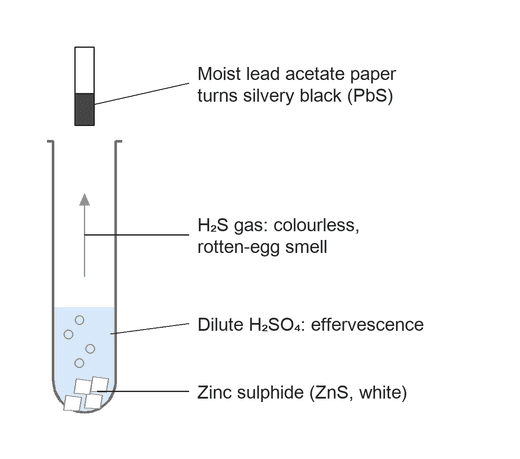
Therefore, (a) BaCl₂ + H₂SO₄ → BaSO₄ + 2HCl; (b) Na₂S + H₂SO₄ → Na₂SO₄ + H₂S; (c) ZnS + H₂SO₄ → ZnSO₄ + H₂S.
- 402 marks
Question 40
Dilute and concentrated sulphuric acid can be distinguished by using metals copper and zinc. Explain by giving balanced equations.
Solve with AIWritten solution
Solution:
Concept: The dilute acid behaves as a typical acid: it gives hydrogen with metals above hydrogen and does not attack copper. The hot concentrated acid is an oxidising agent: it attacks both metals and gives sulphur dioxide, not hydrogen.
Step 1 — Test with copper.
With the dilute acid there is no reaction, because copper is below hydrogen in the activity series. With the hot conc. acid, copper dissolves and sulphur dioxide is given off; the solution turns blue on dilution:
Step 2 — Test with zinc and the dilute acid.
With the dilute acid, hydrogen is given off; it burns with a pop sound:
Step 3 — Test with zinc and the concentrated acid.
With the hot conc. acid, sulphur dioxide is given off instead (smell of burning sulphur; it turns acidified potassium dichromate paper green):

Therefore, any gas with copper, or sulphur dioxide instead of hydrogen with zinc, shows the concentrated acid; no reaction with copper and hydrogen with zinc show the dilute acid.
- 415 marks
Question 41
Give two balanced reactions of each type to show the following properties of sulphuric acid :
(a) Acidic nature, (b) Oxidising agent,
(c) Dehydrating nature, (d) Non-volatile nature.
Solve with AIWritten solution
Solution:
Concept: Show each property with two reactions: acid + metal or base (acidic), the acid giving (oxidising), water removed from a compound (dehydrating), a volatile acid driven out of its salt (non-volatile).
Step 1 — (a) Acidic nature.
The dilute acid reacts with an active metal and with an alkali, like any acid:
Step 2 — (b) Oxidising agent.
The hot conc. acid oxidises carbon and copper, and is itself reduced to :
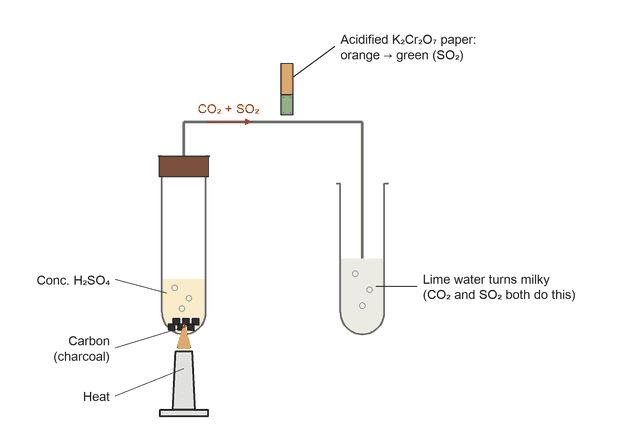
Step 3 — (c) Dehydrating nature.
The conc. acid removes the elements of water from sugar and from formic acid:
Step 4 — (d) Non-volatile nature.
The conc. acid drives volatile HCl and out of their salts:
Watch out: Copper gives no hydrogen; its reaction with the conc. acid shows the oxidising property, not the acidic one.
Therefore, the two reactions for each of (a) to (d) are the ones shown in Steps 1 to 4.
- 425 marks
Question 42
Give a chemical test to distinguish between :
(a) dilute sulphuric acid and dilute hydrochloric acid, (using lead nitrate solution).
(b) dilute sulphuric acid and conc. sulphuric acid.
(c) dilute sulphuric acid and dilute hydrochloric acid [using barium chloride solution].
Solve with AIWritten solution
Solution:
Concept: Lead sulphate and barium sulphate are insoluble white precipitates that do not dissolve on heating or in mineral acids. The concentrated acid can be picked out by its oxidising action on copper.
Step 1 — (a) Use lead nitrate solution.
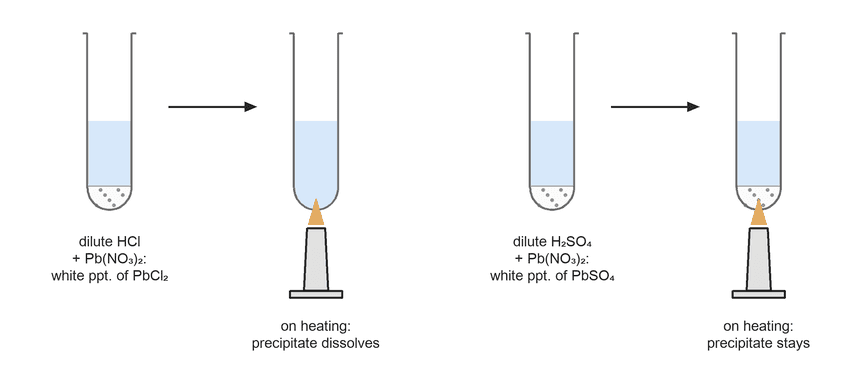
Add lead nitrate solution to each acid and warm. Dilute sulphuric acid gives a white precipitate of lead sulphate, which does not dissolve on heating:
Dilute hydrochloric acid gives a white precipitate of lead chloride, which dissolves on heating:
Step 2 — (b) Use copper turnings.
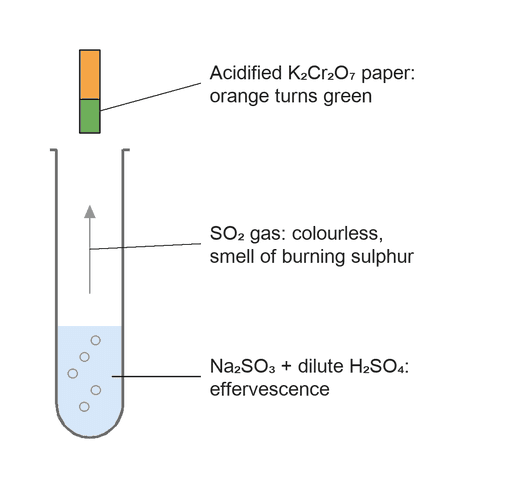
Add copper turnings to each acid and heat. The conc. acid gives sulphur dioxide (it turns acidified potassium dichromate paper from orange to green) and the solution turns blue; the dilute acid shows no reaction:
Step 3 — (c) Use barium chloride solution.
Add barium chloride solution to each acid. Dilute sulphuric acid gives a white precipitate of barium sulphate, insoluble in dilute HCl or ; dilute hydrochloric acid gives no precipitate:

Watch out: In (a) both acids give a white precipitate at first; only heating tells them apart.
Therefore, (a) the precipitate with H₂SO₄ stays on heating, while that with HCl dissolves; (b) only the conc. acid gives SO₂ with copper; (c) only H₂SO₄ gives a white precipitate with BaCl₂.
- 432 marks
Question 43
State the conditions required for the conversion of sulphur dioxide to sulphur trioxide to take place.
Solve with AIWritten solution
Solution:
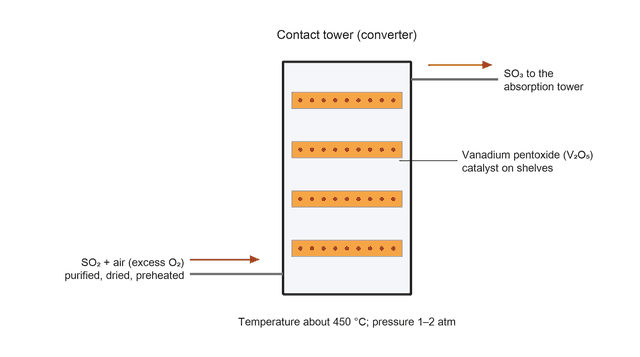
Concept: The oxidation of is reversible and exothermic, and 3 volumes of gas give 2 volumes. The conditions are chosen to get a good yield quickly.
Step 1 — Write the reaction.
Sulphur dioxide is oxidised in the contact tower:
Step 2 — List the conditions with their reasons.
Each condition is chosen for a reason:
- Temperature about 410–450 °C: a low temperature favours an exothermic reaction, but below this the catalyst is too slow. The catalyst is heated only at the start; the heat of the reaction then keeps it hot.
- Pressure 1–2 atm: a high pressure would help (fewer gas molecules on the right), but acid-resistant towers that stand a high pressure are hard to build.
- Catalyst: vanadium pentoxide, (or platinum, which is costly and easily poisoned).
- Excess of oxygen (air), which increases the production of .
- Purified, dry gases, so that the catalyst is not poisoned.
Therefore, the conditions are about 450 °C, 1–2 atm, a V₂O₅ catalyst, excess oxygen and pure, dry gases.
- 445 marks
Question 44
Making use only of substances given : dil. sulphuric acid, sodium carbonate, zinc, sodium sulphite, lead, calcium carbonate :
Give equations for the reactions by which you could obtain :
(a) hydrogen (b) sulphur dioxide
(c) carbon dioxide (d) zinc carbonate [2 steps]
Solve with AIWritten solution
Solution:
Concept: Use dilute sulphuric acid as a typical acid. Lead and calcium carbonate are not used, because they form insoluble sulphates (, ) that coat the solid and stop the reaction.
Step 1 — (a) Hydrogen.
Zinc is an active metal, so it displaces hydrogen from the dilute acid:
Step 2 — (b) Sulphur dioxide.
A sulphite with a dilute acid gives sulphur dioxide:
Step 3 — (c) Carbon dioxide.
A carbonate with a dilute acid gives carbon dioxide:
Step 4 — (d) Zinc carbonate, first step.
First make a solution of a zinc salt by dissolving zinc in the dilute acid:
Step 5 — (d) Zinc carbonate, second step.
Then add sodium carbonate solution. Zinc carbonate is insoluble, so it precipitates (double decomposition) and is filtered off:
Watch out: Calcium carbonate is a carbonate, but it is the wrong choice for (c): the insoluble calcium sulphate coats it and the reaction soon stops.
Therefore, (a) zinc gives hydrogen; (b) sodium sulphite gives sulphur dioxide; (c) sodium carbonate gives carbon dioxide; (d) zinc sulphate from zinc, then sodium carbonate, gives zinc carbonate.
- 454 marks
Question 45
Give equations for the action of sulphuric acid on
(a) Potassium hydrogen carbonate
(b) Sulphur
Solve with AIWritten solution
Solution:
Concept: (a) is a typical acid reaction of the dilute acid with a hydrogen carbonate; (b) needs the hot concentrated acid acting as an oxidising agent.
Step 1 — (a) Potassium hydrogen carbonate.
The acid gives salt, water and carbon dioxide (brisk effervescence):
Two are needed because sulphuric acid is dibasic: each acid molecule gives two ions.
Step 2 — (b) Sulphur.
Heated with the conc. acid, sulphur is oxidised to sulphur dioxide and the acid is reduced to sulphur dioxide:
Watch out: Balance (a) carefully: one reacts with two .
Therefore, (a) 2KHCO₃ + H₂SO₄ → K₂SO₄ + 2H₂O + 2CO₂; (b) S + 2H₂SO₄ → 3SO₂ + 2H₂O.
- 462 marks
Question 46
In the manufacture of sulphuric acid by contact process give the equations for the conversion of sulphur trioxide to sulphuric acid.
Solve with AIWritten solution
Solution:
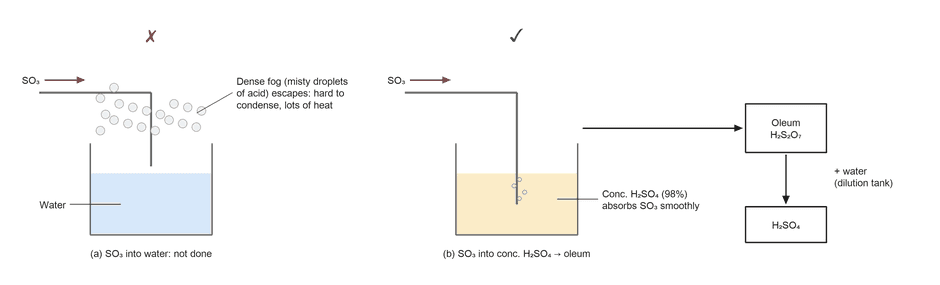
Concept: is not dissolved in water directly: that gives so much heat that a dense fog of acid droplets forms, which is hard to condense. It is absorbed in conc. sulphuric acid (98%) to give oleum, which is then diluted.
Step 1 — Absorb the sulphur trioxide.
In the absorption tower dissolves in conc. sulphuric acid, forming oleum (pyrosulphuric acid):
Step 2 — Dilute the oleum.
In the dilution tank the oleum is diluted with the calculated amount of water:
Therefore, SO₃ + H₂SO₄ → H₂S₂O₇, then H₂S₂O₇ + H₂O → 2H₂SO₄.
- 472 marks
Question 47
Give a balanced equation for the conversion of zinc oxide to zinc sulphate.
Solve with AIWritten solution
Solution:
Concept: Zinc oxide is amphoteric, but with an acid it behaves as a basic oxide, so it is neutralised by dilute sulphuric acid: acid + base → salt + water.
Step 1 — Choose the reagent.
Zinc sulphate contains the sulphate ion, so we dissolve zinc oxide in dilute sulphuric acid.
Step 2 — Write the balanced equation.
The white zinc oxide dissolves and gives a colourless solution of zinc sulphate:
Therefore, ZnO + H₂SO₄ → ZnSO₄ + H₂O.
- 485 marks
Question 48
What property of conc. is made use of in each of the following cases? Give an equation for the reaction in each case :
(a) in the production of HCl gas when it reacts with a chloride,
(b) in the preparation of CO from HCOOH,
(c) as a source of hydrogen by diluting it and adding a strip of magnesium,
(d) in the preparation of sulphur dioxide by warming a mixture of conc. sulphuric acid and copper-turnings,
(e) hydrogen chloride gas is passed through concentrated sulphuric acid.
(f) its reaction with (i) Ethanol (ii) Carbon.
Solve with AIWritten solution
Solution:
Concept: For each case, name the property, then show it with an equation. Conc. is non-volatile, a dehydrating agent, a drying agent and an oxidising agent; the dilute acid is a typical acid.
Step 1 — (a) HCl from a chloride.
This is the non-volatile nature. The acid boils at about 338 °C, so on heating it drives the volatile acid HCl out of a chloride:
Step 2 — (b) CO from formic acid.
This is the dehydrating property. The acid removes the elements of water from formic acid, leaving carbon monoxide:
Step 3 — (c) Hydrogen from magnesium.
This is the acidic nature of the dilute acid. Diluted, it behaves as a typical acid and gives hydrogen with magnesium, an active metal:
Step 4 — (d) Sulphur dioxide from copper.
This is the oxidising property. Copper is below hydrogen, so it gives no hydrogen; instead the warm conc. acid oxidises the copper and is reduced to sulphur dioxide:
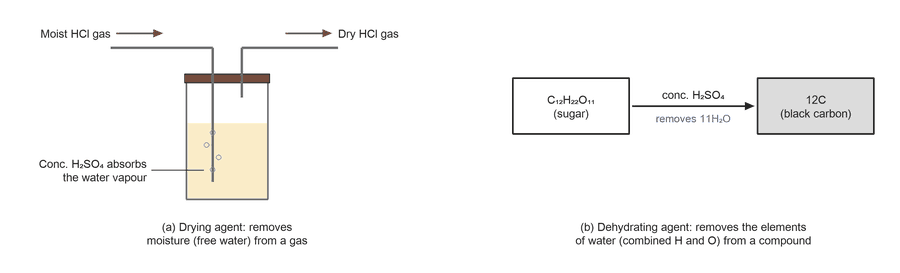
Step 5 — (e) Hydrogen chloride passed through the acid.
This is the drying property (hygroscopic nature). The acid absorbs the moisture from the gas. HCl does not react with it, so there is no chemical equation: the gas simply comes out dry.
Step 6 — (f) (i) Ethanol.
This is the dehydrating property. A molecule of water is removed from ethanol at 170 °C, giving ethene:

Step 7 — (f) (ii) Carbon.
This is the oxidising property. Carbon is oxidised to carbon dioxide and the acid is reduced to sulphur dioxide:
Watch out: Drying (e) removes free moisture from a gas and needs no equation; dehydrating (b, f(i)) removes combined water from a compound.
Therefore, (a) non-volatile acid; (b) dehydrating agent; (c) acidic nature of the dilute acid; (d) oxidising agent; (e) drying agent; (f) (i) dehydrating agent, (ii) oxidising agent.
- 495 marks
Question 49
(a) Which property of sulphuric acid accounts for its use as a dehydrating agent ?
(b) Concentrated sulphuric acid is both an oxidizing agent and a non-volatile acid. Write one equation each to illustrate the above mentioned properties of sulphuric acid.
Solve with AIWritten solution
Solution:
Concept: Conc. sulphuric acid has a very great affinity for water; this one property makes it a dehydrating agent. Its high boiling point and the nascent oxygen it gives on heating account for its other two properties.
Step 1 — (a) Name the property behind dehydration.
The property is its great affinity for water. It removes hydrogen and oxygen in the ratio 2 : 1 (the elements of water) from compounds such as sugar, and the water of crystallisation from salts such as blue vitriol:
Step 2 — (b) Show the oxidising property.
On heating, the acid gives nascent oxygen, which oxidises carbon to carbon dioxide; the acid is reduced to sulphur dioxide:

Step 3 — (b) Show the non-volatile property.
Being non-volatile (boiling point about 338 °C), the acid drives the more volatile nitric acid out of potassium nitrate:
Therefore, (a) its great affinity for water; (b) oxidising: C + 2H₂SO₄ → CO₂ + 2SO₂ + 2H₂O, non-volatile: KNO₃ + H₂SO₄ → KHSO₄ + HNO₃.
What Class 10 Chemistry Ch 11 covers
The sections of the chapter, in the order the book takes them. Every question above comes from one of these.
- 01Preparation of Sulphuric Acid
- 02Manufacture of Sulphuric Acid (Contact Process)
- 03Properties of Sulphuric Acid
- 04Uses of Sulphuric Acid
- 05Tests for Sulphuric Acid and Sulphates
More ways to study this chapter
The same chapter asked three other ways. Practise it, revise it, and see what the board has set on Ch 11 before.
- Competency-Based Questions (CBQ)Case study questions: a situation, and the part of the chapter that answers it.40questionsOpen
- Previous Year QuestionsQuestions that have actually appeared in board papers, each tagged with its year.34questionsOpen
- Practice QuestionsExtra questions per chapter, for when one attempt at a method is not enough.44questionsOpen
Ch 11 in past ICSE papers
The same chapter as the board has actually asked it. These are worded differently from the textbook exercise, which is the point of reading them.
- 11 mark
Board paper question 1
Write balanced chemical equations for each of the following:
Action of dilute Sulphuric acid on Sodium Sulphite.
Solve with AIWritten solution
Solution:
Concept: Dilute sulphuric acid shows the typical properties of an acid: it neutralises bases, reacts with active metals to give hydrogen, and decomposes carbonates, sulphites and sulphides. A sulphite reacts with an acid to give a salt, water and sulphur dioxide gas.
Step 1 — Name the reactants and the products.
Sodium sulphite reacts with dilute sulphuric acid. The sulphate ion of the acid takes the sodium, giving sodium sulphate, and the sulphite part breaks up into water and sulphur dioxide.
Step 2 — Write and balance the equation.
There are two sodium atoms on each side, two sulphur atoms on each side (one in the sulphite and one in the acid), two hydrogen atoms on each side and seven oxygen atoms on each side, so the equation is balanced as written:
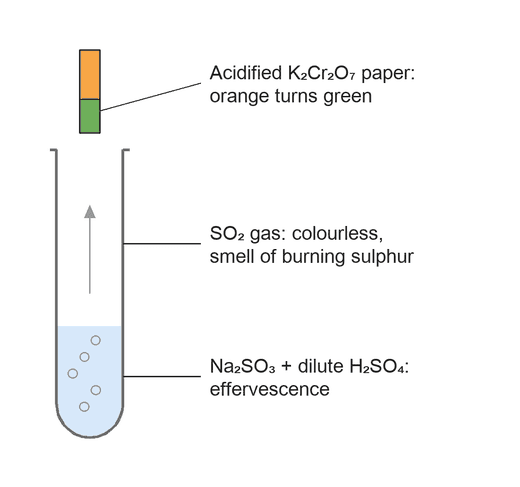
Step 3 — What is seen.
There is effervescence of a colourless gas with the smell of burning sulphur. The gas turns acidified potassium dichromate paper from orange to green, which shows that it is sulphur dioxide.
Watch out: A sulphite gives sulphur dioxide (SO₂), while a sulphate gives no gas with dilute acid; do not write SO₃ as a product.
Therefore, Na₂SO₃ + H₂SO₄ → Na₂SO₄ + H₂O + SO₂↑.
- 23 marks
Board paper question 2
A, B, C and D summarize the properties of sulphuric acid depending on whether it is dilute or concentrated.
A: Typical acid property
B: Non-volatile acid
C: Oxidizing agent
D: Dehydrating agent
Choose the property [A, B, C or D] depending on which is relevant to each of the following:
(i) Preparation of hydrogen chloride gas.
(ii) Preparation of copper sulphate from copper oxide.
(iii) Action of conc. sulphuric acid on sulphur.
Solve with AIWritten solution
Solution:
Concept: Dilute sulphuric acid shows the typical properties of an acid: it neutralises bases, reacts with active metals to give hydrogen, and decomposes carbonates, sulphites and sulphides. Concentrated sulphuric acid is also non-volatile, an oxidising agent and a dehydrating agent. To match a reaction with a property, look at what the acid actually does in that reaction.
Step 1 — (i) Preparation of hydrogen chloride gas — B.
Sodium chloride is heated with concentrated sulphuric acid. Sulphuric acid has a very high boiling point (about 338 °C), so it stays in the flask, while the volatile hydrogen chloride gas is driven off. This is the non-volatile acid property (B).
Step 2 — (ii) Preparation of copper sulphate from copper oxide — A.
Copper oxide is a base. Dilute sulphuric acid neutralises it and gives a salt and water, exactly as any acid does. This is the typical acid property (A).
Step 3 — (iii) Action of conc. sulphuric acid on sulphur — C.
Hot concentrated sulphuric acid gives nascent oxygen, which oxidises sulphur to sulphur dioxide; the acid itself is reduced to sulphur dioxide. This is the oxidising agent property (C).

Watch out: In (i) the acid is not acting as a dehydrating agent; it simply stays behind because it does not boil off.
Therefore, (i) B — non-volatile acid; (ii) A — typical acid property; (iii) C — oxidising agent.
- 31 mark
Board paper question 3
Write a balanced chemical equation for each of the following:
Action of concentrated sulphuric acid on Sulphur.
Solve with AIWritten solution
Solution:
Concept: Hot concentrated sulphuric acid is an oxidising agent. On heating it breaks up and gives nascent oxygen [O], which oxidises non-metals such as carbon and sulphur; the acid itself is reduced to sulphur dioxide.
Step 1 — Identify what happens.
Sulphur is a non-metal. When it is heated with concentrated sulphuric acid, the acid gives it oxygen, so sulphur is oxidised to sulphur dioxide. The acid loses oxygen and is reduced, also to sulphur dioxide, and water is formed.
Step 2 — Write and balance the equation.
One sulphur atom needs two units of nascent oxygen to become one SO₂, so two molecules of acid are used. Counting atoms: sulphur 3 on each side, hydrogen 4 on each side and oxygen 8 on each side.
Step 3 — Why the acid is the oxidising agent.
Sulphur gains oxygen (it is oxidised); sulphuric acid loses oxygen (it is reduced). The acid supplies the oxygen, so it is the oxidising agent here.

Watch out: All three sulphur atoms on the right end up as SO₂ (one from the sulphur and two from the acid), so the coefficient of SO₂ is 3, not 1.
Therefore, S + 2H₂SO₄ (conc.) → 3SO₂↑ + 2H₂O.
- 41 mark
Board paper question 4
State one relevant observation for each of the following reactions:
Action of concentrated Sulphuric acid on hydrated copper sulphate.
Solve with AIWritten solution
Solution:
Concept: Concentrated sulphuric acid is a dehydrating agent: it has a very strong attraction for water, so it removes the elements of water (hydrogen and oxygen in the ratio 2 : 1) from compounds, or the water of crystallisation from hydrated salts.
Step 1 — Know what blue copper sulphate is.
Hydrated copper sulphate, , is blue because of its five molecules of water of crystallisation.
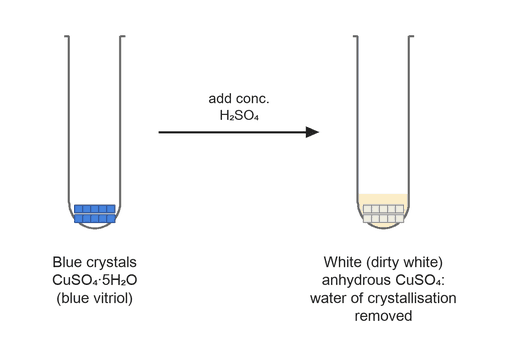
Step 2 — See what the acid does.
Concentrated sulphuric acid removes this water of crystallisation, leaving anhydrous copper sulphate, which has no water and is white.
Watch out: The observation is a colour change of the solid (blue to white); no gas is given off.
Therefore, the blue crystals of hydrated copper sulphate turn white (dirty white anhydrous copper sulphate).
- 53 marks
Board paper question 5
Write balanced chemical equations to show:
(i) The oxidizing action of conc. Sulphuric acid on Carbon.
(ii) The behavior of as an acid when it reacts with Magnesium.
(iii) The dehydrating property of conc. Sulphuric acid with sugar.
Solve with AIWritten solution
Solution:
Concept: Concentrated sulphuric acid acts as an oxidising agent (with carbon) and a dehydrating agent (with sugar), while dilute sulphuric acid behaves as a typical acid (with an active metal such as magnesium).
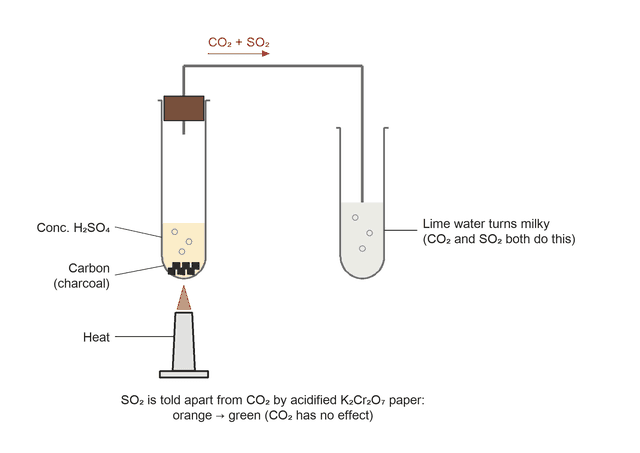
Step 1 — (i) Oxidising action on carbon.
Hot concentrated sulphuric acid gives nascent oxygen. Carbon takes this oxygen and is oxidised to carbon dioxide, and the acid is reduced to sulphur dioxide. Counting atoms: C 1, H 4, S 2 and O 8 on each side.
Step 2 — (ii) Acid behaviour with magnesium.
Magnesium is above hydrogen in the activity series, so it displaces hydrogen from dilute sulphuric acid, forming magnesium sulphate and hydrogen gas.
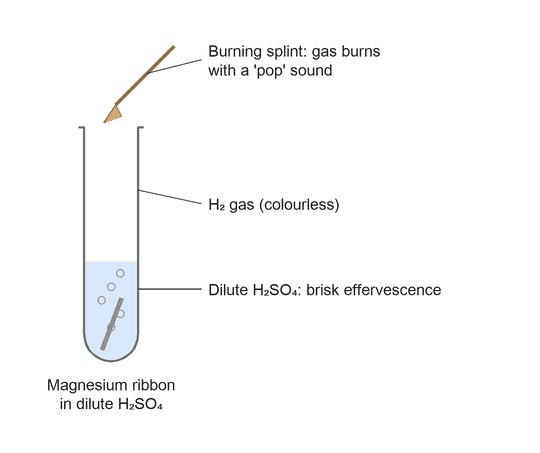
Step 3 — (iii) Dehydrating action on sugar.
Concentrated sulphuric acid removes hydrogen and oxygen from cane sugar in the ratio 2 : 1, as water, and a black, spongy mass of carbon (sugar charcoal) is left. Counting atoms: C 12, H 22 and O 11 on each side.
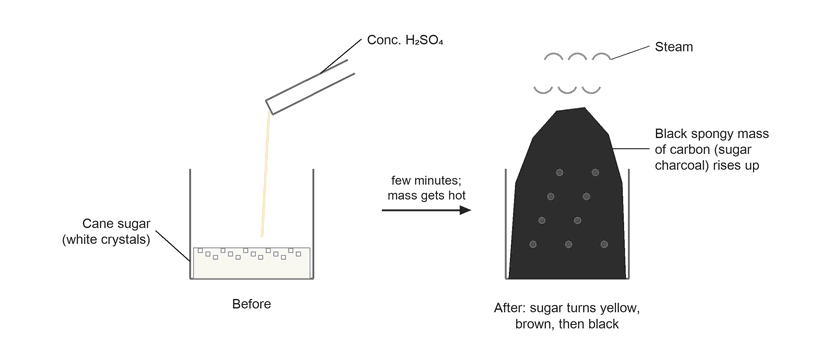
Watch out: For (ii) the acid must be dilute; hot concentrated sulphuric acid would give sulphur dioxide with metals instead of hydrogen.
Therefore, (i) C + 2H₂SO₄ → CO₂ + 2SO₂ + 2H₂O; (ii) Mg + H₂SO₄ → MgSO₄ + H₂; (iii) C₁₂H₂₂O₁₁ → 12C + 11H₂O (with conc. H₂SO₄).
- 62 marks
Board paper question 6
Write balanced chemical equations to show how is converted to Sulphuric acid in the contact process.
Solve with AIWritten solution
Solution:
Concept: In the Contact process, sulphur (or iron pyrites) is burnt to sulphur dioxide; the purified, dry sulphur dioxide is oxidised by air to sulphur trioxide over vanadium pentoxide at about 450 °C; the sulphur trioxide is absorbed in concentrated sulphuric acid to give oleum, which is diluted with water to give sulphuric acid. Sulphur trioxide does not dissolve in water satisfactorily. The reaction gives out a lot of heat, and the acid formed comes off as a dense fog of misty droplets that is very hard to condense, so much of it would be lost.
Step 1 — Absorb SO₃ in concentrated sulphuric acid.
Sulphur trioxide from the contact tower is passed into 98% concentrated sulphuric acid in the absorption tower. It dissolves smoothly and forms oleum (pyrosulphuric acid).
Step 2 — Dilute the oleum with water.
The oleum is run into the dilution tank and mixed with the calculated amount of water. Each molecule of oleum gives two molecules of sulphuric acid.
Step 3 — Why water is not used directly.
If sulphur trioxide were passed straight into water, much heat would be given out and the acid would form a dense mist of droplets that is very hard to condense, so much of it would be lost. Absorbing it in concentrated acid avoids this.
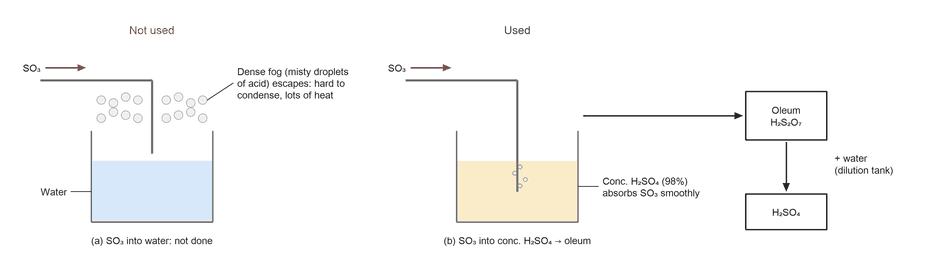
Watch out: The question asks for SO₃ → H₂SO₄, so both steps (oleum, then dilution) are needed, not SO₃ + H₂O → H₂SO₄.
Therefore, SO₃ + H₂SO₄ → H₂S₂O₇ (oleum), then H₂S₂O₇ + H₂O → 2H₂SO₄.
All 34 board paper questions for this chapter, solved the same way.
Class 10 Chemistry Ch 11 questions students ask
How many questions are there in Class 10 Chemistry Ch 11?
49 questions. Every one is solved step by step on this page.
Are these Class 10 Chemistry solutions free?
Yes. Every question and its full working is free to read, with no account needed.
Can I download the Class 10 Chemistry Ch 11 solutions as a PDF?
There is no PDF to download. Every solution is on this page instead, which means it is searchable, always the current syllabus, and readable on a phone. Use your browser's print option if you want it on paper.