
Opening your dashboard
Class 10 Chemistry Chapter 11 Study of Compounds – Sulphuric Acid: Competency-Based Questions (CBQ)
40 questions on Chapter 11, each worked through on its own page with the AI tutor. Class 10 Chemistry, ICSE 2026-27.
40 questions
1–5 marks · Mixed difficulty
- 12 marks
Question 1
Cognitive domain: Recall & Understanding · CISCE Competency-Focused Practice Questions 2024, Q96
To the acid prepared by the contact process, Barium chloride solution is added. State one observation and write an equation for the reaction that occurs.
- 22 marks
Question 2
Cognitive domain: Application · CISCE Competency-Focused Practice Questions 2024, Q98
With reference to the reaction occurring in the given figure:
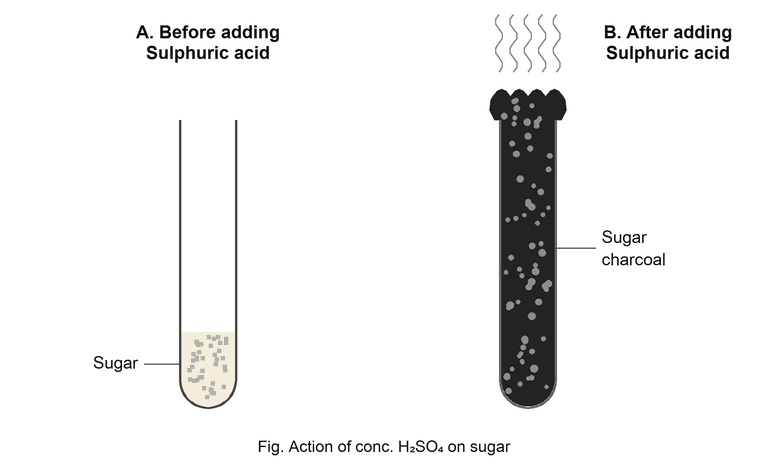
(a) Write an equation for the reaction.
(b) State the property of sulphuric acid exhibited in the above case.
- 31 mark
Question 3
Cognitive domain: Analysis
A few drops of dilute sulphuric acid splash on Rehana's cotton laboratory coat. Nothing seems to happen, so she does not wash them off. The coat hangs in a warm, dry room overnight. Next morning there are holes with black edges where the drops fell.
Which explanation is the best one?
- 41 mark
Question 4
Cognitive domain: Understanding
On a visit to a sulphuric acid plant, Meher notices that the mixture of sulphur dioxide and air is first washed with a spray of water in a scrubber. Only after this is it passed up a tower in which concentrated sulphuric acid is sprayed, and then it goes on towards the catalyst.
Why are the two towers placed in this order?
- 51 mark
Question 5
Cognitive domain: Application
A fertiliser factory makes ammonium sulphate by passing ammonia gas into sulphuric acid.
What mass of ammonium sulphate can be made from every 49 kg of pure sulphuric acid, if the ammonia is in excess? (H = 1, N = 14, O = 16, S = 32)
- 61 mark
Question 6
Cognitive domain: Application
The smoke from a coal-fired power station contains sulphur dioxide. Rain water collected near the station is found to contain a little sulphuric acid.
Which change, which is also a method of preparing sulphuric acid, best accounts for the acid in the rain?
- 71 mark
Question 7
Cognitive domain: Analysis
Assertion (A): In the last step of the Contact process, a calculated amount of water is added to oleum in the dilution tank.
Reason (R): Sulphur trioxide does not dissolve satisfactorily in water; it gives out a lot of heat and forms misty droplets of sulphuric acid.
- 81 mark
Question 8
Cognitive domain: Understanding
Assertion (A): When sulphur is warmed with concentrated nitric acid, sulphuric acid is formed and reddish-brown fumes are given off.
Reason (R): Concentrated nitric acid oxidises sulphur to sulphuric acid and is itself reduced to nitrogen dioxide.
- 91 mark
Question 9
Cognitive domain: Understanding
A car battery is a lead accumulator. When the level of the liquid in it falls, a mechanic tops it up with distilled water and never with concentrated acid.
Fill in the blanks.
The liquid in the battery is ________ sulphuric acid. It is a good conductor of electricity because, in water, the acid is ________ to a great extent. Pure sulphuric acid would not do, as it is almost a ________ of electricity.
- 101 mark
Question 10
Cognitive domain: Application
Two colourless solutions, P and Q, each give a white precipitate with barium chloride solution. Dilute hydrochloric acid is then added to both test tubes. The precipitate from P dissolves, giving off a gas with the smell of burning sulphur, but the precipitate from Q remains.
Name the white precipitate formed from P and the white precipitate formed from Q.
- 111 mark
Question 11
Cognitive domain: Application
To find out whether a bottle of sulphuric acid is dilute or concentrated, Farhan warms a little of the acid with common salt in a test tube. Pungent fumes come off, which shows that the acid is concentrated. He then holds a glass rod dipped in ammonium hydroxide solution at the mouth of the test tube.
Predict what Farhan sees at the glass rod, and name the substance that causes it.
- 122 marks
Question 12
Cognitive domain: Evaluation
Vikram wants to prepare hydrogen. He reasons: "A metal and an acid give hydrogen, and a concentrated acid will give it faster." He heats copper turnings with concentrated sulphuric acid. A colourless gas with a choking smell comes off. It does not burn with a pop, and it turns orange acidified potassium dichromate solution green.
Evaluate Vikram's reasoning in the light of these observations, and state what he should have used to obtain hydrogen.
- 134 marks
Question 13
Cognitive domain: Analysis
In the contact tower of a sulphuric acid plant, sulphur dioxide and oxygen combine on a catalyst of vanadium pentoxide. The reaction is reversible.
For a class project, a teacher gives the illustrative figures below. They show how much of the sulphur dioxide is converted when the gases are kept at different temperatures, at the same pressure. She adds one more fact: the catalyst works more slowly as the temperature falls, and below about 400 °C it is too slow to be of use.
Temperature (°C) 400 450 500 550 600 Sulphur dioxide converted (%) 99 97 93 86 74 (a) Describe the trend shown by the table. What does it tell you about the heat change in the forward reaction? Give your reasoning.
(b) Use the table and the teacher's extra fact to explain why the plant is run at about 450 °C, and neither at 600 °C nor at 300 °C.
(c) In one hour, 500 m³ of sulphur dioxide enters the tower with excess air at 450 °C. Using the table, calculate the volume of sulphur trioxide formed and the volume of sulphur dioxide left unconverted, both measured at the same temperature and pressure. Why should the unconverted gas not simply be let out into the air?
- 144 marks
Question 14
Cognitive domain: Evaluation
While shifting bottles in a school chemical store, an attendant drops a bottle of concentrated sulphuric acid. The oily liquid spreads over the cement floor, soaks a cotton duster and runs under a wooden stool. Within minutes the duster and the foot of the stool turn black. A helper, Suresh, runs to fetch a mug of water to throw on the puddle. The teacher stops him. She opens the windows and covers the puddle with plenty of dry washing soda (sodium carbonate) powder, which froths. Only when the frothing is over does she have the floor washed with a large amount of water.
(a) Explain why the duster and the wood turned black. Name the property of the acid that is responsible and the black substance formed.
(b) Predict what would have happened if Suresh had thrown the mug of water on the puddle. Explain your answer.
(c) Evaluate the teacher's method. Write the equation for the reaction that causes the frothing, and give two reasons why her method is safer than Suresh's.
- 155 marks
Question 15
Cognitive domain: Creativity
Aditi reads that concentrated sulphuric acid is hygroscopic: it absorbs moisture from the air. Her friend doubts it and says, "A liquid left open can only lose weight by evaporating." Aditi decides to settle the matter by measurement.
Her teacher can give her concentrated sulphuric acid, water, three identical small glass dishes, a glass cover that fits a dish tightly, a digital balance, gloves and safety goggles. The experiment can run for five days on a shelf in the laboratory.
Design the investigation.
(a) Describe what should be put in each dish, which dish is the control, and what must be kept the same.
(b) State what Aditi should measure, and the results she should expect in each dish if the acid is hygroscopic.
(c) Use the expected result to explain why the acid is stored in tightly stoppered bottles, and name one use of the acid that depends on this property.
(d) Give two safety precautions for this experiment, each with a reason.
- 161 mark
Question 16
Cognitive domain: Analysis
The textbook draws the structure of a molecule of sulphuric acid as shown below. In such a drawing, a plain line is a pair of electrons shared by the two atoms, and an arrow is a pair of electrons that was given by the atom at the tail of the arrow.

How many covalent bonds and how many coordinate bonds are shown in this drawing?
- 171 mark
Question 17
Cognitive domain: Application
A school store keeps concentrated sulphuric acid in a 100 cm³ bottle. The label says that the acid is 98 % sulphuric acid by mass, and its density is 1.85 g cm⁻³. (Hypothetical data.) (H = 1, S = 32, O = 16)
How many moles of sulphuric acid are present in the full bottle?
- 181 mark
Question 18
Cognitive domain: Analysis
Rahul drops a small marble chip into a test tube that contains dilute sulphuric acid. Bubbles of a colourless gas come off briskly at first. After a few minutes the bubbling slows down and almost stops, although a good-sized piece of marble and plenty of acid are still left in the tube.
Which is the best explanation of why the bubbling almost stops?
- 191 mark
Question 19
Cognitive domain: Analysis
Assertion (A): Sulphur dioxide bleaches a red flower permanently.
Reason (R): Sulphur dioxide bleaches by reduction, and the colourless product that it forms can regain its colour on standing in air.
- 201 mark
Question 20
Cognitive domain: Understanding
Assertion (A): A suspension of barium sulphate can be swallowed safely before an X-ray of the stomach, although soluble barium compounds such as barium chloride are poisonous.
Reason (R): Barium sulphate does not dissolve even in dilute mineral acids such as the hydrochloric acid present in the stomach.
- 211 mark
Question 21
Cognitive domain: Application
In the dilution tank of a sulphuric acid plant, oleum, , is diluted by adding a calculated amount of water, and every molecule of oleum gives two molecules of sulphuric acid. A batch of 356 g of pure oleum is diluted. (Hypothetical data.) (H = 1, S = 32, O = 16)
What mass of water is needed to turn all the oleum into sulphuric acid?
- 221 mark
Question 22
Cognitive domain: Understanding
On a winter night in a hill-station school, the temperature of the science store falls to 8 °C. Next morning the teacher finds colourless crystals at the bottom of a bottle that is labelled 'sulphuric acid, 100 % pure'. The crystals melt again when the bottle is brought into a warm room.
Which is the best explanation?
- 231 mark
Question 23
Cognitive domain: Evaluation
Four students write one statement each about sulphuric acid in their class notes.
Which student has written a correct statement?
- 241 mark
Question 24
Cognitive domain: Application
In a fume cupboard, 1.2 g of powdered carbon is heated with an excess of concentrated sulphuric acid. The acid oxidises the carbon, and the steam is condensed. (Hypothetical data.) (C = 12; one mole of a gas occupies 22.4 dm³ at s.t.p.)
What is the total volume of the gases collected at s.t.p., after the water has condensed?
- 251 mark
Question 25
Cognitive domain: Analysis
At a plant that recovers used acid, spent dilute sulphuric acid is boiled in an acid-proof evaporator to make it stronger. A thermometer dipped in the boiling liquid gives the readings below. (Hypothetical data.)
Stage of heating Start Middle End Temperature of the boiling liquid 102 °C 180 °C 338 °C, and then steady Which statement best explains the readings?
- 262 marks
Question 26
Cognitive domain: Application
In the later Middle Ages, sulphuric acid was obtained as an oily liquid by heating crystals of green vitriol, . The crystals break up as follows.
Suppose that 55.6 g of green vitriol is heated strongly. (Hypothetical data.) (Fe = 56, S = 32, O = 16, H = 1)
(a) Name the product that gives sulphuric acid when it dissolves in water, and write the equation for this change.
(b) Calculate the mass of this product that is obtained.
- 272 marks
Question 27
Cognitive domain: Evaluation
Gokul warms sodium ethanoate (sodium acetate), , with concentrated sulphuric acid in a fume cupboard. Vapours with the smell of vinegar come off, and he condenses them to obtain ethanoic acid. His friend Ira says: "Concentrated hydrochloric acid is also a strong acid and it costs less, so use that instead."
(a) Write the equation for Gokul's reaction.
(b) Evaluate Ira's suggestion. Give the reason, based on a property of sulphuric acid.
- 282 marks
Question 28
Cognitive domain: Evaluation
A teacher needs a small sample of carbon monoxide, a poisonous gas, for a demonstration in a fume cupboard. Concentrated sulphuric acid dehydrates both methanoic (formic) acid and oxalic acid, as shown below. She has 2.3 g of methanoic acid and 4.5 g of anhydrous oxalic acid. (Hypothetical data.) (H = 1, C = 12, O = 16; one mole of a gas occupies 22.4 dm³ at s.t.p.)
(a) Calculate the volume of carbon monoxide at s.t.p. that each sample gives.
(b) Which acid should she use to obtain carbon monoxide free from other gases? Give the reason.
- 292 marks
Question 29
Cognitive domain: Evaluation
A Contact-process plant can obtain its sulphur dioxide by burning Louisiana sulphur, which is 99.5 % pure, or by roasting iron pyrites, (take it as pure). The manager compares the two raw materials, using 1 kg of each. Sulphur costs ₹ 40 per kg, and pyrites costs ₹ 12 per kg. (Hypothetical data.) (Fe = 56, S = 32, O = 16)
(a) Calculate the mass of sulphur dioxide obtained from 1 kg of each raw material.
(b) Which raw material gives sulphur dioxide at the lower cost per kg of the gas? Name one disadvantage of that material.
- 302 marks
Question 30
Cognitive domain: Application
Sulphuric acid can be made by oxidising sulphur with concentrated nitric acid. In a fume cupboard, 0.32 g of sulphur is warmed with an excess of concentrated nitric acid. Brown fumes of a poisonous gas are given off. (Hypothetical data.) (H = 1, N = 14, S = 32, O = 16; one mole of a gas occupies 22.4 dm³ at s.t.p.)
(a) Calculate the mass of sulphuric acid formed.
(b) Calculate the volume of the brown gas, nitrogen dioxide, at s.t.p.
- 312 marks
Question 31
Cognitive domain: Analysis
Padma mixes a solution of sodium sulphate with a solution of barium chloride and filters off the white precipitate. She does not know which of the two solutions was in excess. She takes two portions of the clear filtrate. To portion 1 she adds a few drops of sodium sulphate solution, and a white precipitate appears. To portion 2 she adds a few drops of barium chloride solution, and the liquid stays clear.
(a) Which solution was in excess? Give the reason.
(b) Name the white precipitate, and write the balanced equation for the reaction between the two original solutions. State what Padma sees if she adds dilute hydrochloric acid to the precipitate that she filtered off.
- 323 marks
Question 32
Cognitive domain: Analysis
Two flasks each contain 9.8 g of sulphuric acid dissolved in water. To flask 1, 4.0 g of sodium hydroxide is added, and to flask 2, 8.0 g of sodium hydroxide is added. Each mixture is stirred until the reaction is over. (Hypothetical data.) (H = 1, O = 16, Na = 23, S = 32)
(a) Name the salt formed in each flask, and write the equation for each reaction.
(b) Calculate the mass of the salt formed in each flask.
(c) Which flask will turn blue litmus red? Explain.
- 333 marks
Question 33
Cognitive domain: Evaluation
A school laboratory collects the waste solution from its experiments with lead nitrate, , in a plastic can, and each canful holds 16.55 g of the salt. Lead compounds are poisonous. The laboratory assistant adds dilute sulphuric acid in excess to a canful, filters off the white solid, and says: "The lead is out, so the clear filtrate can go down the drain." (Hypothetical data.) (H = 1, N = 14, O = 16, S = 32, Pb = 207)
(a) Write the equation for the reaction, and name the white solid.
(b) Calculate the mass of the white solid and the mass of nitric acid formed from one canful.
(c) Evaluate the assistant's statement about the filtrate.
- 343 marks
Question 34
Cognitive domain: Analysis
Three bottles hold powders P, Q and R, which are a carbonate, a sulphite and a sulphide, in some order. A little of each powder is warmed with dilute sulphuric acid, and the gases are tested. (Hypothetical data.)
Powder Colour Gas observed Effect of the gas on lime water P White Colourless and odourless Turns milky Q White Colourless, with a choking smell like burning sulphur Turns milky R Black Colourless, with the smell of rotten eggs No effect (a) Name the gas given off by each powder, and say which powder is the carbonate, the sulphite and the sulphide.
(b) The gases from P and Q both turn lime water milky. Describe one test that tells them apart, with the result for each gas.
(c) Taking R to be iron(II) sulphide, write the equation for its reaction with dilute sulphuric acid.
- 353 marks
Question 35
Cognitive domain: Application
A fertiliser works makes superphosphate by treating rock phosphate, which is mainly calcium phosphate, with sulphuric acid. The product is a mixture of calcium dihydrogen phosphate and calcium sulphate. One batch uses 3.1 kg of pure calcium phosphate. (Hypothetical data.) (H = 1, O = 16, P = 31, S = 32, Ca = 40)
(a) Calculate the mass of sulphuric acid needed for this batch.
(b) Calculate the total mass of superphosphate formed.
(c) Calculate the percentage by mass of calcium sulphate in the superphosphate.
- 363 marks
Question 36
Cognitive domain: Analysis
Mohan's teacher gives him a boiling tube holding 0.635 g of copper turnings. Working in a fume cupboard, because sulphur dioxide is poisonous, he adds concentrated sulphuric acid and heats the tube until all the metal has dissolved. (Hypothetical data.) (H = 1, O = 16, S = 32, Cu = 63.5; molar volume of a gas = 22.4 dm³ at s.t.p.)
(a) How much copper sulphate does the boiling tube hold at the end?
(b) What volume would the sulphur dioxide occupy at s.t.p.?
(c) How much of the acid is used up, and what fraction of it is reduced to sulphur dioxide?
- 374 marks
Question 37
Cognitive domain: Analysis
A zinc smelter roasts zinc blende, ZnS, in air to give zinc oxide and sulphur dioxide. Instead of letting the gas escape, the plant sends it to a Contact-process unit, which turns 95 % of it into sulphuric acid. The acid then dissolves the zinc oxide, and the zinc sulphate solution that results is electrolysed to obtain pure zinc. The plant roasts 194 tonnes of zinc blende every day. (Hypothetical data.)
Substance ZnS ZnO SO₂ H₂SO₄ Formula mass 97 81 64 98 (a) Calculate the mass of sulphur dioxide and the mass of zinc oxide formed in one day.
(b) Calculate the mass of sulphuric acid made in one day. What mass of the zinc oxide can this acid dissolve, and what mass of zinc oxide is left over?
(c) At which electrode is the zinc deposited? Give one advantage of using the sulphur dioxide in this way.
- 384 marks
Question 38
Cognitive domain: Creativity
Aarav has four strips of equal size and thickness, made of magnesium, zinc, iron and copper. He also has dilute sulphuric acid, four identical test tubes, a measuring cylinder, a gas syringe, a stopwatch and a pair of goggles. He wants to arrange the four metals in the order of their reactivity with dilute sulphuric acid, and he has to finish the work within one 40-minute lesson in a laboratory at room temperature.
(a) Design the investigation. State what goes into each test tube, and name three things that Aarav must keep the same.
(b) Predict what Aarav will see with each metal, and name the gas that is given off.
(c) His results are shown below. (Hypothetical data.) Calculate the average rate of formation of gas for magnesium and for zinc, and state how many times faster magnesium is than zinc. What do the results show about copper?
Metal Magnesium Zinc Iron Copper Time to collect 10 cm³ of gas 15 s 90 s 420 s No gas in 15 minutes - 395 marks
Question 39
Cognitive domain: Application
Nisha wants to make blue crystals of copper(II) sulphate for her school fair. She has copper turnings, black copper(II) oxide powder and dilute sulphuric acid. She warms the acid in a beaker and adds the oxide a little at a time, stirring, until some black powder is left undissolved. In all, 15.9 g of the oxide dissolves. She filters the hot mixture, evaporates the blue filtrate until its volume is about one third, and leaves it to cool. Blue crystals of form, and when dried their mass is 44.9 g. (Hypothetical data.) (H = 1, O = 16, S = 32, Cu = 63.5)
(a) Which of the two copper materials should she use with the dilute acid? Why does the other not do?
(b) Why does she add the oxide until some is left over? What is on the filter paper and what is in the filtrate? Why should she not evaporate the filtrate to dryness?
(c) Calculate the mass of crystals that the 15.9 g of oxide could give in theory, and the percentage yield that Nisha obtained.
- 404 marks
Question 40
Cognitive domain: Evaluation
A sulphuric acid plant on the edge of a town burns 320 tonnes of sulphur every day to make sulphur dioxide. In its contact towers, 98 % of the sulphur dioxide is changed into sulphur trioxide, and the rest leaves through the waste-gas stack. After the towers are upgraded, 99.5 % of the gas is converted. (Hypothetical data.) The technicians record the figures below. (S = 32, O = 16, H = 1)
Before the upgrade After the upgrade Sulphur burnt (tonnes per day) 320 320 Sulphur dioxide converted (%) 98 99.5 (a) Calculate the mass of sulphur dioxide formed in a day, and the mass that leaves through the stack before and after the upgrade.
(b) Calculate the extra mass of sulphuric acid that the plant makes in a day after the upgrade.
(c) A councillor says: "Build a taller stack, and the town will be safe." Evaluate this suggestion, and say why the plant cannot reach 100 % conversion.