Answer: (B) (2)
Concept: In an assertion–reason item, judge the Assertion (A) and the Reason (R) separately as true or false; only when both are true do we ask whether R correctly explains A.
Step 1 — Judge the Assertion.
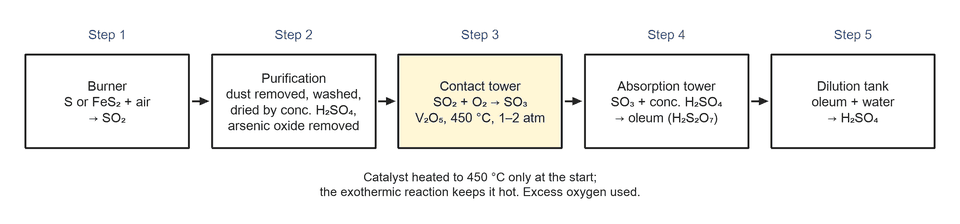
V2O5 (or platinum) is the catalyst for the oxidation of sulphur dioxide. A is true:
2SO2+O21–2 atm⇌V2O5, 450 °C2SO3+heat
Step 2 — Judge the Reason.
The reaction is exothermic, so the catalyst is heated to about 450 °C only at the start; the heat given out then keeps it hot. R is true.
Step 3 — Decide whether R explains A.
R explains why heating is needed only at the beginning. It does not explain why a catalyst is used (the reason is that without one the reaction is far too slow). So R does not explain A.
Watch out: Two true statements about the same reaction are not enough for code (1); R must give the reason for A.
Why the other options are wrong:
- (A) (1): it says R explains A, but R is about the heating, not about the need for a catalyst.
- (C) (3): it says R is false, but R is true.
- (D) (4): it says A is false, but A is true.
Therefore, both A and R are true but R does not explain A: code (2), option (B).
