Study of Compounds – Sulphuric Acid · Question 48 of 49
What property of conc.
Question 485 marksMedium
What property of conc. H2SO4 is made use of in each of the following cases? Give an equation for the reaction in each case :
(a) in the production of HCl gas when it reacts with a chloride,
(b) in the preparation of CO from HCOOH,
(c) as a source of hydrogen by diluting it and adding a strip of magnesium,
(d) in the preparation of sulphur dioxide by warming a mixture of conc. sulphuric acid and copper-turnings,
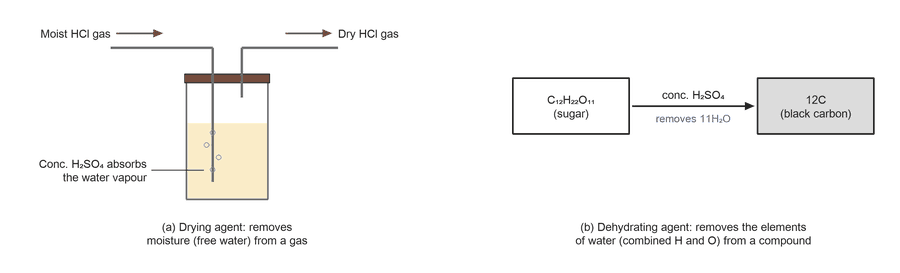
(e) hydrogen chloride gas is passed through concentrated sulphuric acid.
(f) its reaction with (i) Ethanol (ii) Carbon.
Solution:
Concept: For each case, name the property, then show it with an equation. Conc. H2SO4 is non-volatile, a dehydrating agent, a drying agent and an oxidising agent; the dilute acid is a typical acid.
Step 1 — (a) HCl from a chloride.
This is the non-volatile nature. The acid boils at about 338 °C, so on heating it drives the volatile acid HCl out of a chloride:
NaCl+H2SO4below 200 °CNaHSO4+HCl↑
Step 2 — (b) CO from formic acid.
This is the dehydrating property. The acid removes the elements of water from formic acid, leaving carbon monoxide:
HCOOHconc. H2SO4CO+H2O
Step 3 — (c) Hydrogen from magnesium.
This is the acidic nature of the dilute acid. Diluted, it behaves as a typical acid and gives hydrogen with magnesium, an active metal:
Mg+H2SO4→MgSO4+H2↑
Step 4 — (d) Sulphur dioxide from copper.
This is the oxidising property. Copper is below hydrogen, so it gives no hydrogen; instead the warm conc. acid oxidises the copper and is reduced to sulphur dioxide:
Cu+2H2SO4→CuSO4+SO2↑+2H2O
Step 5 — (e) Hydrogen chloride passed through the acid.
This is the drying property (hygroscopic nature). The acid absorbs the moisture from the gas. HCl does not react with it, so there is no chemical equation: the gas simply comes out dry.
Step 6 — (f) (i) Ethanol.
This is the dehydrating property. A molecule of water is removed from ethanol at 170 °C, giving ethene:
C2H5OHconc. H2SO4170 °CC2H4↑+H2O
Step 7 — (f) (ii) Carbon.
This is the oxidising property. Carbon is oxidised to carbon dioxide and the acid is reduced to sulphur dioxide:
C+2H2SO4→CO2+2SO2+2H2O
Watch out: Drying (e) removes free moisture from a gas and needs no equation; dehydrating (b, f(i)) removes combined water from a compound.
Therefore, (a) non-volatile acid; (b) dehydrating agent; (c) acidic nature of the dilute acid; (d) oxidising agent; (e) drying agent; (f) (i) dehydrating agent, (ii) oxidising agent.