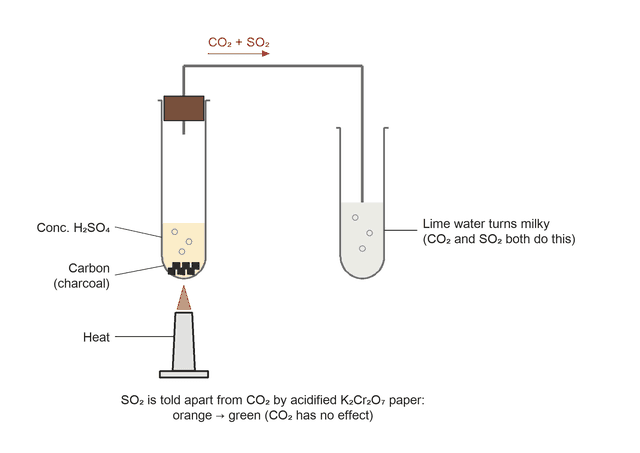
(i) The oxidizing action of conc. Sulphuric acid on Carbon.
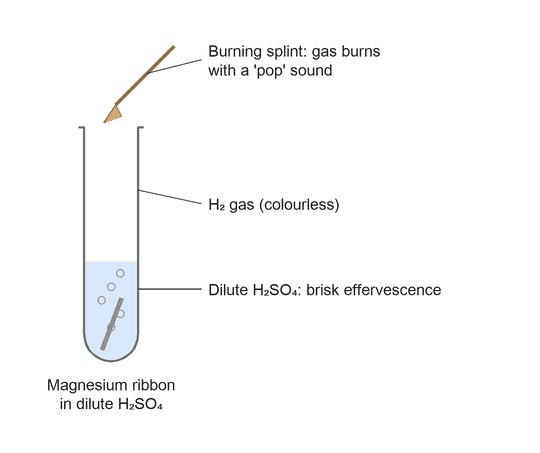
(ii) The behavior of H2SO4 as an acid when it reacts with Magnesium.
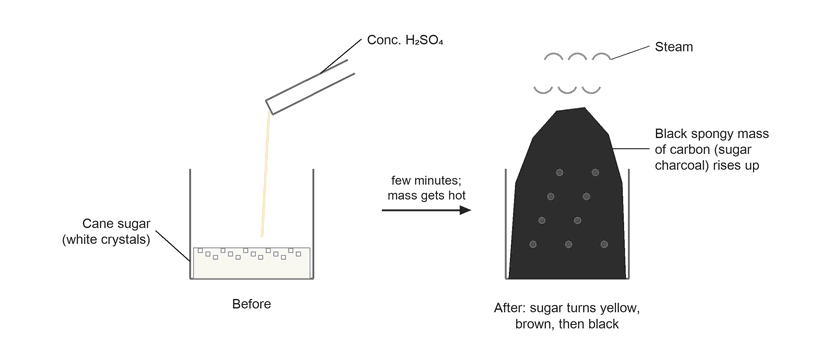
(iii) The dehydrating property of conc. Sulphuric acid with sugar.
Solution:
Concept: Concentrated sulphuric acid acts as an oxidising agent (with carbon) and a dehydrating agent (with sugar), while dilute sulphuric acid behaves as a typical acid (with an active metal such as magnesium).
Step 1 — (i) Oxidising action on carbon.
Hot concentrated sulphuric acid gives nascent oxygen. Carbon takes this oxygen and is oxidised to carbon dioxide, and the acid is reduced to sulphur dioxide. Counting atoms: C 1, H 4, S 2 and O 8 on each side.
C+2H2SO4(conc.)→CO2↑+2SO2↑+2H2O
Step 2 — (ii) Acid behaviour with magnesium.
Magnesium is above hydrogen in the activity series, so it displaces hydrogen from dilute sulphuric acid, forming magnesium sulphate and hydrogen gas.
Mg+H2SO4(dil.)→MgSO4+H2↑
Step 3 — (iii) Dehydrating action on sugar.
Concentrated sulphuric acid removes hydrogen and oxygen from cane sugar in the ratio 2 : 1, as water, and a black, spongy mass of carbon (sugar charcoal) is left. Counting atoms: C 12, H 22 and O 11 on each side.
C12H22O11conc. H2SO412C+11H2O
Watch out: For (ii) the acid must be dilute; hot concentrated sulphuric acid would give sulphur dioxide with metals instead of hydrogen.