
Opening your dashboard
Class 10 Chemistry Chapter 11 Study of Compounds – Sulphuric Acid: Previous Year Questions
34 questions on Chapter 11, each solved step by step. Class 10 Chemistry, ICSE 2026-27.
34 questions with solutions
1–5 marks · Mixed difficulty
- 11 mark
Question 1
Write balanced chemical equations for each of the following:
Action of dilute Sulphuric acid on Sodium Sulphite.
Solve with AIWritten solution
Solution:
Concept: Dilute sulphuric acid shows the typical properties of an acid: it neutralises bases, reacts with active metals to give hydrogen, and decomposes carbonates, sulphites and sulphides. A sulphite reacts with an acid to give a salt, water and sulphur dioxide gas.
Step 1 — Name the reactants and the products.
Sodium sulphite reacts with dilute sulphuric acid. The sulphate ion of the acid takes the sodium, giving sodium sulphate, and the sulphite part breaks up into water and sulphur dioxide.
Step 2 — Write and balance the equation.
There are two sodium atoms on each side, two sulphur atoms on each side (one in the sulphite and one in the acid), two hydrogen atoms on each side and seven oxygen atoms on each side, so the equation is balanced as written:
Step 3 — What is seen.
There is effervescence of a colourless gas with the smell of burning sulphur. The gas turns acidified potassium dichromate paper from orange to green, which shows that it is sulphur dioxide.
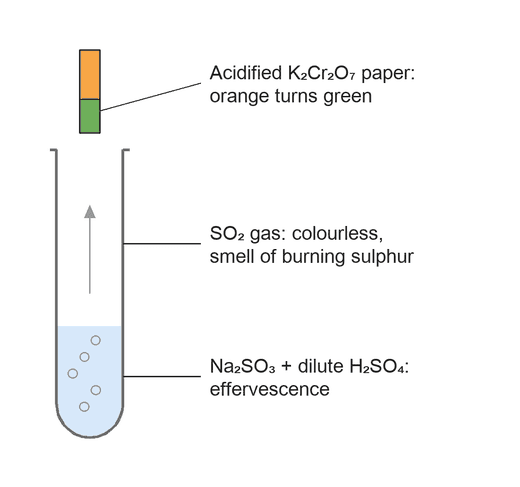
Watch out: A sulphite gives sulphur dioxide (SO₂), while a sulphate gives no gas with dilute acid; do not write SO₃ as a product.
Therefore, Na₂SO₃ + H₂SO₄ → Na₂SO₄ + H₂O + SO₂↑.
- 23 marks
Question 2
A, B, C and D summarize the properties of sulphuric acid depending on whether it is dilute or concentrated.
A: Typical acid property
B: Non-volatile acid
C: Oxidizing agent
D: Dehydrating agent
Choose the property [A, B, C or D] depending on which is relevant to each of the following:
(i) Preparation of hydrogen chloride gas.
(ii) Preparation of copper sulphate from copper oxide.
(iii) Action of conc. sulphuric acid on sulphur.
Solve with AIWritten solution
Solution:
Concept: Dilute sulphuric acid shows the typical properties of an acid: it neutralises bases, reacts with active metals to give hydrogen, and decomposes carbonates, sulphites and sulphides. Concentrated sulphuric acid is also non-volatile, an oxidising agent and a dehydrating agent. To match a reaction with a property, look at what the acid actually does in that reaction.
Step 1 — (i) Preparation of hydrogen chloride gas — B.
Sodium chloride is heated with concentrated sulphuric acid. Sulphuric acid has a very high boiling point (about 338 °C), so it stays in the flask, while the volatile hydrogen chloride gas is driven off. This is the non-volatile acid property (B).
Step 2 — (ii) Preparation of copper sulphate from copper oxide — A.
Copper oxide is a base. Dilute sulphuric acid neutralises it and gives a salt and water, exactly as any acid does. This is the typical acid property (A).
Step 3 — (iii) Action of conc. sulphuric acid on sulphur — C.
Hot concentrated sulphuric acid gives nascent oxygen, which oxidises sulphur to sulphur dioxide; the acid itself is reduced to sulphur dioxide. This is the oxidising agent property (C).

Watch out: In (i) the acid is not acting as a dehydrating agent; it simply stays behind because it does not boil off.
Therefore, (i) B — non-volatile acid; (ii) A — typical acid property; (iii) C — oxidising agent.
- 31 mark
Question 3
Write a balanced chemical equation for each of the following:
Action of concentrated sulphuric acid on Sulphur.
Solve with AIWritten solution
Solution:
Concept: Hot concentrated sulphuric acid is an oxidising agent. On heating it breaks up and gives nascent oxygen [O], which oxidises non-metals such as carbon and sulphur; the acid itself is reduced to sulphur dioxide.
Step 1 — Identify what happens.
Sulphur is a non-metal. When it is heated with concentrated sulphuric acid, the acid gives it oxygen, so sulphur is oxidised to sulphur dioxide. The acid loses oxygen and is reduced, also to sulphur dioxide, and water is formed.
Step 2 — Write and balance the equation.
One sulphur atom needs two units of nascent oxygen to become one SO₂, so two molecules of acid are used. Counting atoms: sulphur 3 on each side, hydrogen 4 on each side and oxygen 8 on each side.
Step 3 — Why the acid is the oxidising agent.
Sulphur gains oxygen (it is oxidised); sulphuric acid loses oxygen (it is reduced). The acid supplies the oxygen, so it is the oxidising agent here.

Watch out: All three sulphur atoms on the right end up as SO₂ (one from the sulphur and two from the acid), so the coefficient of SO₂ is 3, not 1.
Therefore, S + 2H₂SO₄ (conc.) → 3SO₂↑ + 2H₂O.
- 41 mark
Question 4
State one relevant observation for each of the following reactions:
Action of concentrated Sulphuric acid on hydrated copper sulphate.
Solve with AIWritten solution
Solution:
Concept: Concentrated sulphuric acid is a dehydrating agent: it has a very strong attraction for water, so it removes the elements of water (hydrogen and oxygen in the ratio 2 : 1) from compounds, or the water of crystallisation from hydrated salts.
Step 1 — Know what blue copper sulphate is.
Hydrated copper sulphate, , is blue because of its five molecules of water of crystallisation.
Step 2 — See what the acid does.
Concentrated sulphuric acid removes this water of crystallisation, leaving anhydrous copper sulphate, which has no water and is white.
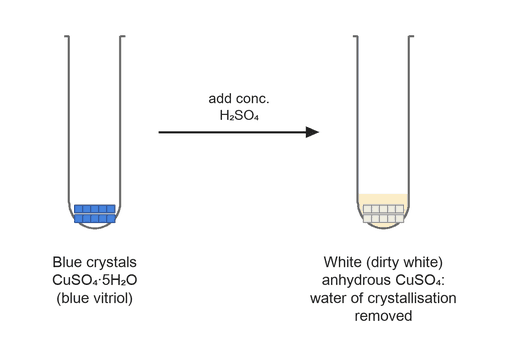
Watch out: The observation is a colour change of the solid (blue to white); no gas is given off.
Therefore, the blue crystals of hydrated copper sulphate turn white (dirty white anhydrous copper sulphate).
- 53 marks
Question 5
Write balanced chemical equations to show:
(i) The oxidizing action of conc. Sulphuric acid on Carbon.
(ii) The behavior of as an acid when it reacts with Magnesium.
(iii) The dehydrating property of conc. Sulphuric acid with sugar.
Solve with AIWritten solution
Solution:
Concept: Concentrated sulphuric acid acts as an oxidising agent (with carbon) and a dehydrating agent (with sugar), while dilute sulphuric acid behaves as a typical acid (with an active metal such as magnesium).
Step 1 — (i) Oxidising action on carbon.
Hot concentrated sulphuric acid gives nascent oxygen. Carbon takes this oxygen and is oxidised to carbon dioxide, and the acid is reduced to sulphur dioxide. Counting atoms: C 1, H 4, S 2 and O 8 on each side.
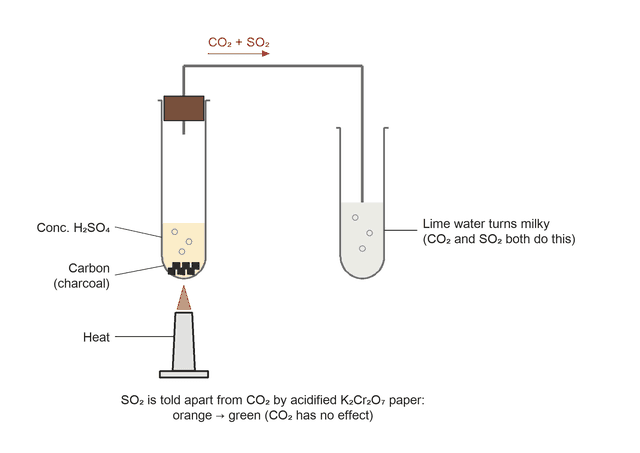
Step 2 — (ii) Acid behaviour with magnesium.
Magnesium is above hydrogen in the activity series, so it displaces hydrogen from dilute sulphuric acid, forming magnesium sulphate and hydrogen gas.
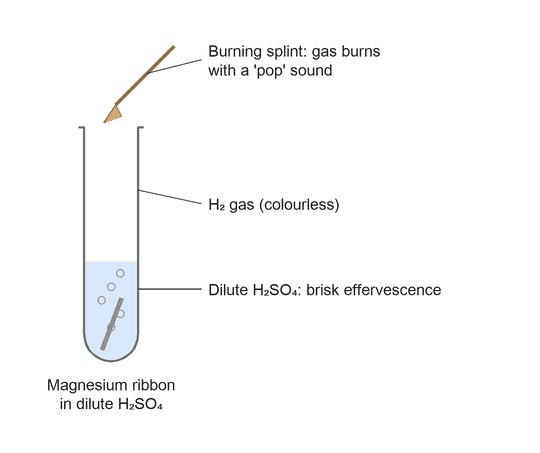
Step 3 — (iii) Dehydrating action on sugar.
Concentrated sulphuric acid removes hydrogen and oxygen from cane sugar in the ratio 2 : 1, as water, and a black, spongy mass of carbon (sugar charcoal) is left. Counting atoms: C 12, H 22 and O 11 on each side.
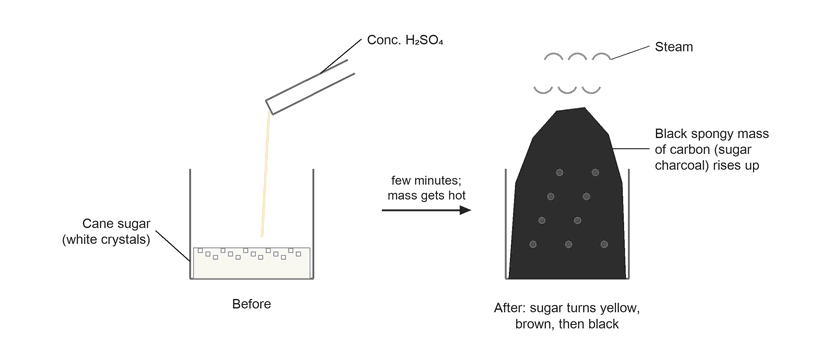
Watch out: For (ii) the acid must be dilute; hot concentrated sulphuric acid would give sulphur dioxide with metals instead of hydrogen.
Therefore, (i) C + 2H₂SO₄ → CO₂ + 2SO₂ + 2H₂O; (ii) Mg + H₂SO₄ → MgSO₄ + H₂; (iii) C₁₂H₂₂O₁₁ → 12C + 11H₂O (with conc. H₂SO₄).
- 62 marks
Question 6
Write balanced chemical equations to show how is converted to Sulphuric acid in the contact process.
Solve with AIWritten solution
Solution:
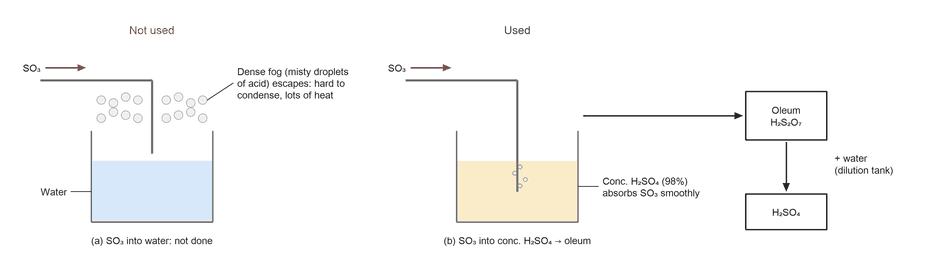
Concept: In the Contact process, sulphur (or iron pyrites) is burnt to sulphur dioxide; the purified, dry sulphur dioxide is oxidised by air to sulphur trioxide over vanadium pentoxide at about 450 °C; the sulphur trioxide is absorbed in concentrated sulphuric acid to give oleum, which is diluted with water to give sulphuric acid. Sulphur trioxide does not dissolve in water satisfactorily. The reaction gives out a lot of heat, and the acid formed comes off as a dense fog of misty droplets that is very hard to condense, so much of it would be lost.
Step 1 — Absorb SO₃ in concentrated sulphuric acid.
Sulphur trioxide from the contact tower is passed into 98% concentrated sulphuric acid in the absorption tower. It dissolves smoothly and forms oleum (pyrosulphuric acid).
Step 2 — Dilute the oleum with water.
The oleum is run into the dilution tank and mixed with the calculated amount of water. Each molecule of oleum gives two molecules of sulphuric acid.
Step 3 — Why water is not used directly.
If sulphur trioxide were passed straight into water, much heat would be given out and the acid would form a dense mist of droplets that is very hard to condense, so much of it would be lost. Absorbing it in concentrated acid avoids this.
Watch out: The question asks for SO₃ → H₂SO₄, so both steps (oleum, then dilution) are needed, not SO₃ + H₂O → H₂SO₄.
Therefore, SO₃ + H₂SO₄ → H₂S₂O₇ (oleum), then H₂S₂O₇ + H₂O → 2H₂SO₄.
- 71 mark
Question 7
The catalyst used in the Contact Process is:
Solve with AIAnswer
(A) Copper
(B) Iron
- Correct
(C) Vanadium pentoxide
(D) Manganese dioxide
Answer: (C) Vanadium pentoxide
Concept: In the Contact process, sulphur (or iron pyrites) is burnt to sulphur dioxide; the purified, dry sulphur dioxide is oxidised by air to sulphur trioxide over vanadium pentoxide at about 450 °C; the sulphur trioxide is absorbed in concentrated sulphuric acid to give oleum, which is diluted with water to give sulphuric acid.
Step 1 — Find the catalysed step.
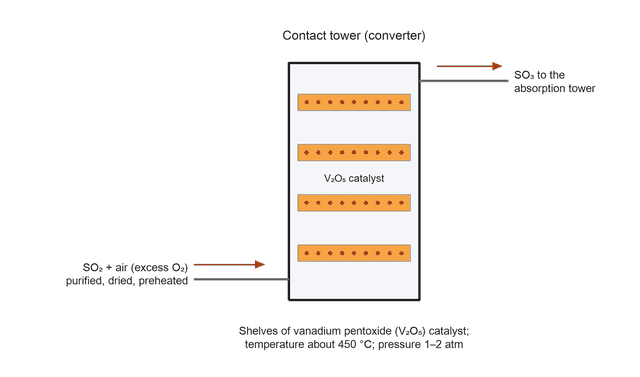
The only catalysed step of the Contact process is the oxidation of sulphur dioxide to sulphur trioxide in the contact tower (converter), at about 450 °C and 1–2 atm.
Step 2 — Name the catalyst.
The catalyst is vanadium pentoxide, . Platinum also works and is more efficient, but it is costly and is easily poisoned by impurities such as arsenic oxide, so vanadium pentoxide is used.
Watch out: Iron is the catalyst of the Haber process, not of the Contact process; do not mix up the two industrial processes.
Why the other options are wrong:
- (A) Copper: copper is not the catalyst for any step of the Contact process.
- (B) Iron: finely divided iron is the catalyst of the Haber process for ammonia, not of the Contact process.
- (D) Manganese dioxide: manganese dioxide is the catalyst used when potassium chlorate or hydrogen peroxide is decomposed to give oxygen.
Therefore, the catalyst used in the Contact process is vanadium pentoxide, option (C).
- 81 mark
Question 8
Write a balanced chemical equation for each of the following:
Action of concentrated sulphuric acid on carbon.
Solve with AIWritten solution
Solution:
Concept: Hot concentrated sulphuric acid is an oxidising agent. On heating it breaks up and gives nascent oxygen [O], which oxidises non-metals such as carbon and sulphur; the acid itself is reduced to sulphur dioxide.
Step 1 — Identify what happens.
Carbon is a non-metal. Heated with concentrated sulphuric acid, it takes oxygen from the acid and is oxidised to carbon dioxide, while the acid is reduced to sulphur dioxide and water.
Step 2 — Write and balance the equation.
One carbon atom needs two units of nascent oxygen to become CO₂, so two molecules of acid are used. Counting atoms: carbon 1, hydrogen 4, sulphur 2 and oxygen 8 on each side.
Watch out: Two different gases are formed, CO₂ and SO₂; leaving out either one makes the equation unbalanced.
Therefore, C + 2H₂SO₄ (conc.) → CO₂↑ + 2SO₂↑ + 2H₂O.
- 91 mark
Question 9
State one relevant observation for each of the following:
Barium chloride solution is slowly added to sodium sulphate solution.
Solve with AIWritten solution
Solution:
Concept: Barium chloride solution is the test for a sulphate ion: barium sulphate is insoluble in water and in dilute mineral acids, so it appears as a white precipitate.
Step 1 — Write the reaction.
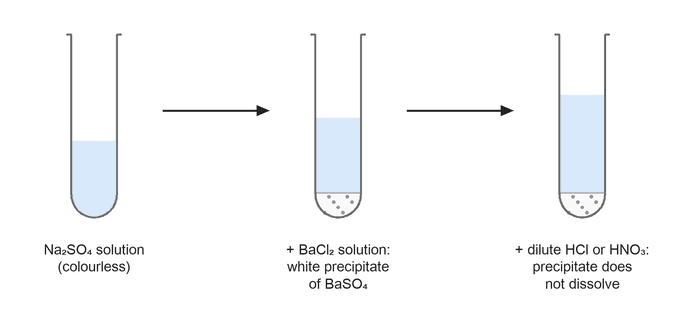
Barium ions from barium chloride meet sulphate ions from sodium sulphate and form insoluble barium sulphate; sodium chloride stays in solution.
Step 2 — State the observation.
A white precipitate of barium sulphate forms. It does not dissolve even when dilute hydrochloric acid or dilute nitric acid is added.
Watch out: The precipitate is white, not yellow or curdy; a curdy white precipitate that dissolves in ammonia is silver chloride, a different test.
Therefore, a white precipitate of barium sulphate (BaSO₄) is formed, insoluble in dilute HCl or HNO₃.
- 102 marks
Question 10
Which property of sulphuric acid is shown by the reaction of concentrated sulphuric acid with:
(i) Ethanol?
(ii) Carbon?
Solve with AIWritten solution
Solution:
Concept: Look at what the acid takes from, or gives to, the other substance. If it removes the elements of water, it is acting as a dehydrating agent; if it supplies oxygen, it is acting as an oxidising agent.
Step 1 — (i) Ethanol — dehydrating property.
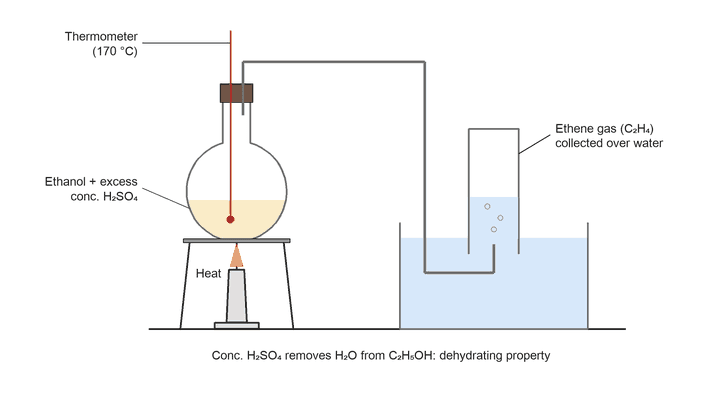
Ethanol heated with excess concentrated sulphuric acid at about 170 °C loses one molecule of water, made of its own hydrogen and oxygen, and gives ethene gas. The acid has removed the elements of water, so it is acting as a dehydrating agent.
Step 2 — (ii) Carbon — oxidising property.
Hot concentrated sulphuric acid gives nascent oxygen, which oxidises carbon to carbon dioxide; the acid is reduced to sulphur dioxide. The acid has supplied oxygen, so it is acting as an oxidising agent.
Watch out: With ethanol the acid takes water out of the molecule; it does not add oxygen, so it is not oxidation.
Therefore, (i) with ethanol: dehydrating property; (ii) with carbon: oxidising property.
- 111 mark
Question 11
Write a balanced chemical equation for each of the following reactions:
Action of dilute sulphuric acid on zinc sulphide.
Solve with AIWritten solution
Solution:
Concept: Dilute sulphuric acid shows the typical properties of an acid: it neutralises bases, reacts with active metals to give hydrogen, and decomposes carbonates, sulphites and sulphides. A metal sulphide reacts with a dilute acid to give a salt and hydrogen sulphide gas.
Step 1 — Write and balance the equation.
Zinc sulphide exchanges its sulphide for the sulphate of the acid. Counting atoms: Zn 1, S 2, H 2 and O 4 on each side, so the equation is balanced as written.
Step 2 — How the gas is recognised.
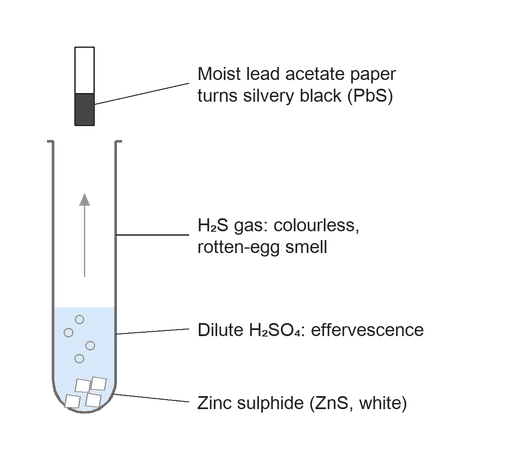
Hydrogen sulphide is a colourless gas with the smell of rotten eggs. It turns moist lead acetate paper silvery black, because black lead sulphide forms on the paper.
Watch out: Use DILUTE acid: concentrated sulphuric acid oxidises hydrogen sulphide, so it is not used to make this gas.
Therefore, ZnS + H₂SO₄ → ZnSO₄ + H₂S↑.
- 121 mark
Question 12
The acid which can produce carbon from cane sugar, is:
Solve with AIAnswer
(A) Concentrated Hydrochloric acid
(B) Concentrated Nitric acid
- Correct
(C) Concentrated Sulphuric acid
(D) Concentrated Acetic acid
Answer: (C) Concentrated Sulphuric acid
Concept: Concentrated sulphuric acid is a dehydrating agent: it has a very strong attraction for water, so it removes the elements of water (hydrogen and oxygen in the ratio 2 : 1) from compounds, or the water of crystallisation from hydrated salts.
Step 1 — Recognise the reaction.
Producing carbon from cane sugar means taking away all of its hydrogen and oxygen as water. That is dehydration, and the acid that does it is concentrated sulphuric acid.
Step 2 — What is seen.
The white sugar turns yellow, then brown and finally black. A black, spongy mass of carbon (sugar charcoal) rises up, steam is given off and the mass becomes hot.
Watch out: This is dehydration, not oxidation: the carbon is left behind, not burnt.
Why the other options are wrong:
- (A) Concentrated Hydrochloric acid: concentrated hydrochloric acid is not a dehydrating agent, so it does not char sugar.
- (B) Concentrated Nitric acid: concentrated nitric acid is an oxidising acid; it oxidises sugar (to oxalic acid) instead of leaving a mass of carbon.
- (D) Concentrated Acetic acid: concentrated (glacial) acetic acid is a weak organic acid with no dehydrating action on sugar.
Therefore, the acid that produces carbon from cane sugar is concentrated sulphuric acid, option (C).
- 131 mark
Question 13
Identify the substance underlined in each of the following:
(ii) The acid that is a dehydrating as well as a drying agent.
Solve with AIWritten solution
Solution:
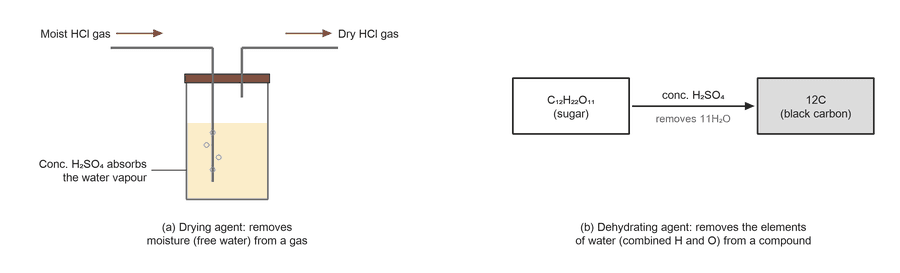
Concept: A drying agent removes moisture (free water) from a substance such as a gas. A dehydrating agent removes the elements of water (hydrogen and oxygen in the ratio 2 : 1) that are chemically combined in a compound.
Step 1 — Name the acid.
The acid that does both jobs is concentrated sulphuric acid, , because it has a very strong attraction for water.
Step 2 — As a drying agent.
Gases that do not react with it, such as hydrogen chloride and sulphur dioxide, are dried by bubbling them through concentrated sulphuric acid, which takes up the water vapour.
Step 3 — As a dehydrating agent.
It removes the elements of water from cane sugar and leaves carbon behind.
Watch out: Concentrated sulphuric acid cannot dry ammonia, because it reacts with this basic gas.
Therefore, the acid is concentrated sulphuric acid (H₂SO₄).
- 141 mark
Question 14
The acid which is least volatile is:
Solve with AIAnswer
(A) Hydrochloric acid
(B) Nitric acid
(C) Dilute sulphuric acid
- Correct
(D) Concentrated sulphuric acid
Answer: (D) Concentrated sulphuric acid
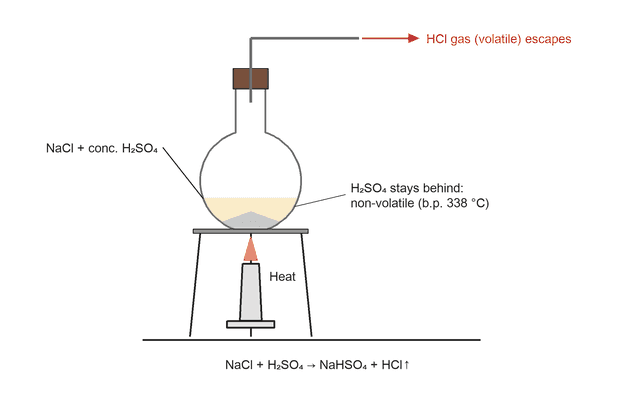
Concept: Concentrated sulphuric acid is a non-volatile acid: its boiling point is very high (about 338 °C), so on heating it stays in the flask while a more volatile acid formed from a salt is driven off as a gas.
Step 1 — Compare how easily each acid turns into vapour.
An acid is volatile if it turns into vapour easily. Concentrated sulphuric acid boils only at about 338 °C, far higher than hydrochloric acid or nitric acid, so it is the least volatile.
Step 2 — Use of this property.
Because it does not vaporise easily, concentrated sulphuric acid is used to prepare the volatile acids, hydrochloric acid and nitric acid, from their salts: the volatile acid distils off and sulphuric acid stays behind.
Watch out: Dilute sulphuric acid is mostly water, so it is not the least volatile; the property belongs to the concentrated acid.
Why the other options are wrong:
- (A) Hydrochloric acid: hydrochloric acid is volatile: hydrogen chloride gas escapes from it easily, and the concentrated acid fumes in moist air.
- (B) Nitric acid: nitric acid is volatile; it is itself made by distilling it out of a nitrate heated with concentrated sulphuric acid.
- (C) Dilute sulphuric acid: dilute sulphuric acid is mostly water, which evaporates at about 100 °C, so it gives off vapour much more easily than the concentrated acid.
Therefore, the least volatile acid is concentrated sulphuric acid, option (D).
- 151 mark
Question 15
Vanadium pentoxide is used as a catalyst in the preparation of:
Solve with AIAnswer
(A) Nitrogen gas
(B) Nitrogen dioxide gas
- Correct
(C) Sulphur trioxide gas
(D) Carbon dioxide gas
Answer: (C) Sulphur trioxide gas
Concept: In the Contact process, sulphur (or iron pyrites) is burnt to sulphur dioxide; the purified, dry sulphur dioxide is oxidised by air to sulphur trioxide over vanadium pentoxide at about 450 °C; the sulphur trioxide is absorbed in concentrated sulphuric acid to give oleum, which is diluted with water to give sulphuric acid.
Step 1 — Find where vanadium pentoxide is used.
Vanadium pentoxide is the catalyst of the contact tower. There it speeds up the oxidation of sulphur dioxide by oxygen.
Step 2 — Name the product.
The product of this catalysed step is sulphur trioxide gas, which is then absorbed in concentrated sulphuric acid to make oleum and finally sulphuric acid.
Watch out: The question asks for the gas made with the catalyst (SO₃), not the final product of the whole process (H₂SO₄).
Why the other options are wrong:
- (A) Nitrogen gas: nitrogen gas is obtained from liquid air or by heating ammonium nitrite; vanadium pentoxide plays no part.
- (B) Nitrogen dioxide gas: nitrogen dioxide comes from heating heavy-metal nitrates or from concentrated nitric acid acting on copper; no catalyst is used.
- (D) Carbon dioxide gas: carbon dioxide comes from burning carbon or from an acid acting on a carbonate; no catalyst is needed.
Therefore, vanadium pentoxide is the catalyst in the preparation of sulphur trioxide gas, option (C).
- 161 mark
Question 16
State the following:
(b) A substance added to water, to manufacture sulphuric acid in Contact process.
Solve with AIWritten solution
Solution:
Concept: In the Contact process, sulphur (or iron pyrites) is burnt to sulphur dioxide; the purified, dry sulphur dioxide is oxidised by air to sulphur trioxide over vanadium pentoxide at about 450 °C; the sulphur trioxide is absorbed in concentrated sulphuric acid to give oleum, which is diluted with water to give sulphuric acid.
Step 1 — Find the last step.
In the last step of the Contact process, the oleum formed in the absorption tower is run into the dilution tank and mixed with a calculated amount of water to give sulphuric acid of the required strength.
Step 2 — Why oleum is used.
Sulphur trioxide itself is not put into water, because it forms a dense fog of acid droplets that is hard to condense. So it is first absorbed in concentrated sulphuric acid to make oleum, and it is the oleum that is added to water.
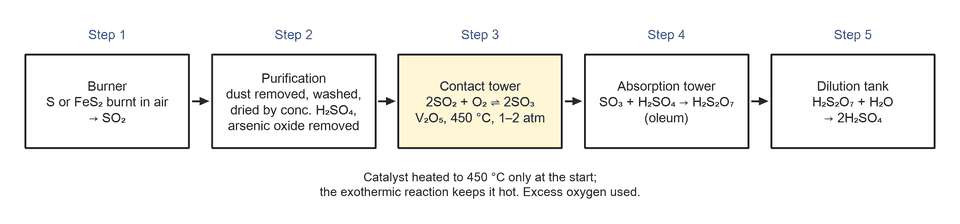
Watch out: The substance added to water is oleum (H₂S₂O₇), not sulphur trioxide.
Therefore, the substance is oleum (pyrosulphuric acid, H₂S₂O₇).
- 171 mark
Question 17
Identify the terms for the following:
(c) The chemical property of sulphuric acid to form two types of salts with an alkali.
Solve with AIWritten solution
Solution:
Concept: The basicity of an acid is the number of hydrogen ions that one molecule of it can give (the number of replaceable hydrogen atoms). Sulphuric acid has two, so it is dibasic; hydrochloric acid has one, so it is monobasic.
Step 1 — Name the term.
The property that decides how many types of salt an acid can form is its basicity. Sulphuric acid has basicity 2: it is a dibasic acid.
Step 2 — Acid salt: one hydrogen replaced.
When only one of the two hydrogen atoms is replaced by sodium, the acid salt sodium hydrogen sulphate forms.
Step 3 — Normal salt: both hydrogens replaced.
When both hydrogen atoms are replaced, the normal salt sodium sulphate forms.
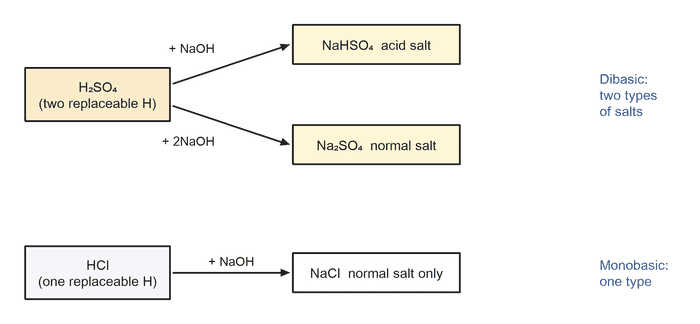
Watch out: Basicity counts replaceable hydrogen atoms, not all hydrogen atoms in the formula.
Therefore, the term is basicity: sulphuric acid is dibasic, so it forms an acid salt (NaHSO₄) and a normal salt (Na₂SO₄).
- 182 marks
Question 18
Differentiate between the following pairs based on the criteria given in the brackets:
(a) Cane sugar and hydrated copper sulphate [using concentrated ]
(b) Sulphuric acid and hydrochloric acid [type of salts formed]
Solve with AIWritten solution
Solution:
Concept: (a) Concentrated sulphuric acid is a dehydrating agent with both substances, but what is seen differs: sugar is charred to carbon, while copper sulphate only loses its water of crystallisation. (b) The basicity of an acid is the number of hydrogen ions that one molecule of it can give (the number of replaceable hydrogen atoms). Sulphuric acid has two, so it is dibasic; hydrochloric acid has one, so it is monobasic.
Step 1 — (a) Cane sugar with conc. sulphuric acid.
The acid removes all the hydrogen and oxygen of the sugar as water. The white sugar turns yellow, brown and then black, and a black, spongy mass of carbon (sugar charcoal) rises up; steam is given off and the mass gets hot.
Step 2 — (a) Hydrated copper sulphate with conc. sulphuric acid.
Here the acid removes only the water of crystallisation. The blue crystals turn white (dirty white anhydrous copper sulphate); no black carbon is formed.
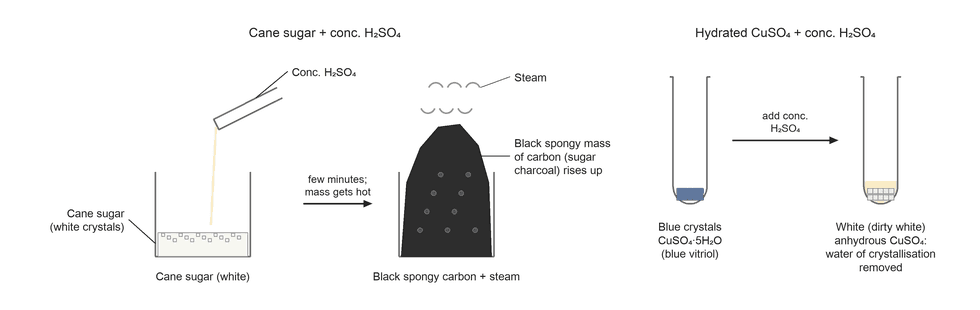
Step 3 — (b) Sulphuric acid: two types of salt.
Sulphuric acid is dibasic (two replaceable hydrogen atoms), so it forms an acid salt when one hydrogen is replaced and a normal salt when both are replaced.
Step 4 — (b) Hydrochloric acid: one type of salt.
Hydrochloric acid is monobasic (one replaceable hydrogen atom), so it forms only one type of salt, the normal salt.
Watch out: In (a) both changes are dehydration; the difference asked for is what you SEE (black spongy carbon versus blue to white).
Therefore, (a) cane sugar chars to a black spongy mass of carbon, while blue hydrated copper sulphate turns white; (b) sulphuric acid (dibasic) forms two types of salts, acid and normal, while hydrochloric acid (monobasic) forms only one, the normal salt.
- 191 mark
Question 19
The oxidizing agent in the equation is:
Solve with AIAnswer
(A) Sulphur
- Correct
(B) Sulphuric acid
(C) Sulphur dioxide
(D) Water
Answer: (B) Sulphuric acid
Concept: Oxidation is the gain of oxygen (or loss of hydrogen); reduction is the loss of oxygen (or gain of hydrogen). The substance that gives oxygen to another, and is itself reduced, is the oxidising agent; the substance that takes the oxygen, and is itself oxidised, is the reducing agent.
Step 1 — Follow the sulphur.
Sulphur changes from S to SO₂: it gains oxygen, so sulphur is oxidised. That makes sulphur the reducing agent.
Step 2 — Follow the acid.
Sulphuric acid changes to SO₂ and water: it loses oxygen, so the acid is reduced. Heated concentrated sulphuric acid gives up nascent oxygen:
Step 3 — Name the oxidising agent.
The substance that supplies the oxygen and is itself reduced is the oxidising agent, so the oxidising agent is sulphuric acid.
Watch out: SO₂ appears on the right as a product; a product is not the oxidising agent of the reaction that makes it.
Why the other options are wrong:
- (A) Sulphur: sulphur gains oxygen and is oxidised; it is the reducing agent.
- (C) Sulphur dioxide: sulphur dioxide is a product of the reaction, formed from both the sulphur and the acid.
- (D) Water: water is also a product; it neither gives nor takes oxygen in this reaction.
Therefore, the oxidising agent is sulphuric acid, option (B).
- 201 mark
Question 20
Rewrite the following statements by adding the correct word as shown in the example:
Example:
Given statement: Ammonia changes moist red litmus to blue.
Correct statement: Aqueous ammonia changes moist red litmus to blue.
(a) Sulphuric acid acts as a dehydrating agent.
Solve with AIWritten solution
Solution:
Concept: Concentrated sulphuric acid is a dehydrating agent: it has a very strong attraction for water, so it removes the elements of water (hydrogen and oxygen in the ratio 2 : 1) from compounds, or the water of crystallisation from hydrated salts.
Step 1 — Decide which form of the acid is meant.
Only the concentrated acid can take water away from other substances. Dilute sulphuric acid already contains a great deal of water, so it cannot act as a dehydrating (or drying) agent.
Step 2 — Check with an example.
Concentrated sulphuric acid removes the elements of water from cane sugar and leaves carbon:
Watch out: The missing word is 'Concentrated', not 'Dilute'; dilute sulphuric acid shows only the typical acid properties.
Therefore, the correct statement is: Concentrated sulphuric acid acts as a dehydrating agent.
- 213 marks
Question 21
The following table is related to an Industrial process of an acid.
Name of the process Reactant Catalyst Final product (a) (b) (c) Identify (a), (b) and (c).
Solve with AIWritten solution
Solution:
Concept: In the Contact process, sulphur (or iron pyrites) is burnt to sulphur dioxide; the purified, dry sulphur dioxide is oxidised by air to sulphur trioxide over vanadium pentoxide at about 450 °C; the sulphur trioxide is absorbed in concentrated sulphuric acid to give oleum, which is diluted with water to give sulphuric acid.
Step 1 — (a) Name the process.
Sulphur dioxide and oxygen reacting over a catalyst is the key step in the industrial manufacture of sulphuric acid, so the process is the Contact process.
Step 2 — (b) Name the catalyst.
The catalyst is vanadium pentoxide, , used at about 450 °C and 1–2 atm.
Step 3 — (c) Name the final product.
The sulphur trioxide formed is absorbed in concentrated sulphuric acid to give oleum, and the oleum is diluted with water. The final product of the process is therefore sulphuric acid, .
Watch out: The catalysed step itself gives sulphur trioxide; the FINAL product of the industrial process named in (a) is sulphuric acid.
Note: if (c) is read as the product of the catalysed reaction SO₂ + O₂ alone, the answer is sulphur trioxide (SO₃); both readings are explained above.
Therefore, (a) Contact process; (b) vanadium pentoxide (V₂O₅); (c) sulphuric acid (H₂SO₄).
- 221 mark
Question 22
In the reaction given below sulphuric acid acts as a/an:
Solve with AIAnswer
(A) Non-volatile acid
(B) Dibasic acid
- Correct
(C) Oxidising agent
(D) Reducing agent
Answer: (C) Oxidising agent
Concept: Hot concentrated sulphuric acid is an oxidising agent. On heating it breaks up and gives nascent oxygen [O], which oxidises non-metals such as carbon and sulphur; the acid itself is reduced to sulphur dioxide. Oxidation is the gain of oxygen (or loss of hydrogen); reduction is the loss of oxygen (or gain of hydrogen). The substance that gives oxygen to another, and is itself reduced, is the oxidising agent; the substance that takes the oxygen, and is itself oxidised, is the reducing agent.
Step 1 — See what happens to sulphur.
Sulphur becomes sulphur dioxide: it gains oxygen, so sulphur is oxidised.
Step 2 — See what happens to the acid.
Sulphuric acid loses oxygen and is reduced to sulphur dioxide and water.
Step 3 — Name the role of the acid.
The acid supplies the oxygen that oxidises sulphur, so it acts as an oxidising agent.
Watch out: The acid is reduced in this reaction; that is exactly why it is called the oxidising agent, not the reducing agent.
Why the other options are wrong:
- (A) Non-volatile acid: the non-volatile property is used to prepare volatile acids such as HCl from their salts; no volatile acid is formed here.
- (B) Dibasic acid: the dibasic nature shows when the acid forms two types of salts with a base; no salt is formed here.
- (D) Reducing agent: the reducing agent in this reaction is sulphur, because sulphur takes the oxygen; the acid is reduced, so it is the oxidising agent.
Therefore, in this reaction sulphuric acid acts as an oxidising agent, option (C).
- 231 mark
Question 23
Assertion (A): In the Contact Process gas is not directly dissolved in water to obtain sulphuric acid.
Reason (R): Dense fog or misty droplets of sulphuric acid are formed which is difficult to condense.
Solve with AIAnswer
- Correct
(A) Both (A) and (R) are true, and (R) is the correct explanation of (A).
(B) Both (A) and (R) are true, and (R) is not the correct explanation of (A).
(C) (A) is true but (R) is false.
(D) (A) is false but (R) is true.
Answer: (A) Both (A) and (R) are true, and (R) is the correct explanation of (A).
Concept: In the Contact process, sulphur (or iron pyrites) is burnt to sulphur dioxide; the purified, dry sulphur dioxide is oxidised by air to sulphur trioxide over vanadium pentoxide at about 450 °C; the sulphur trioxide is absorbed in concentrated sulphuric acid to give oleum, which is diluted with water to give sulphuric acid. Sulphur trioxide does not dissolve in water satisfactorily. The reaction gives out a lot of heat, and the acid formed comes off as a dense fog of misty droplets that is very hard to condense, so much of it would be lost.
Step 1 — Judge the Assertion.
The Assertion is true. In the Contact process sulphur trioxide is not dissolved directly in water; it is absorbed in 98% sulphuric acid to form oleum, which is then diluted.
Step 2 — Judge the Reason.
The Reason is true. With water, sulphur trioxide gives out much heat and forms a dense fog of misty droplets of sulphuric acid that is very difficult to condense.
Step 3 — Does the Reason explain the Assertion?
Yes. The acid fog, and the loss of acid it would cause, is exactly why water is not used. So the Reason is the correct explanation of the Assertion.
Watch out: Both statements being true is not enough; also check that the Reason is the cause of the Assertion.
Why the other options are wrong:
- (B) Both (A) and (R) are true, and (R) is not the correct explanation of (A): the Reason is not a separate, unrelated fact: the fog it describes is the cause of the Assertion.
- (C) (A) is true but (R) is false: the Reason is true: dissolving SO₃ in water does produce a dense mist of acid droplets.
- (D) (A) is false but (R) is true: the Assertion is true: in the Contact process SO₃ is not dissolved directly in water.
Therefore, both the Assertion and the Reason are true, and the Reason is the correct explanation, option (A).
- 241 mark
Question 24
Match the Column A with Column B:
Column A Column B (c) 1. Vanadium Pentoxide 2. Nickel 3. Iron 4. Concentrated Sulphuric acid 5. Platinum Solve with AIWritten solution
Solution:
Concept: In the Contact process, sulphur (or iron pyrites) is burnt to sulphur dioxide; the purified, dry sulphur dioxide is oxidised by air to sulphur trioxide over vanadium pentoxide at about 450 °C; the sulphur trioxide is absorbed in concentrated sulphuric acid to give oleum, which is diluted with water to give sulphuric acid.
Step 1 — Recognise the reaction.
The reaction is the catalysed step of the Contact process, which takes place in the contact tower at about 450 °C.
Step 2 — Pick the catalyst from Column B.
The catalyst used for this step is vanadium pentoxide, item 1. Platinum also catalyses this reaction (and is more efficient), but it is costly and easily poisoned by arsenic impurities, so vanadium pentoxide is the catalyst used.
Step 3 — Place the other items.
Of the other items, platinum is the catalyst for oxidising ammonia (Ostwald process), iron for the Haber process and nickel for adding hydrogen to unsaturated compounds; concentrated sulphuric acid is a dehydrating agent, not a catalyst for this step.
Watch out: Iron belongs to the Haber process (ammonia), not to the Contact process.
Therefore, (c) matches 1. Vanadium Pentoxide.
- 251 mark
Question 25
Match the Column A with Column B:
Column A Column B (e) 1. Vanadium Pentoxide 2. Nickel 3. Iron 4. Concentrated Sulphuric acid 5. Platinum Solve with AIWritten solution
Solution:
Concept: Concentrated sulphuric acid is a dehydrating agent: it has a very strong attraction for water, so it removes the elements of water (hydrogen and oxygen in the ratio 2 : 1) from compounds, or the water of crystallisation from hydrated salts.
Step 1 — Recognise the change.
Blue hydrated copper sulphate loses its five molecules of water of crystallisation and becomes white anhydrous copper sulphate. Removing water like this is dehydration.
Step 2 — Pick the substance from Column B.
The dehydrating agent in Column B is concentrated sulphuric acid, item 4. The blue crystals turn white (dirty white).
Watch out: The other items in Column B are catalysts; this change needs a dehydrating agent, not a catalyst.
Therefore, (e) matches 4. Concentrated Sulphuric acid.
- 261 mark
Question 26
Give balanced equations for the following:
Reaction of concentrated sulphuric acid with carbon.
Solve with AIWritten solution
Solution:
Concept: Hot concentrated sulphuric acid is an oxidising agent. On heating it breaks up and gives nascent oxygen [O], which oxidises non-metals such as carbon and sulphur; the acid itself is reduced to sulphur dioxide.
Step 1 — Identify the products.
Carbon takes oxygen from hot concentrated sulphuric acid and is oxidised to carbon dioxide; the acid is reduced to sulphur dioxide and water.
Step 2 — Write and balance the equation.
One carbon atom needs two units of nascent oxygen, so two molecules of acid are used. Counting atoms: carbon 1, hydrogen 4, sulphur 2 and oxygen 8 on each side.
Watch out: The coefficient of SO₂ is 2, because each of the two acid molecules gives one SO₂.
Therefore, C + 2H₂SO₄ (conc.) → CO₂↑ + 2SO₂↑ + 2H₂O.
- 275 marks
Question 27
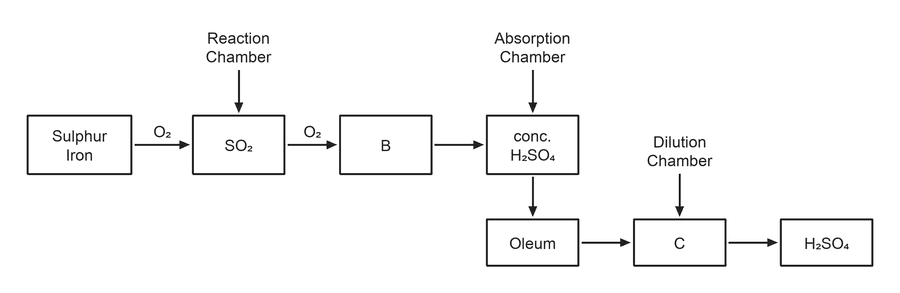
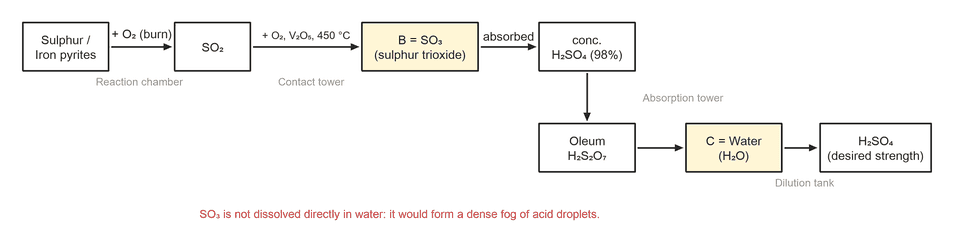
(a) Balance the chemical equation given below:
(b) Write balanced chemical equation for formation of ‘B’.
(c) Why is it necessary to convert ‘B’ to Oleum?
(d) Identify ‘C’.
(e) Write an equation for the reaction between Oleum and ‘C’.
Solve with AIWritten solution
Solution:
Concept: The chart shows the Contact process: sulphur or iron pyrites is burnt to SO₂ in the reaction chamber; SO₂ is oxidised to SO₃ (B) over a catalyst; SO₃ is absorbed in concentrated sulphuric acid to give oleum; oleum is diluted with water (C) to give sulphuric acid.
Step 1 — (a) Balance iron.
Iron(III) oxide, , contains 2 iron atoms. To get a whole number of oxygen molecules later we take 4 FeS₂, which gives 2 Fe₂O₃.
Step 2 — (a) Balance sulphur.
Each FeS₂ has 2 sulphur atoms, so 4 FeS₂ give 8 sulphur atoms, and each SO₂ takes one of them:
So 8 SO₂ are formed.
Step 3 — (a) Balance oxygen.
We count the oxygen atoms on the right: 3 in each of the 2 Fe₂O₃ and 2 in each of the 8 SO₂.
Each O₂ molecule has 2 oxygen atoms, so 22 ÷ 2 gives 11 molecules of O₂:
Step 4 — (b) Formation of B.
B is sulphur trioxide. Sulphur dioxide and excess oxygen pass over vanadium pentoxide at about 450 °C and 1–2 atm in the contact tower.
Step 5 — (c) Why B is converted to oleum.
Sulphur trioxide does not dissolve in water satisfactorily. The reaction gives out a lot of heat, and the acid formed comes off as a dense fog of misty droplets that is very hard to condense, so much of it would be lost. Absorbing SO₃ in concentrated sulphuric acid (98%) is smooth and complete, and gives oleum:
Step 6 — (d) Identify C.
C is water, , added to the oleum in the dilution chamber in the calculated amount.
Step 7 — (e) Oleum and C.
Each molecule of oleum reacts with one molecule of water to give two molecules of sulphuric acid.
Watch out: The iron oxide formed is Fe₂O₃ (iron(III) oxide), so the smallest whole-number set starts with 4 FeS₂, not 2.
Note: the first box of the printed chart reads 'Sulphur Iron'; it means sulphur or iron pyrites (FeS₂), the ore whose burning is balanced in part (a).
Therefore, (a) 4FeS₂ + 11O₂ → 2Fe₂O₃ + 8SO₂; (b) B = SO₃: 2SO₂ + O₂ ⇌ 2SO₃ (V₂O₅, 450 °C); (c) SO₃ dissolves badly in water and forms a dense acid fog that is hard to condense, so it is absorbed in conc. H₂SO₄ as oleum; (d) C = water; (e) H₂S₂O₇ + H₂O → 2H₂SO₄.
- 281 mark
Question 28
Complete the following sentences by choosing the correct answer from the brackets:
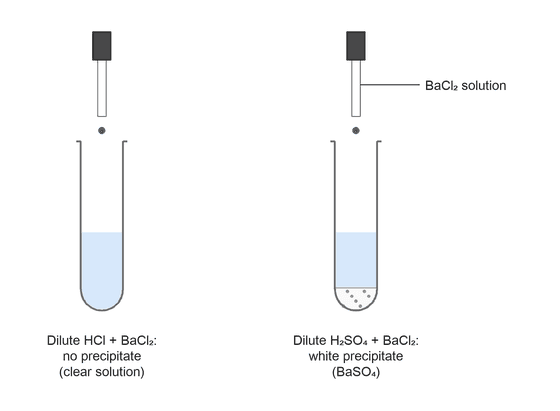
Dilute and dilute can be distinguished by adding ............... solution. [ / ]
Solve with AIWritten solution
Solution:
Concept: Barium chloride is the test for a sulphate ion: it gives a white precipitate of barium sulphate, which is insoluble in water and in dilute acids. A chloride gives no precipitate with it.
Step 1 — Dilute sulphuric acid with barium chloride.
Barium ions meet sulphate ions and form insoluble barium sulphate, so a white precipitate appears.
Step 2 — Dilute hydrochloric acid with barium chloride.
Both contain only chloride as the negative ion, and barium chloride is soluble, so no precipitate forms and the solution stays clear.
Step 3 — Why sodium nitrate cannot be used.
Sodium nitrate gives no visible change with either acid, because no insoluble product can form, so it cannot tell them apart.
Watch out: The reagent must give a visible change with only ONE of the two acids; barium chloride does, sodium nitrate does not.
Therefore, dilute HCl and dilute H₂SO₄ can be distinguished by adding BaCl₂ solution.
- 291 mark
Question 29
Harsh performed the following experiments in the laboratory. State one significant observation made by Harsh when:
he added concentrated sulphuric acid to blue vitriol.
Solve with AIWritten solution
Solution:
Concept: Concentrated sulphuric acid is a dehydrating agent: it has a very strong attraction for water, so it removes the elements of water (hydrogen and oxygen in the ratio 2 : 1) from compounds, or the water of crystallisation from hydrated salts.
Step 1 — Know what blue vitriol is.
Blue vitriol is the common name of hydrated copper sulphate, . Its blue colour comes from its water of crystallisation.
Step 2 — See what the acid does.
Concentrated sulphuric acid removes the water of crystallisation, leaving white anhydrous copper sulphate.
Watch out: Blue vitriol is copper sulphate, not iron sulphate (green vitriol) or zinc sulphate (white vitriol).
Therefore, Harsh observed the blue crystals of blue vitriol turning white (dirty white anhydrous copper sulphate).
- 304 marks
Question 30
Match the Column A (showing the properties of ) with Column B (showing the reaction of )
Column A (Properties of ) Column B (Reaction of ) (a) Acidic property . (b) Dehydrating property . (c) Non-volatile acid . (d) Oxidizing agent . Solve with AIWritten solution
Solution:
Concept: Decide what sulphuric acid does in each reaction: it neutralises a base (acidic property), removes the elements of water (dehydrating property), stays behind while a volatile acid is driven out (non-volatile acid), or gives oxygen to another substance (oxidising agent).
Step 1 — (a) Acidic property — 3.
Calcium oxide is a basic oxide. The acid neutralises it and gives a salt and water, as any acid does.
Step 2 — (b) Dehydrating property — 1.
The acid removes hydrogen and oxygen from sugar as water and leaves carbon. It is written on both sides of the printed equation because it is not changed into another product.
Step 3 — (c) Non-volatile acid — 4.
Sulphuric acid (boiling point about 338 °C) stays in the flask while the volatile hydrogen chloride is driven out on heating.
Step 4 — (d) Oxidising agent — 2.
The acid gives oxygen to sulphur, oxidising it to sulphur dioxide, and is itself reduced.
Watch out: Reaction 1 is dehydration, not oxidation: the carbon is left behind as a black mass, not turned into CO₂.
Therefore, (a) → 3, (b) → 1, (c) → 4, (d) → 2.
- 311 mark
Question 31
A non-metal which reacts with concentrated sulphuric acid to form two gases which turn lime water milky is ............... .
Solve with AIAnswer
(A) Sulphur
- Correct
(B) Carbon
(C) Oxygen
(D) Nitrogen
Answer: (B) Carbon
Concept: Hot concentrated sulphuric acid is an oxidising agent. On heating it breaks up and gives nascent oxygen [O], which oxidises non-metals such as carbon and sulphur; the acid itself is reduced to sulphur dioxide.
Step 1 — Write the reaction with carbon.
Hot concentrated sulphuric acid oxidises carbon to carbon dioxide and is itself reduced to sulphur dioxide, so two different gases are given off.
Step 2 — Check both gases with lime water.
Both gases turn lime water milky: carbon dioxide forms insoluble calcium carbonate and sulphur dioxide forms insoluble calcium sulphite.
Sulphur dioxide can be told apart because it also turns acidified potassium dichromate paper from orange to green.
Watch out: Sulphur also reacts with the acid, but it gives only ONE gas, sulphur dioxide; the stem asks for two gases.
Why the other options are wrong:
- (A) Sulphur: sulphur is oxidised to sulphur dioxide only, so it gives one gas that turns lime water milky, not two.
- (C) Oxygen: oxygen is a gas and does not react with concentrated sulphuric acid to give any gas that turns lime water milky.
- (D) Nitrogen: nitrogen is an unreactive gas and does not react with concentrated sulphuric acid at all.
Therefore, the non-metal is carbon, option (B).
- 321 mark
Question 32
Complete and balance the following equations:
Solve with AIWritten solution
Solution:
Concept: Concentrated sulphuric acid is a dehydrating agent: it has a very strong attraction for water, so it removes the elements of water (hydrogen and oxygen in the ratio 2 : 1) from compounds, or the water of crystallisation from hydrated salts.
Step 1 — Decide what happens.
Concentrated sulphuric acid removes all the hydrogen and oxygen of cane sugar as water, because sugar contains them in exactly the ratio 2 : 1. Only carbon is left.
Step 2 — Complete and balance.
One molecule of sugar has 12 carbon atoms, 22 hydrogen atoms and 11 oxygen atoms. The 22 hydrogen and 11 oxygen atoms make 11 molecules of water, and the 12 carbon atoms are left as 12C.
Step 3 — What is seen.
The sugar turns black, and a spongy mass of carbon (sugar charcoal) rises up with steam.
Watch out: The acid is written over the arrow because it is the dehydrating agent; it is not a reactant that forms a product.
Therefore, C₁₂H₂₂O₁₁ → 12C + 11H₂O (with conc. H₂SO₄).
- 333 marks
Question 33
During the manufacture of sulphuric acid, a chemist collected the gas formed after catalytic oxidation of sulphur dioxide.
(a) Name the gas collected.
(b) Which acid is formed when the gas collected by the chemist is dissolved directly in water?
(c) Why should we not dissolve this gas directly in water?
Solve with AIWritten solution
Solution:
Concept: In the Contact process, sulphur (or iron pyrites) is burnt to sulphur dioxide; the purified, dry sulphur dioxide is oxidised by air to sulphur trioxide over vanadium pentoxide at about 450 °C; the sulphur trioxide is absorbed in concentrated sulphuric acid to give oleum, which is diluted with water to give sulphuric acid.
Step 1 — (a) Name the gas.
The catalytic oxidation of sulphur dioxide over vanadium pentoxide gives sulphur trioxide, .
Step 2 — (b) Acid formed with water.
Sulphur trioxide is the acidic oxide of sulphuric acid, so with water it forms sulphuric acid.
Step 3 — (c) Why not dissolve it directly in water.
Sulphur trioxide does not dissolve in water satisfactorily. The reaction gives out a lot of heat, and the acid formed comes off as a dense fog of misty droplets that is very hard to condense, so much of it would be lost. Instead it is absorbed in 98% sulphuric acid to form oleum, which is then diluted with water:
Watch out: The reaction in (b) does happen; the problem is the heat and the acid fog it produces, not that no acid forms.
Therefore, (a) sulphur trioxide (SO₃); (b) sulphuric acid (H₂SO₄); (c) because it dissolves unsatisfactorily, gives out much heat and forms a dense fog of acid droplets that is hard to condense.
- 342 marks
Question 34
Which property of concentrated is used in each of the following cases?
(a) For the production of gas when it reacts with a metal chloride.
(b) For the conversion of blue copper sulphate crystals to white anhydrous copper sulphate.
Solve with AIWritten solution
Solution:
Concept: Name the property from what the acid does: in (a) it stays behind while a volatile acid escapes; in (b) it removes water of crystallisation.
Step 1 — (a) Production of HCl gas from a metal chloride — non-volatile nature.
Concentrated sulphuric acid has a high boiling point (about 338 °C). On heating, the volatile hydrogen chloride escapes while the sulphuric acid stays behind.
Step 2 — (b) Blue copper sulphate to white anhydrous copper sulphate — dehydrating property.
The acid removes the water of crystallisation from the blue crystals, leaving the white anhydrous salt.
Watch out: (b) is dehydration (water removed), not drying; drying removes free moisture from a gas.
Therefore, (a) non-volatile nature; (b) dehydrating property.