
Question 241 markAsked 2025Easy
Match the Column A with Column B:
| Column A | Column B |
|---|---|
| (c) | 1. Vanadium Pentoxide |
| 2. Nickel | |
| 3. Iron | |
| 4. Concentrated Sulphuric acid | |
| 5. Platinum |
Confirming your payment
Sign up now and get 250 free tokens.
Previous Year Questions · Question 24 of 34
Match the Column A with Column B:
| Column A | Column B |
|---|---|
| (c) | 1. Vanadium Pentoxide |
| 2. Nickel | |
| 3. Iron | |
| 4. Concentrated Sulphuric acid | |
| 5. Platinum |
Solution:
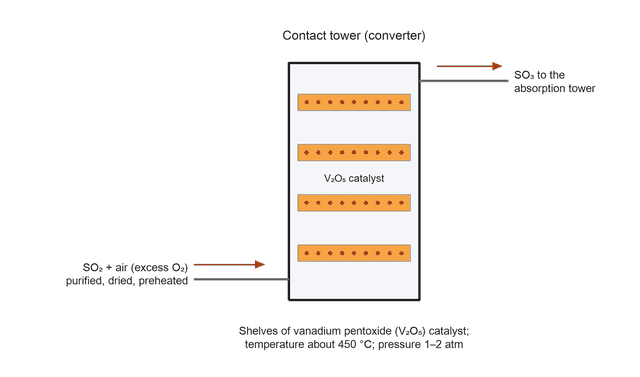
Concept: In the Contact process, sulphur (or iron pyrites) is burnt to sulphur dioxide; the purified, dry sulphur dioxide is oxidised by air to sulphur trioxide over vanadium pentoxide at about 450 °C; the sulphur trioxide is absorbed in concentrated sulphuric acid to give oleum, which is diluted with water to give sulphuric acid.
Step 1 — Recognise the reaction.
The reaction is the catalysed step of the Contact process, which takes place in the contact tower at about 450 °C.
Step 2 — Pick the catalyst from Column B.
The catalyst used for this step is vanadium pentoxide, item 1. Platinum also catalyses this reaction (and is more efficient), but it is costly and easily poisoned by arsenic impurities, so vanadium pentoxide is the catalyst used.
Step 3 — Place the other items.
Of the other items, platinum is the catalyst for oxidising ammonia (Ostwald process), iron for the Haber process and nickel for adding hydrogen to unsaturated compounds; concentrated sulphuric acid is a dehydrating agent, not a catalyst for this step.
Watch out: Iron belongs to the Haber process (ammonia), not to the Contact process.
Therefore, (c) matches 1. Vanadium Pentoxide.