
Question 231 markMCQAsked 2025Medium
Assertion (A): In the Contact Process gas is not directly dissolved in water to obtain sulphuric acid.
Reason (R): Dense fog or misty droplets of sulphuric acid are formed which is difficult to condense.
Confirming your payment
Sign up now and get 250 free tokens.
Previous Year Questions · Question 23 of 34
Assertion (A): In the Contact Process gas is not directly dissolved in water to obtain sulphuric acid.
Reason (R): Dense fog or misty droplets of sulphuric acid are formed which is difficult to condense.
(A) Both (A) and (R) are true, and (R) is the correct explanation of (A).
(B) Both (A) and (R) are true, and (R) is not the correct explanation of (A).
(C) (A) is true but (R) is false.
(D) (A) is false but (R) is true.
Answer: (A) Both (A) and (R) are true, and (R) is the correct explanation of (A).
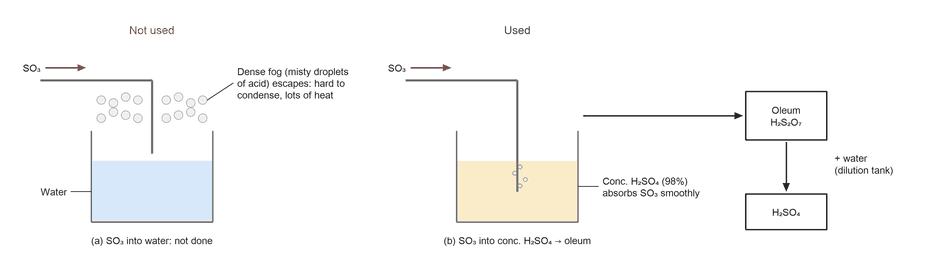
Concept: In the Contact process, sulphur (or iron pyrites) is burnt to sulphur dioxide; the purified, dry sulphur dioxide is oxidised by air to sulphur trioxide over vanadium pentoxide at about 450 °C; the sulphur trioxide is absorbed in concentrated sulphuric acid to give oleum, which is diluted with water to give sulphuric acid. Sulphur trioxide does not dissolve in water satisfactorily. The reaction gives out a lot of heat, and the acid formed comes off as a dense fog of misty droplets that is very hard to condense, so much of it would be lost.
Step 1 — Judge the Assertion.
The Assertion is true. In the Contact process sulphur trioxide is not dissolved directly in water; it is absorbed in 98% sulphuric acid to form oleum, which is then diluted.
Step 2 — Judge the Reason.
The Reason is true. With water, sulphur trioxide gives out much heat and forms a dense fog of misty droplets of sulphuric acid that is very difficult to condense.
Step 3 — Does the Reason explain the Assertion?
Yes. The acid fog, and the loss of acid it would cause, is exactly why water is not used. So the Reason is the correct explanation of the Assertion.
Watch out: Both statements being true is not enough; also check that the Reason is the cause of the Assertion.
Why the other options are wrong:
Therefore, both the Assertion and the Reason are true, and the Reason is the correct explanation, option (A).