
Question 213 marksAsked 2024Easy
The following table is related to an Industrial process of an acid.
| Name of the process | Reactant | Catalyst | Final product |
|---|---|---|---|
| (a) | (b) | (c) |
Identify (a), (b) and (c).
Confirming your payment
Sign up now and get 250 free tokens.
Previous Year Questions · Question 21 of 34
The following table is related to an Industrial process of an acid.
| Name of the process | Reactant | Catalyst | Final product |
|---|---|---|---|
| (a) | (b) | (c) |
Identify (a), (b) and (c).
Solution:
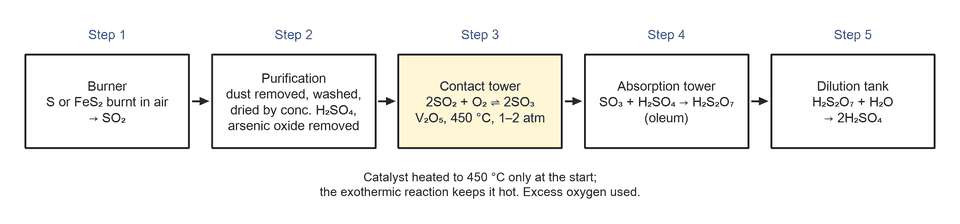
Concept: In the Contact process, sulphur (or iron pyrites) is burnt to sulphur dioxide; the purified, dry sulphur dioxide is oxidised by air to sulphur trioxide over vanadium pentoxide at about 450 °C; the sulphur trioxide is absorbed in concentrated sulphuric acid to give oleum, which is diluted with water to give sulphuric acid.
Step 1 — (a) Name the process.
Sulphur dioxide and oxygen reacting over a catalyst is the key step in the industrial manufacture of sulphuric acid, so the process is the Contact process.
Step 2 — (b) Name the catalyst.
The catalyst is vanadium pentoxide, , used at about 450 °C and 1–2 atm.
Step 3 — (c) Name the final product.
The sulphur trioxide formed is absorbed in concentrated sulphuric acid to give oleum, and the oleum is diluted with water. The final product of the process is therefore sulphuric acid, .
Watch out: The catalysed step itself gives sulphur trioxide; the FINAL product of the industrial process named in (a) is sulphuric acid.
Note: if (c) is read as the product of the catalysed reaction SO₂ + O₂ alone, the answer is sulphur trioxide (SO₃); both readings are explained above.
Therefore, (a) Contact process; (b) vanadium pentoxide (V₂O₅); (c) sulphuric acid (H₂SO₄).