(a) Balance the chemical equation given below: FeS₂ + O₂ Fe₂O₃ + SO₂ (b) Write balanced chemical equation for…
Question 275 marksAsked 2025Medium
(a) Balance the chemical equation given below:
FeS2+O2⟶Fe2O3+SO2
(b) Write balanced chemical equation for formation of ‘B’.
(c) Why is it necessary to convert ‘B’ to Oleum?
(d) Identify ‘C’.
(e) Write an equation for the reaction between Oleum and ‘C’.
Solution:
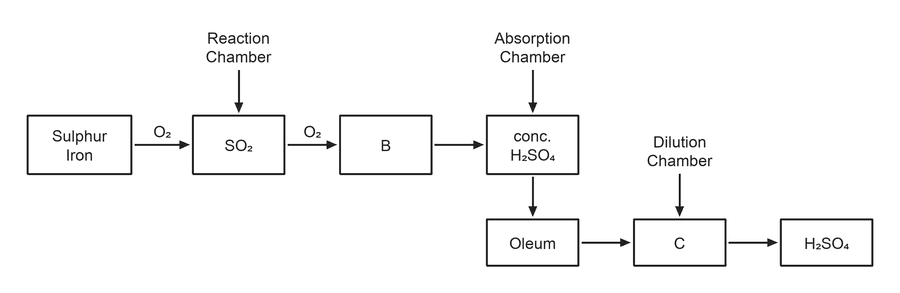
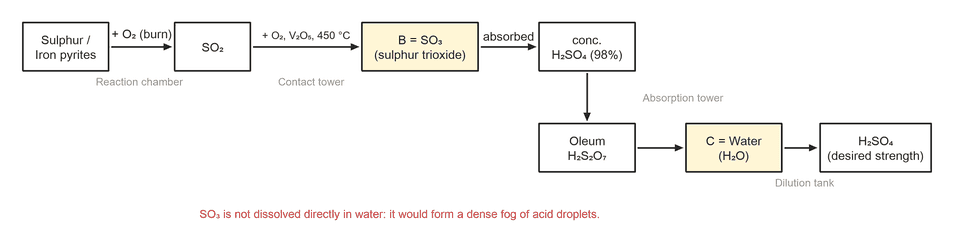
Concept: The chart shows the Contact process: sulphur or iron pyrites is burnt to SO₂ in the reaction chamber; SO₂ is oxidised to SO₃ (B) over a catalyst; SO₃ is absorbed in concentrated sulphuric acid to give oleum; oleum is diluted with water (C) to give sulphuric acid.
Step 1 — (a) Balance iron.
Iron(III) oxide, Fe2O3, contains 2 iron atoms. To get a whole number of oxygen molecules later we take 4 FeS₂, which gives 2 Fe₂O₃.
Step 2 — (a) Balance sulphur.
Each FeS₂ has 2 sulphur atoms, so 4 FeS₂ give 8 sulphur atoms, and each SO₂ takes one of them:
S atoms=4×2=8
So 8 SO₂ are formed.
Step 3 — (a) Balance oxygen.
We count the oxygen atoms on the right: 3 in each of the 2 Fe₂O₃ and 2 in each of the 8 SO₂.
O atoms=2×3+8×2=6+16=22
Each O₂ molecule has 2 oxygen atoms, so 22 ÷ 2 gives 11 molecules of O₂:
4FeS2+11O2→2Fe2O3+8SO2
Step 4 — (b) Formation of B.
B is sulphur trioxide. Sulphur dioxide and excess oxygen pass over vanadium pentoxide at about 450 °C and 1–2 atm in the contact tower.
2SO2+O2V2O5450∘C2SO3
Step 5 — (c) Why B is converted to oleum.
Sulphur trioxide does not dissolve in water satisfactorily. The reaction gives out a lot of heat, and the acid formed comes off as a dense fog of misty droplets that is very hard to condense, so much of it would be lost. Absorbing SO₃ in concentrated sulphuric acid (98%) is smooth and complete, and gives oleum:
SO3+H2SO4→H2S2O7
Step 6 — (d) Identify C.
C is water, H2O, added to the oleum in the dilution chamber in the calculated amount.
Step 7 — (e) Oleum and C.
Each molecule of oleum reacts with one molecule of water to give two molecules of sulphuric acid.
H2S2O7+H2O→2H2SO4
Watch out: The iron oxide formed is Fe₂O₃ (iron(III) oxide), so the smallest whole-number set starts with 4 FeS₂, not 2.
Note: the first box of the printed chart reads 'Sulphur Iron'; it means sulphur or iron pyrites (FeS₂), the ore whose burning is balanced in part (a).
Therefore, (a) 4FeS₂ + 11O₂ → 2Fe₂O₃ + 8SO₂; (b) B = SO₃: 2SO₂ + O₂ ⇌ 2SO₃ (V₂O₅, 450 °C); (c) SO₃ dissolves badly in water and forms a dense acid fog that is hard to condense, so it is absorbed in conc. H₂SO₄ as oleum; (d) C = water; (e) H₂S₂O₇ + H₂O → 2H₂SO₄.