
Question 141 markMCQAsked 2022Easy
The acid which is least volatile is:
Confirming your payment
Sign up now and get 250 free tokens.
Previous Year Questions · Question 14 of 34
The acid which is least volatile is:
(A) Hydrochloric acid
(B) Nitric acid
(C) Dilute sulphuric acid
(D) Concentrated sulphuric acid
Answer: (D) Concentrated sulphuric acid
Concept: Concentrated sulphuric acid is a non-volatile acid: its boiling point is very high (about 338 °C), so on heating it stays in the flask while a more volatile acid formed from a salt is driven off as a gas.
Step 1 — Compare how easily each acid turns into vapour.
An acid is volatile if it turns into vapour easily. Concentrated sulphuric acid boils only at about 338 °C, far higher than hydrochloric acid or nitric acid, so it is the least volatile.
Step 2 — Use of this property.
Because it does not vaporise easily, concentrated sulphuric acid is used to prepare the volatile acids, hydrochloric acid and nitric acid, from their salts: the volatile acid distils off and sulphuric acid stays behind.
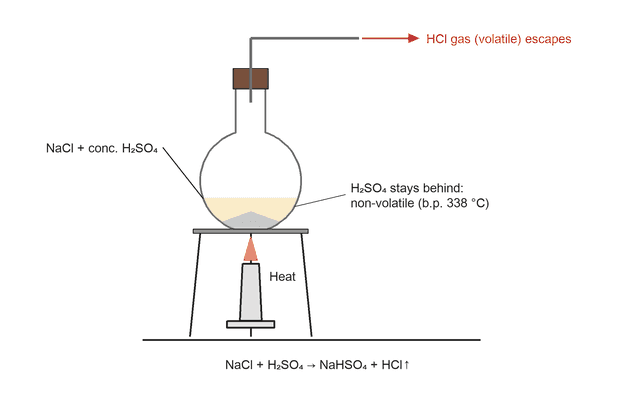
Watch out: Dilute sulphuric acid is mostly water, so it is not the least volatile; the property belongs to the concentrated acid.
Why the other options are wrong:
Therefore, the least volatile acid is concentrated sulphuric acid, option (D).