
Question 151 markMCQAsked 2022Easy
Vanadium pentoxide is used as a catalyst in the preparation of:
Confirming your payment
Sign up now and get 250 free tokens.
Previous Year Questions · Question 15 of 34
Vanadium pentoxide is used as a catalyst in the preparation of:
(A) Nitrogen gas
(B) Nitrogen dioxide gas
(C) Sulphur trioxide gas
(D) Carbon dioxide gas
Answer: (C) Sulphur trioxide gas
Concept: In the Contact process, sulphur (or iron pyrites) is burnt to sulphur dioxide; the purified, dry sulphur dioxide is oxidised by air to sulphur trioxide over vanadium pentoxide at about 450 °C; the sulphur trioxide is absorbed in concentrated sulphuric acid to give oleum, which is diluted with water to give sulphuric acid.
Step 1 — Find where vanadium pentoxide is used.
Vanadium pentoxide is the catalyst of the contact tower. There it speeds up the oxidation of sulphur dioxide by oxygen.
Step 2 — Name the product.
The product of this catalysed step is sulphur trioxide gas, which is then absorbed in concentrated sulphuric acid to make oleum and finally sulphuric acid.
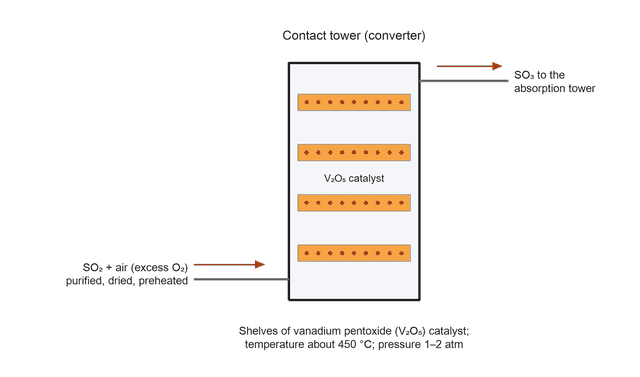
Watch out: The question asks for the gas made with the catalyst (SO₃), not the final product of the whole process (H₂SO₄).
Why the other options are wrong:
Therefore, vanadium pentoxide is the catalyst in the preparation of sulphur trioxide gas, option (C).