During the manufacture of sulphuric acid, a chemist collected the gas formed after catalytic oxidation of sulphur…
Question 333 marksAsked 2026Easy
During the manufacture of sulphuric acid, a chemist collected the gas formed after catalytic oxidation of sulphur dioxide.
(a) Name the gas collected.
(b) Which acid is formed when the gas collected by the chemist is dissolved directly in water?
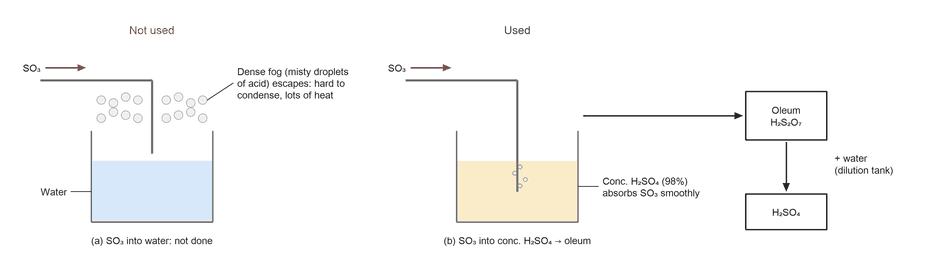
(c) Why should we not dissolve this gas directly in water?
Solution:
Concept: In the Contact process, sulphur (or iron pyrites) is burnt to sulphur dioxide; the purified, dry sulphur dioxide is oxidised by air to sulphur trioxide over vanadium pentoxide at about 450 °C; the sulphur trioxide is absorbed in concentrated sulphuric acid to give oleum, which is diluted with water to give sulphuric acid.
Step 1 — (a) Name the gas.
The catalytic oxidation of sulphur dioxide over vanadium pentoxide gives sulphur trioxide, SO3.
2SO2+O2V2O5450∘C2SO3
Step 2 — (b) Acid formed with water.
Sulphur trioxide is the acidic oxide of sulphuric acid, so with water it forms sulphuric acid.
SO3+H2O→H2SO4
Step 3 — (c) Why not dissolve it directly in water.
Sulphur trioxide does not dissolve in water satisfactorily. The reaction gives out a lot of heat, and the acid formed comes off as a dense fog of misty droplets that is very hard to condense, so much of it would be lost. Instead it is absorbed in 98% sulphuric acid to form oleum, which is then diluted with water:
SO3+H2SO4→H2S2O7H2S2O7+H2O→2H2SO4
Watch out: The reaction in (b) does happen; the problem is the heat and the acid fog it produces, not that no acid forms.
Therefore, (a) sulphur trioxide (SO₃); (b) sulphuric acid (H₂SO₄); (c) because it dissolves unsatisfactorily, gives out much heat and forms a dense fog of acid droplets that is hard to condense.