
Question 62 marksAsked 2017Easy
Write balanced chemical equations to show how is converted to Sulphuric acid in the contact process.
Confirming your payment
Sign up now and get 250 free tokens.
Previous Year Questions · Question 6 of 34
Write balanced chemical equations to show how is converted to Sulphuric acid in the contact process.
Solution:
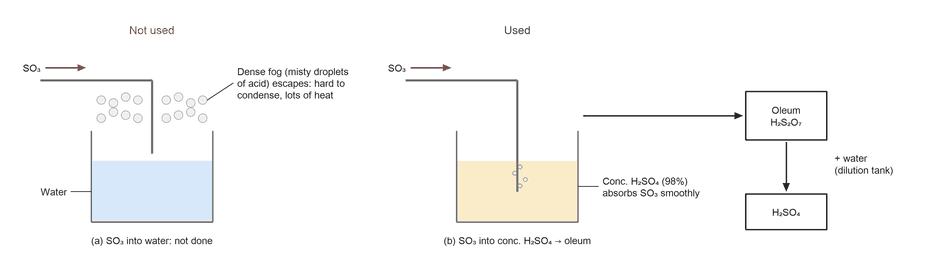
Concept: In the Contact process, sulphur (or iron pyrites) is burnt to sulphur dioxide; the purified, dry sulphur dioxide is oxidised by air to sulphur trioxide over vanadium pentoxide at about 450 °C; the sulphur trioxide is absorbed in concentrated sulphuric acid to give oleum, which is diluted with water to give sulphuric acid. Sulphur trioxide does not dissolve in water satisfactorily. The reaction gives out a lot of heat, and the acid formed comes off as a dense fog of misty droplets that is very hard to condense, so much of it would be lost.
Step 1 — Absorb SO₃ in concentrated sulphuric acid.
Sulphur trioxide from the contact tower is passed into 98% concentrated sulphuric acid in the absorption tower. It dissolves smoothly and forms oleum (pyrosulphuric acid).
Step 2 — Dilute the oleum with water.
The oleum is run into the dilution tank and mixed with the calculated amount of water. Each molecule of oleum gives two molecules of sulphuric acid.
Step 3 — Why water is not used directly.
If sulphur trioxide were passed straight into water, much heat would be given out and the acid would form a dense mist of droplets that is very hard to condense, so much of it would be lost. Absorbing it in concentrated acid avoids this.
Watch out: The question asks for SO₃ → H₂SO₄, so both steps (oleum, then dilution) are needed, not SO₃ + H₂O → H₂SO₄.
Therefore, SO₃ + H₂SO₄ → H₂S₂O₇ (oleum), then H₂S₂O₇ + H₂O → 2H₂SO₄.