
Question 71 markMCQAsked 2018Easy
The catalyst used in the Contact Process is:
Confirming your payment
Sign up now and get 250 free tokens.
Previous Year Questions · Question 7 of 34
The catalyst used in the Contact Process is:
(A) Copper
(B) Iron
(C) Vanadium pentoxide
(D) Manganese dioxide
Answer: (C) Vanadium pentoxide
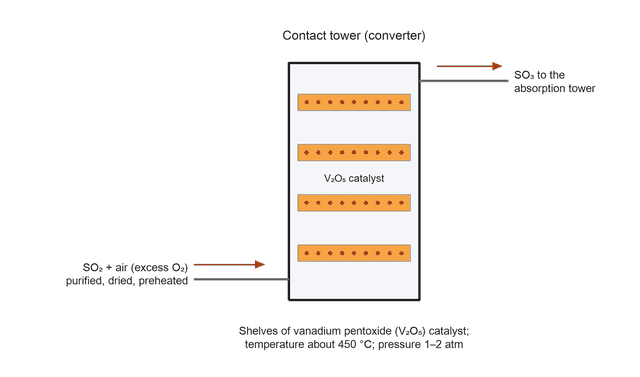
Concept: In the Contact process, sulphur (or iron pyrites) is burnt to sulphur dioxide; the purified, dry sulphur dioxide is oxidised by air to sulphur trioxide over vanadium pentoxide at about 450 °C; the sulphur trioxide is absorbed in concentrated sulphuric acid to give oleum, which is diluted with water to give sulphuric acid.
Step 1 — Find the catalysed step.
The only catalysed step of the Contact process is the oxidation of sulphur dioxide to sulphur trioxide in the contact tower (converter), at about 450 °C and 1–2 atm.
Step 2 — Name the catalyst.
The catalyst is vanadium pentoxide, . Platinum also works and is more efficient, but it is costly and is easily poisoned by impurities such as arsenic oxide, so vanadium pentoxide is used.
Watch out: Iron is the catalyst of the Haber process, not of the Contact process; do not mix up the two industrial processes.
Why the other options are wrong:
Therefore, the catalyst used in the Contact process is vanadium pentoxide, option (C).