
Question 121 markMCQAsked 2020Easy
The acid which can produce carbon from cane sugar, is:
Confirming your payment
Sign up now and get 250 free tokens.
Previous Year Questions · Question 12 of 34
The acid which can produce carbon from cane sugar, is:
(A) Concentrated Hydrochloric acid
(B) Concentrated Nitric acid
(C) Concentrated Sulphuric acid
(D) Concentrated Acetic acid
Answer: (C) Concentrated Sulphuric acid
Concept: Concentrated sulphuric acid is a dehydrating agent: it has a very strong attraction for water, so it removes the elements of water (hydrogen and oxygen in the ratio 2 : 1) from compounds, or the water of crystallisation from hydrated salts.
Step 1 — Recognise the reaction.
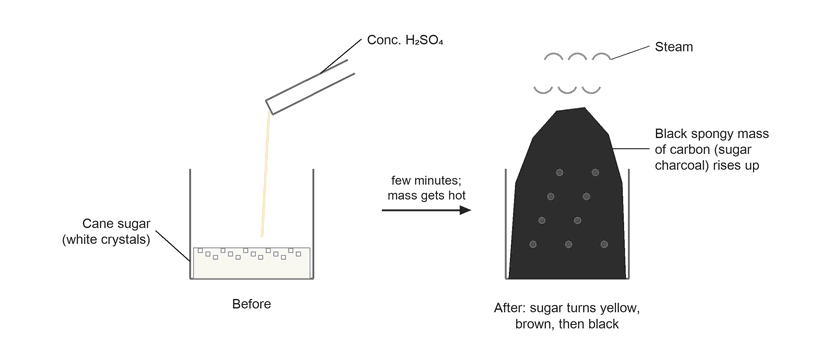
Producing carbon from cane sugar means taking away all of its hydrogen and oxygen as water. That is dehydration, and the acid that does it is concentrated sulphuric acid.
Step 2 — What is seen.
The white sugar turns yellow, then brown and finally black. A black, spongy mass of carbon (sugar charcoal) rises up, steam is given off and the mass becomes hot.
Watch out: This is dehydration, not oxidation: the carbon is left behind, not burnt.
Why the other options are wrong:
Therefore, the acid that produces carbon from cane sugar is concentrated sulphuric acid, option (C).