
Question 365 marksEasy
Why is :
(a) concentrated sulphuric acid kept in air tight bottles ?
(b) is not used as a drying agent for ?
(c) sulphuric acid used in the preparation of HCl and ? Give equations in both cases.
Confirming your payment
Sign up now and get 250 free tokens.
Study of Compounds – Sulphuric Acid · Question 36 of 49
Why is :
(a) concentrated sulphuric acid kept in air tight bottles ?
(b) is not used as a drying agent for ?
(c) sulphuric acid used in the preparation of HCl and ? Give equations in both cases.
Solution:
Concept: The three answers use three properties of conc. sulphuric acid: (a) it is hygroscopic, (b) it is an oxidising agent, (c) it is non-volatile.
Step 1 — (a) Explain the air-tight bottle.
Conc. sulphuric acid is hygroscopic: it absorbs moisture from the air. In an open bottle it would take up water vapour and get diluted (its volume even increases). An air-tight bottle prevents this.
Step 2 — (b) Explain why it cannot dry hydrogen sulphide.
Conc. sulphuric acid is an oxidising agent, and hydrogen sulphide is a reducing gas. So the acid reacts with the gas (oxidising it to sulphur) instead of just removing its moisture; the gas would be destroyed, not dried:
Step 3 — (c) Explain its use in making HCl and nitric acid.
Sulphuric acid is a non-volatile acid (boiling point about 338 °C). On heating it drives the more volatile acids out of their salts, and they distil over:
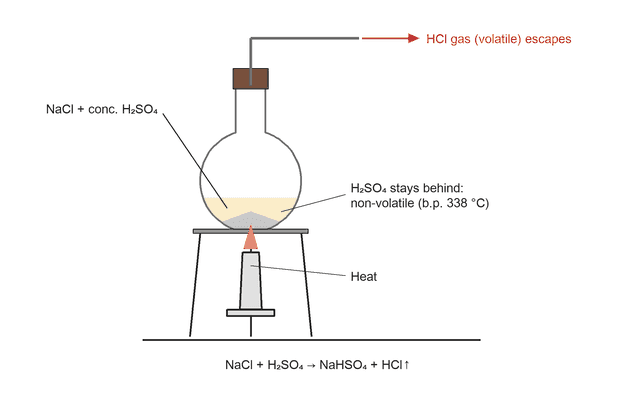
Watch out: A drying agent must not react with the gas being dried; that is why the acid is fine for HCl but not for .
Therefore, (a) it is hygroscopic and would absorb moisture from the air; (b) it oxidises H₂S to sulphur; (c) it is non-volatile, so it drives out volatile HCl and HNO₃ (equations above).