Solution:
Concept: Use dilute sulphuric acid as a typical acid. Lead and calcium carbonate are not used, because they form insoluble sulphates (PbSO4, CaSO4) that coat the solid and stop the reaction.
Step 1 — (a) Hydrogen.
Zinc is an active metal, so it displaces hydrogen from the dilute acid:
Zn+H2SO4→ZnSO4+H2↑
Step 2 — (b) Sulphur dioxide.
A sulphite with a dilute acid gives sulphur dioxide:
Na2SO3+H2SO4→Na2SO4+H2O+SO2↑
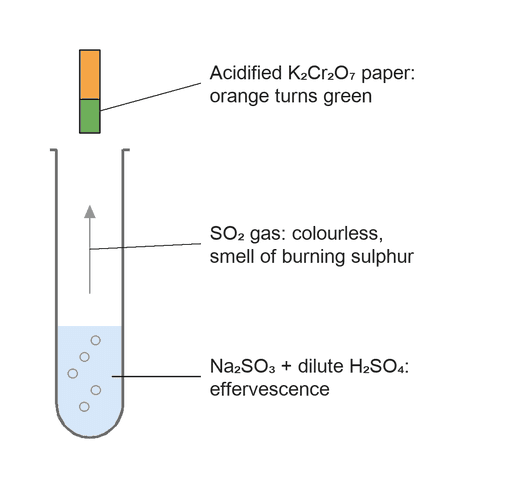
Step 3 — (c) Carbon dioxide.
A carbonate with a dilute acid gives carbon dioxide:
Na2CO3+H2SO4→Na2SO4+H2O+CO2↑
Step 4 — (d) Zinc carbonate, first step.
First make a solution of a zinc salt by dissolving zinc in the dilute acid:
Zn+H2SO4→ZnSO4+H2↑
Step 5 — (d) Zinc carbonate, second step.
Then add sodium carbonate solution. Zinc carbonate is insoluble, so it precipitates (double decomposition) and is filtered off:
ZnSO4+Na2CO3→ZnCO3↓+Na2SO4
Watch out: Calcium carbonate is a carbonate, but it is the wrong choice for (c): the insoluble calcium sulphate coats it and the reaction soon stops.
Therefore, (a) zinc gives hydrogen; (b) sodium sulphite gives sulphur dioxide; (c) sodium carbonate gives carbon dioxide; (d) zinc sulphate from zinc, then sodium carbonate, gives zinc carbonate.
