Answer: (B) (2)
Concept: In an assertion–reason item, judge the Assertion (A) and the Reason (R) separately as true or false; only when both are true do we ask whether R correctly explains A.
Step 1 — Judge the Assertion.
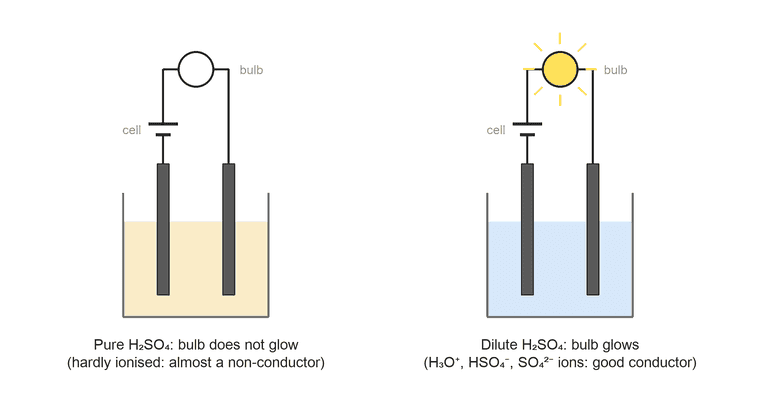
Electricity passes through a liquid only if it contains free ions. Pure (100%) sulphuric acid is hardly ionised, so it is almost a non-conductor. A is true.
Step 2 — Judge the Reason.
Dilute sulphuric acid is well ionised (H3O+, HSO4− and SO42− ions), so it is a good conductor. R is true.
Step 3 — Decide whether R explains A.
R describes the dilute acid. It does not say why the pure acid fails to conduct (the reason is that the pure acid is not ionised). So R does not explain A.
Why the other options are wrong:
- (A) (1): it says R explains A, but R is about a different liquid.
- (C) (3): it says R is false, but R is true.
- (D) (4): it says A is false, but A is true.
Therefore, both A and R are true but R does not explain A: code (2), option (B).
