Solution:
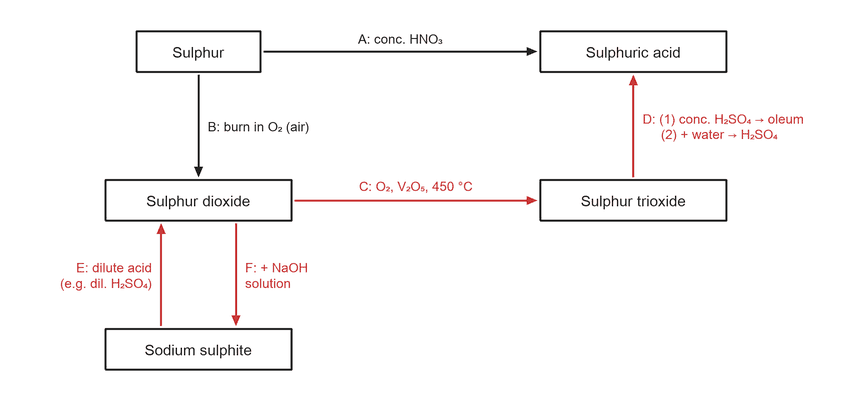
Concept: Steps C and D are the Contact process. Step E is a dilute acid acting on a sulphite, and step F is sulphur dioxide (an acidic oxide) reacting with an alkali.
Step 1 — Read the flow chart.
The completed chart shows what happens along each arrow; the red arrows are the ones asked about.
Step 2 — (a) Name the catalyst for step C.
Step C is the oxidation of sulphur dioxide in the contact tower. The catalyst is vanadium pentoxide, V2O5, at about 450 °C:
2SO2+O21–2 atm⇌V2O5, 450 °C2SO3+heat
Step 3 — (b) Write the first step of D.
Sulphur trioxide is not added to water, because that forms an acid mist which is hard to condense. Instead it is first absorbed in concentrated sulphuric acid, giving oleum:
SO3+H2SO4→H2S2O7
Step 4 — (b) Write the second step of D.
The oleum is then diluted with water to give sulphuric acid:
H2S2O7+H2O→2H2SO4
Step 5 — (c) Name the substance for step E.
Every sulphite gives sulphur dioxide with a dilute acid, such as dilute sulphuric acid or dilute hydrochloric acid:
Na2SO3+H2SO4→Na2SO4+H2O+SO2↑
Step 6 — (d) Write the equation for step F.
Sulphur dioxide is an acidic oxide, so when it is passed into sodium hydroxide solution it forms the salt sodium sulphite and water:
SO2+2NaOH→Na2SO3+H2O
Watch out: In step F the alkali must be in excess; with excess sulphur dioxide the acid salt sodium hydrogen sulphite, NaHSO3, forms instead.
Therefore, (a) V₂O₅; (b) SO₃ + H₂SO₄ → H₂S₂O₇, then H₂S₂O₇ + H₂O → 2H₂SO₄; (c) a dilute acid (e.g. dilute H₂SO₄); (d) SO₂ + 2NaOH → Na₂SO₃ + H₂O.

