Solution:
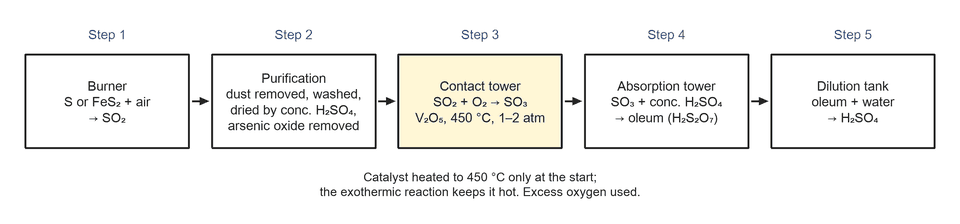
Concept: The Contact process has four chemical stages: make SO2 → oxidise it to SO3 on a catalyst → absorb SO3 in conc. H2SO4 to form oleum → dilute the oleum with water.
Step 1 — (a) Obtain sulphur dioxide.
The flow chart shows the whole plant. Sulphur dioxide is made in the burner (Step 1 of the chart) in either of two ways.
Sulphur is burnt in air:
S+O2→SO2
Or iron pyrites is roasted in air:
4FeS2+11O2→2Fe2O3+8SO2
Step 2 — (b) State the conditions for oxidising sulphur dioxide.
The oxidation of SO2 is reversible and exothermic, so the conditions are chosen to give a good yield at a useful speed:
2SO2+O21–2 atm⇌V2O5, 450 °C2SO3+heat
- Temperature about 410–450 °C. A low temperature favours the yield of an exothermic reaction, but below this the catalyst works too slowly. The catalyst is heated only at the start; the heat given out then keeps it at about 450 °C.
- Pressure 1–2 atm. A high pressure would help (3 volumes of gas give 2 volumes), but acid-resistant towers that stand a high pressure are hard to build.
- Excess of oxygen (air), which pushes more SO2 to change into SO3.
- Purified, dry gases, so that the catalyst is not poisoned.
Step 3 — (c) Name the catalyst.
The catalyst used is vanadium pentoxide, V2O5. Platinum also works, but it is costly and is easily poisoned by arsenic (III) oxide, so V2O5 is preferred.
Step 4 — (d) Explain why sulphur trioxide is not added directly to water.
SO3 does not dissolve in water smoothly. The reaction gives out so much heat that the acid forms a dense fog of tiny droplets (an acid mist). This fog is very hard to condense, so most of the acid would be lost.

Step 5 — (e) Name the absorbing liquid and the product.
SO3 is dissolved in concentrated sulphuric acid (98%). The product is oleum, also called pyrosulphuric acid, H2S2O7:
SO3+H2SO4→H2S2O7
The oleum is then diluted with the calculated amount of water to give sulphuric acid:
H2S2O7+H2O→2H2SO4
Step 6 — (e) Put all the main reactions in order.
Written one after another, the four main reactions of the Contact process are:
S+O2→SO2
2SO2+O21–2 atm⇌V2O5, 450 °C2SO3+heat
SO3+H2SO4→H2S2O7
H2S2O7+H2O→2H2SO4
Watch out: Oleum is H2S2O7, not H2SO4. The SO3 goes into conc. sulphuric acid, never straight into water.
Therefore, (a) S + O₂ → SO₂ and 4FeS₂ + 11O₂ → 2Fe₂O₃ + 8SO₂; (b) about 450 °C, 1–2 atm, excess oxygen and pure, dry gases; (c) vanadium pentoxide, V₂O₅; (d) SO₃ with water forms an acid mist that is hard to condense; (e) SO₃ is dissolved in conc. H₂SO₄ to form oleum, H₂S₂O₇, which is diluted to H₂SO₄.
